

THE HOUSE OF MIRTH
- 1905
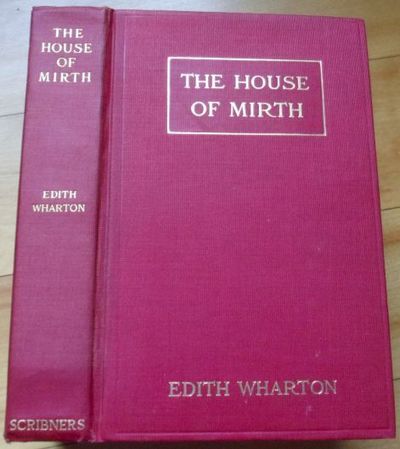
1905. [read this description!] With Illustrations by A.B. Wenzell. New York: Charles Scribner's Sons, 1905. Original red cloth.
First Edition, early but not first printing, of Edith Wharton's first major novel, which had "the most rapid sale of any book ever published by Scribner" at the time. The novel "covers the last seventeen months in the life of Lily Bart, a beautiful and fashionable but also penniless and imprudent young woman in her late twenties. The action... is spurred by Lily's extraordinary capacity to get herself, at least half innocently, into situations of a doubtful, even of a scandalous, nature" [Lewis]. THE HOUSE OF MIRTH has always been complex bibliographically, and recently it has become much MORE complex -- because Garrison's 1990 Wharton bibliography has been found to be in error. It cited four 1905 printings (not so stated), listed as follows: (a) on laid paper, with no ads; (b) on laid paper, with 4 pp ads; (c) on wove paper, with 4 pp ads; and (f) on wove paper, with no ads. Perhaps because nobody could find a copy of "(a)", sellers and buyers have generally ignored the "laid paper" requirement, and incorrectly assumed that no ads = earlier; in fact, these "no ads" copies are ALL on wove paper, which is Garrison's 4th printing. Between 2016 and 2023, Prof. Donna Campbell of Washington State University delved deep into the question of why no "(a)" copies were ever encountered -- going so far as to research the ONE copy Garrison cited, at the Lilly Library -- only to discover that that copy was in fact on wove paper! In her February 2023 monograph on this "bibliographical mystery," she concludes that Garrison's "first printing" -- laid paper, no ads -- DOES NOT EXIST. She further concludes, from examining Wharton's own copies for example, that otherwise Garrison has the "states" in their correct order: new 1st printing = on laid paper, with 4 pp ads; new 2nd printing = on wove paper, with 4 pp ads; new 3rd printing = on wove paper, with no ads. In other words, copies WITH ads precede copies withOUTads! (This makes a lot more sense: why would ads be in Garrison's 2nd and 3rd printings, but not in the 1st and 4th? -- it is much more logical that ads would be in earlier printings, but removed from later printings.) This copy is on wove paper, without ads -- which is Garrison A12.I.f (listed there as the 4th printing, but now recognized as the 3rd printing). Near-fine (scarcely any soil or wear, spine slightly faded as usual).
First Edition, early but not first printing, of Edith Wharton's first major novel, which had "the most rapid sale of any book ever published by Scribner" at the time. The novel "covers the last seventeen months in the life of Lily Bart, a beautiful and fashionable but also penniless and imprudent young woman in her late twenties. The action... is spurred by Lily's extraordinary capacity to get herself, at least half innocently, into situations of a doubtful, even of a scandalous, nature" [Lewis]. THE HOUSE OF MIRTH has always been complex bibliographically, and recently it has become much MORE complex -- because Garrison's 1990 Wharton bibliography has been found to be in error. It cited four 1905 printings (not so stated), listed as follows: (a) on laid paper, with no ads; (b) on laid paper, with 4 pp ads; (c) on wove paper, with 4 pp ads; and (f) on wove paper, with no ads. Perhaps because nobody could find a copy of "(a)", sellers and buyers have generally ignored the "laid paper" requirement, and incorrectly assumed that no ads = earlier; in fact, these "no ads" copies are ALL on wove paper, which is Garrison's 4th printing. Between 2016 and 2023, Prof. Donna Campbell of Washington State University delved deep into the question of why no "(a)" copies were ever encountered -- going so far as to research the ONE copy Garrison cited, at the Lilly Library -- only to discover that that copy was in fact on wove paper! In her February 2023 monograph on this "bibliographical mystery," she concludes that Garrison's "first printing" -- laid paper, no ads -- DOES NOT EXIST. She further concludes, from examining Wharton's own copies for example, that otherwise Garrison has the "states" in their correct order: new 1st printing = on laid paper, with 4 pp ads; new 2nd printing = on wove paper, with 4 pp ads; new 3rd printing = on wove paper, with no ads. In other words, copies WITH ads precede copies withOUTads! (This makes a lot more sense: why would ads be in Garrison's 2nd and 3rd printings, but not in the 1st and 4th? -- it is much more logical that ads would be in earlier printings, but removed from later printings.) This copy is on wove paper, without ads -- which is Garrison A12.I.f (listed there as the 4th printing, but now recognized as the 3rd printing). Near-fine (scarcely any soil or wear, spine slightly faded as usual).
Details
Title
THE HOUSE OF MIRTH
Author
Wharton, Edith
Condition
Unknown
Date
1905