

[AMERICAN "SHITPOST" 1852]. Life of Lord Timothy Dexter. [ISSUED WITH]: A Pickle for the Knowing Ones: or Plain Truths in a Homespun Dress
![[AMERICAN "SHITPOST" 1852]. Life of Lord Timothy D](https://d3525k1ryd2155.cloudfront.net/h/522/691/1770691522.0.x.jpg)
- Newburyport: John G. Tilton, 1852
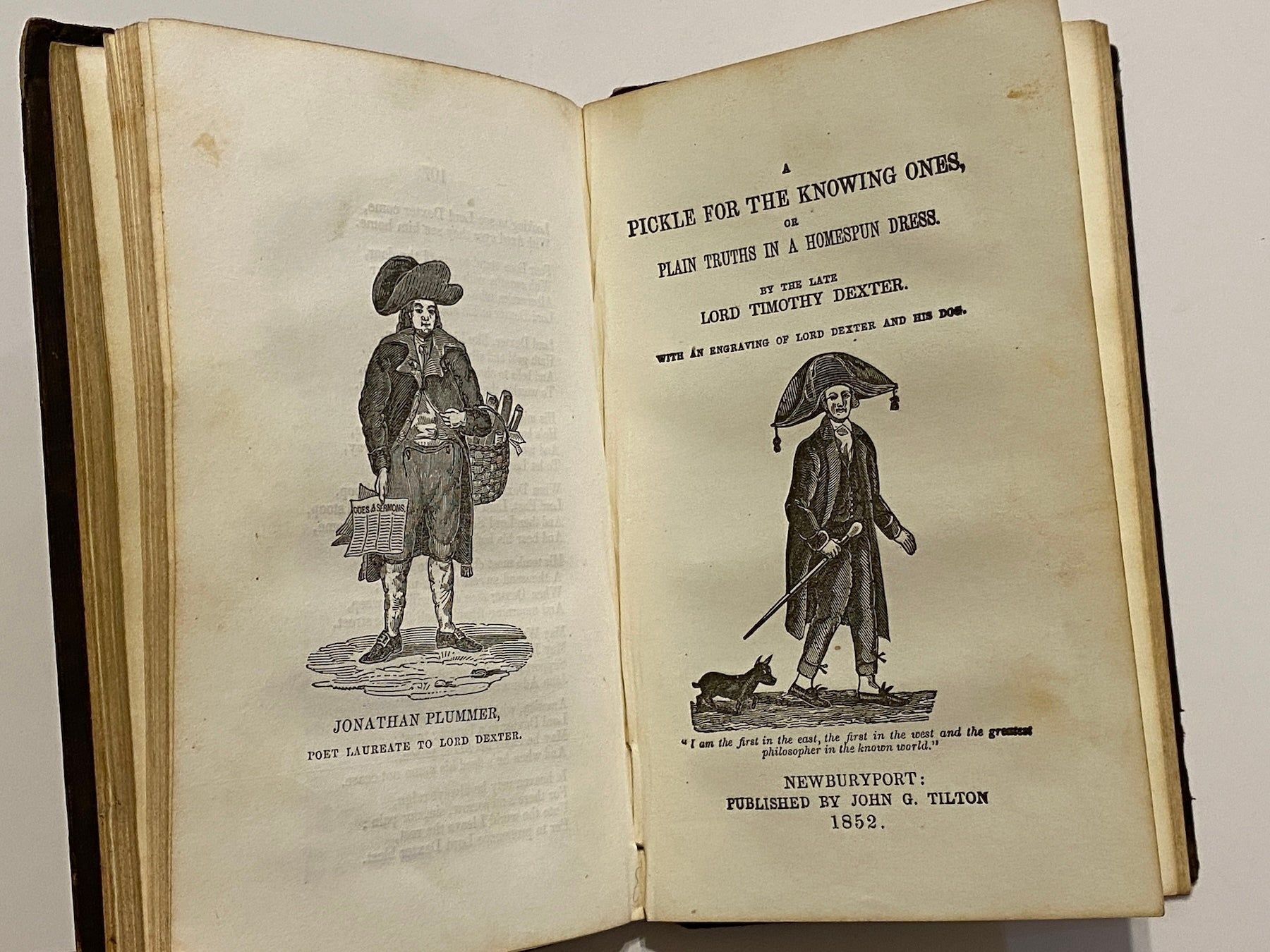
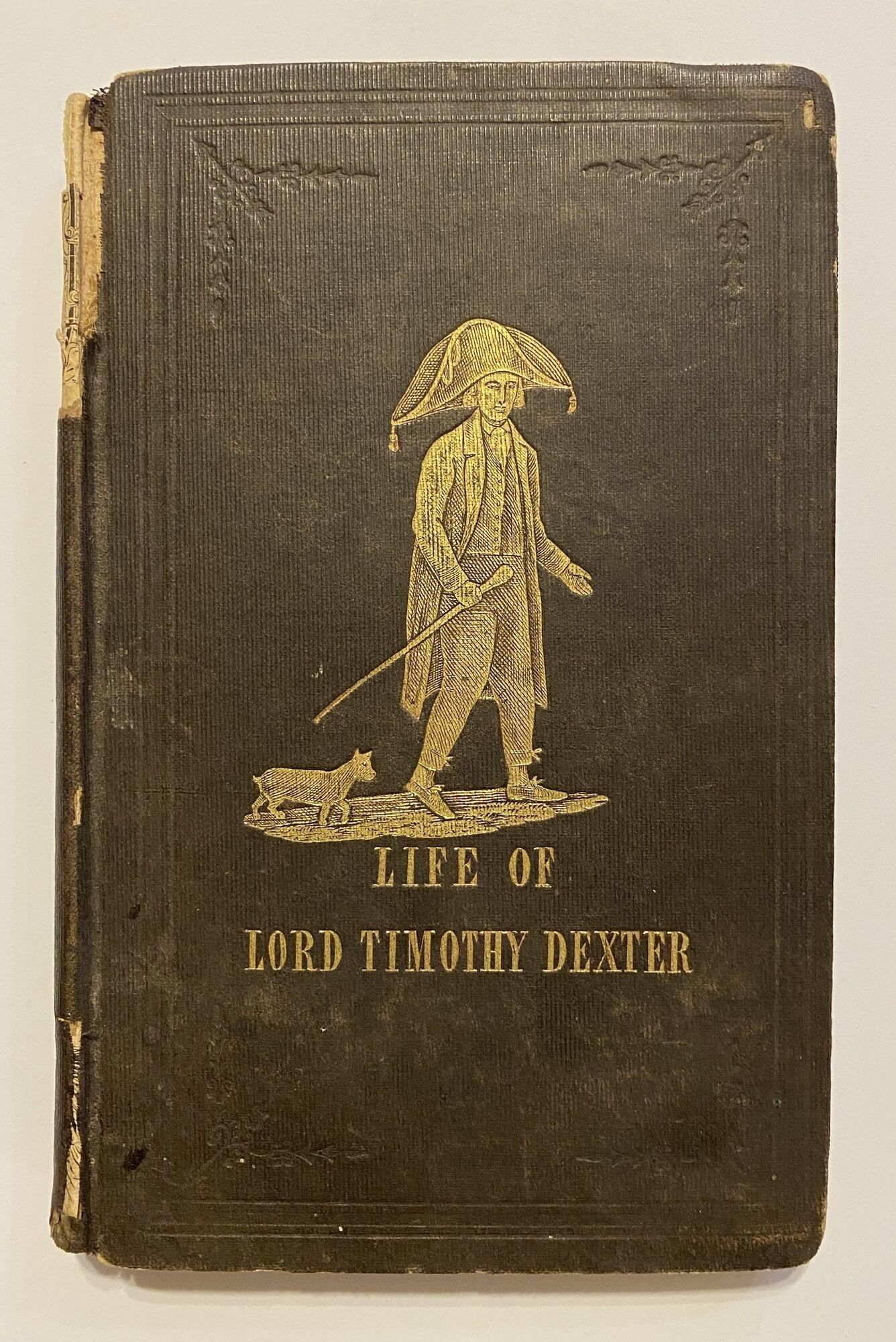
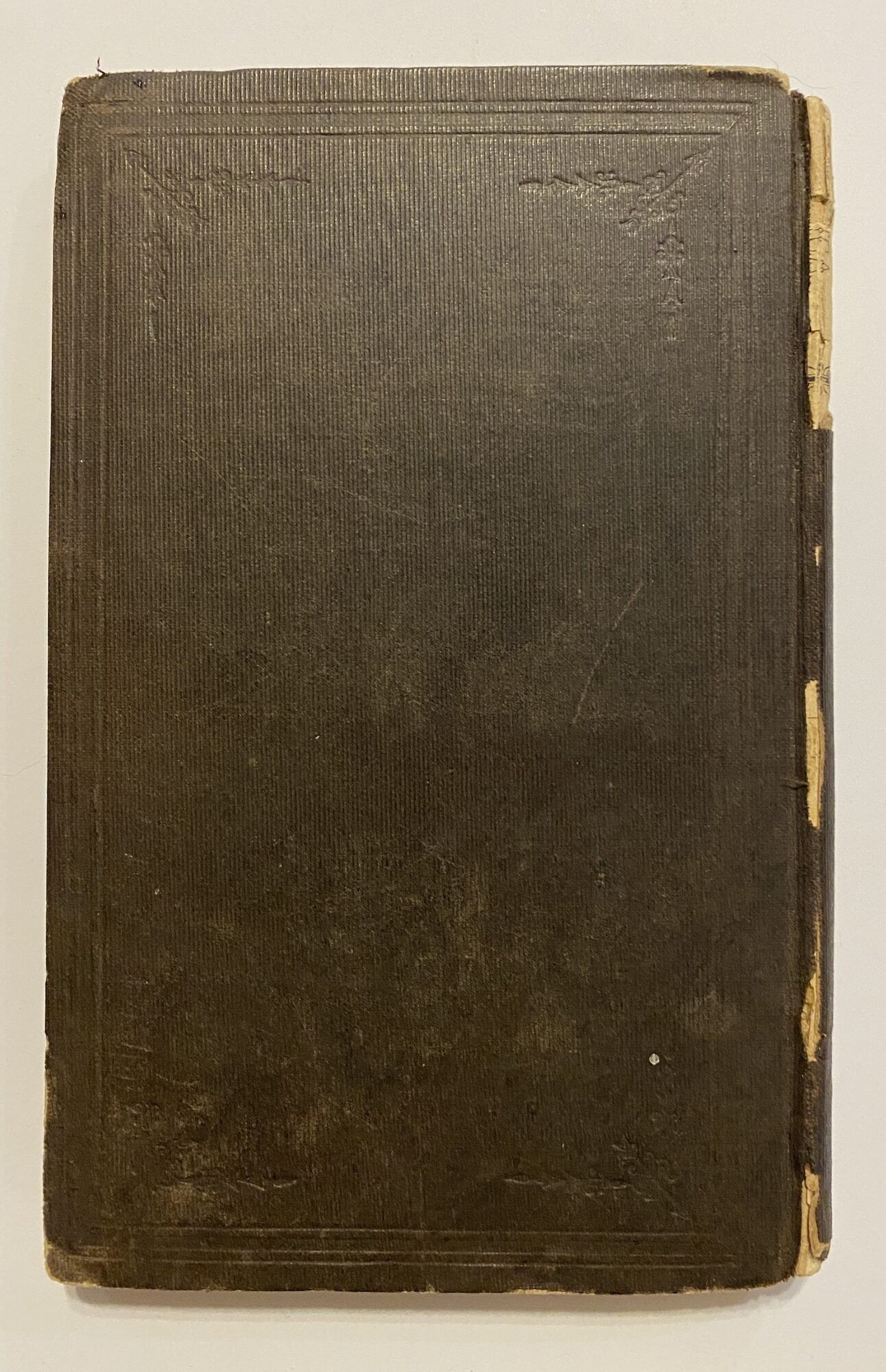
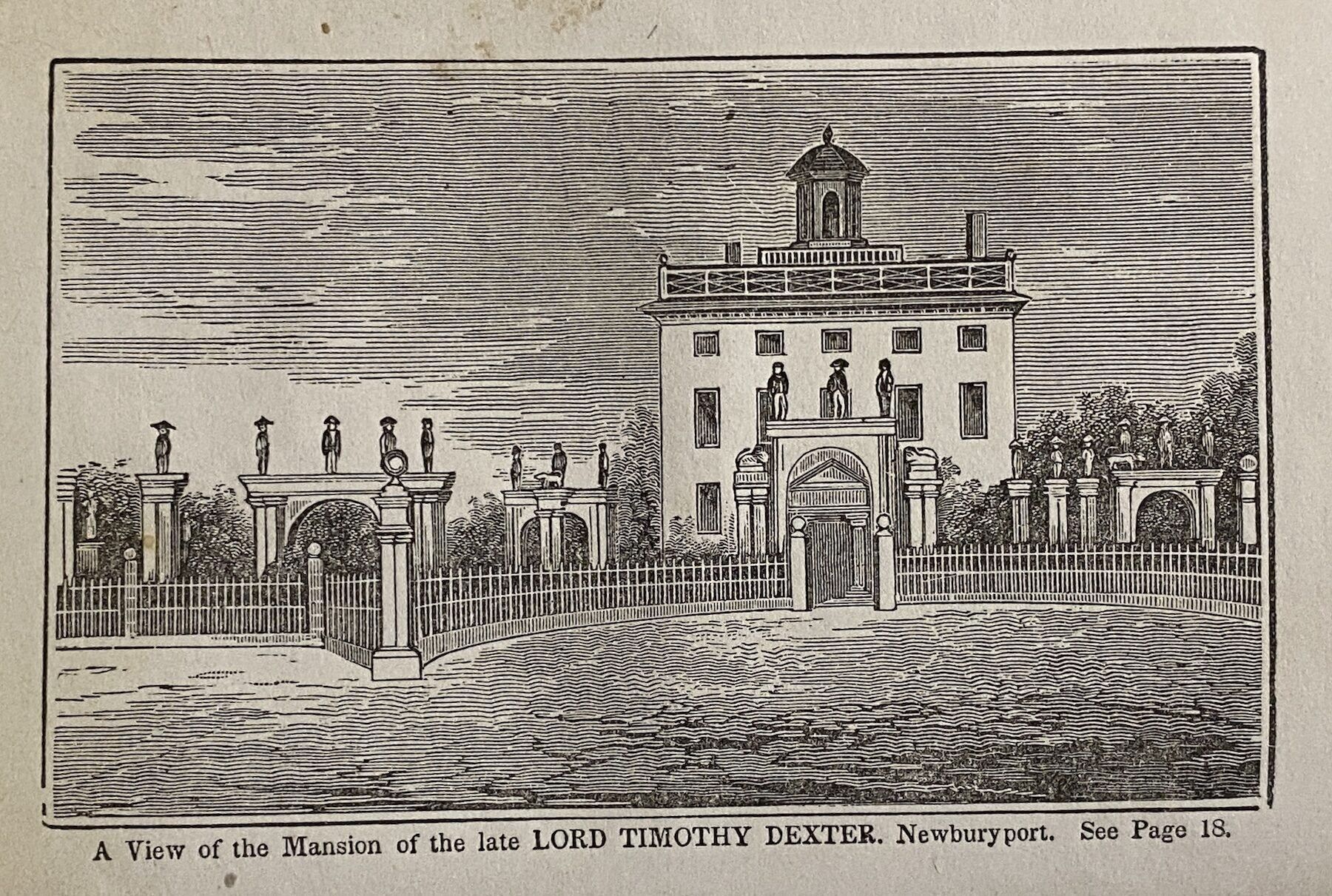
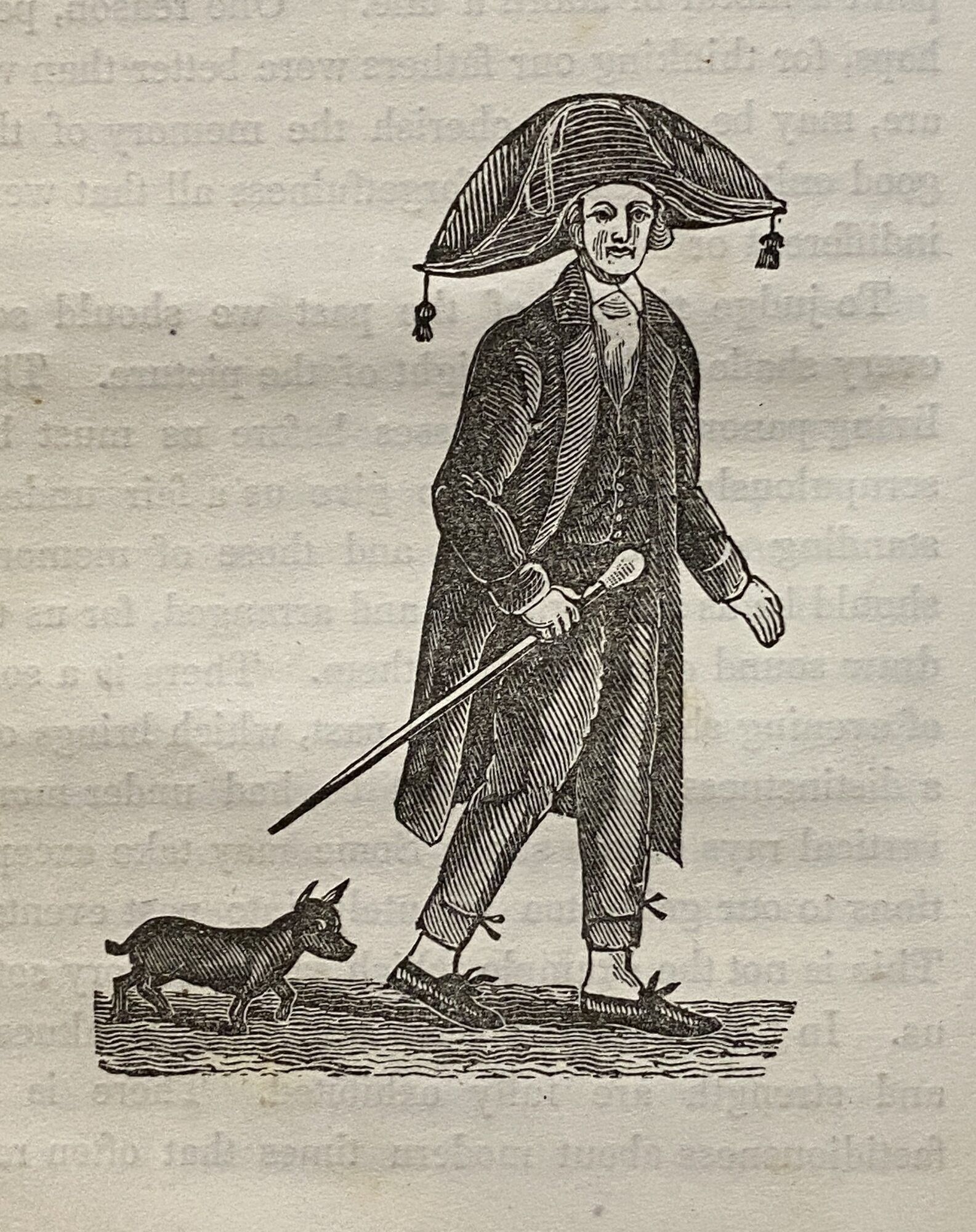
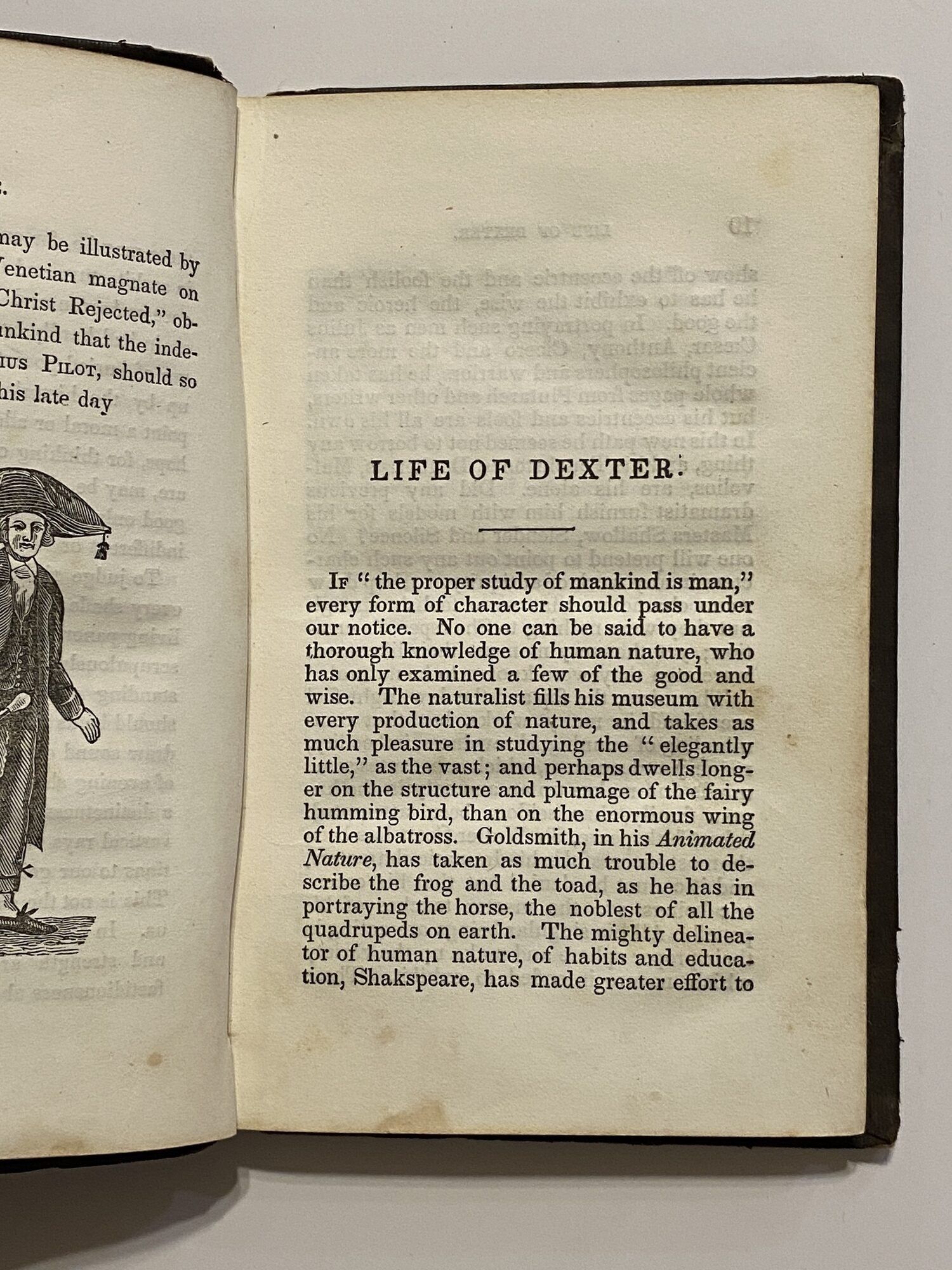
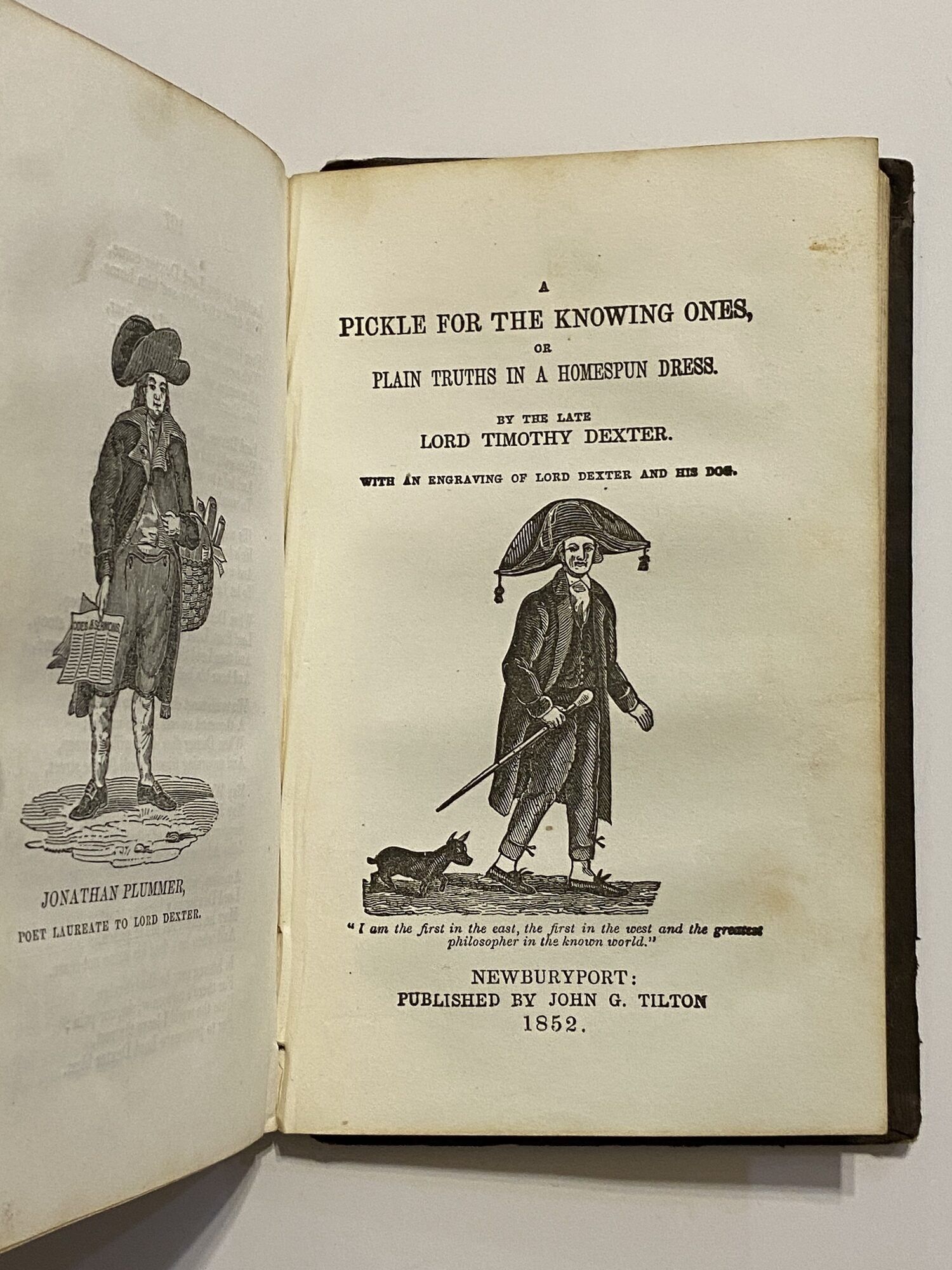
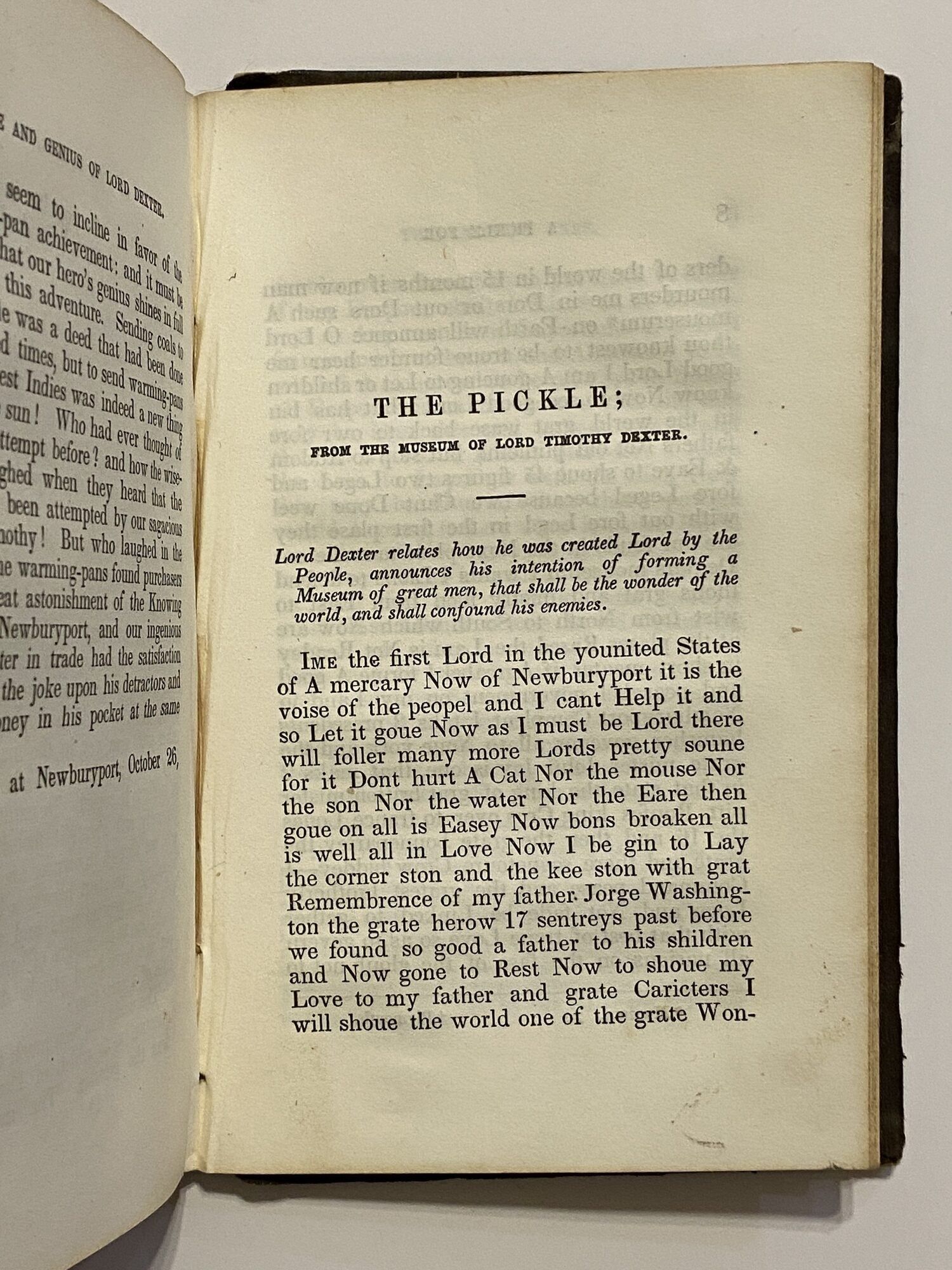
Newburyport: John G. Tilton, 1852. Later edition. Good. Together two parts in one volume. 12mo. Ad 1: viii, [1], 10-107, with a woodcut frontispiece of Dexter's mansion, a half-page woodcut of Dexter on p. viii, and a full-page woodcut of Jonathan Plummer on p. [108] opposite the facing title page; Ad 2: 36 pp., title-page vignette of Dexter and his dog (verso blank. Original stab-stitched self wrappers (both stained and darkened). Original publisher's brown cloth, upper cover with gilt depiction of Timothy Dexter and his dog (spine defective but boards are quite sound as are the hinges; pastedowns and endpapers foxed but the textblock is remarkably clean and crisp). With faults and priced accordingly. "A PICKLE FOR THE KNOWING ONES" IS ONE OF THE EARLIEST AND MOST SPECTACULAR AMERICAN EXPRESSIONS OF VAIN IGNORANCE. SELF-STYLED "LORD" DEXTER, THIS UNEDUCATED MAN IS CONSIDERED THE LUCKIEST INVESTOR OF HIS DAY. MANY "UPPER CLASS" BUSINESSMEN DESPISED HIS GRANDIOSITY AND ENVIED HIS HYPERGAMIC WEALTH. ATTEMPTING TO RUIN HIM, THEY GLEEFULLY COAXED HIM INTO INVESTING IN NUMEROUS, SEEMINGLY "RIDICULOUS" VENTURES. ULTIMATELY, AND MOST IMPROBABLY, HE PROFITED WILDLY FROM THE VERY SCHEMES THEY PRIVATELY CONSIDERED ABSURD.
THIS IS THE ONLY COPY OF ANY EARLY EDITION CURRENTLY ON THE MARKET.
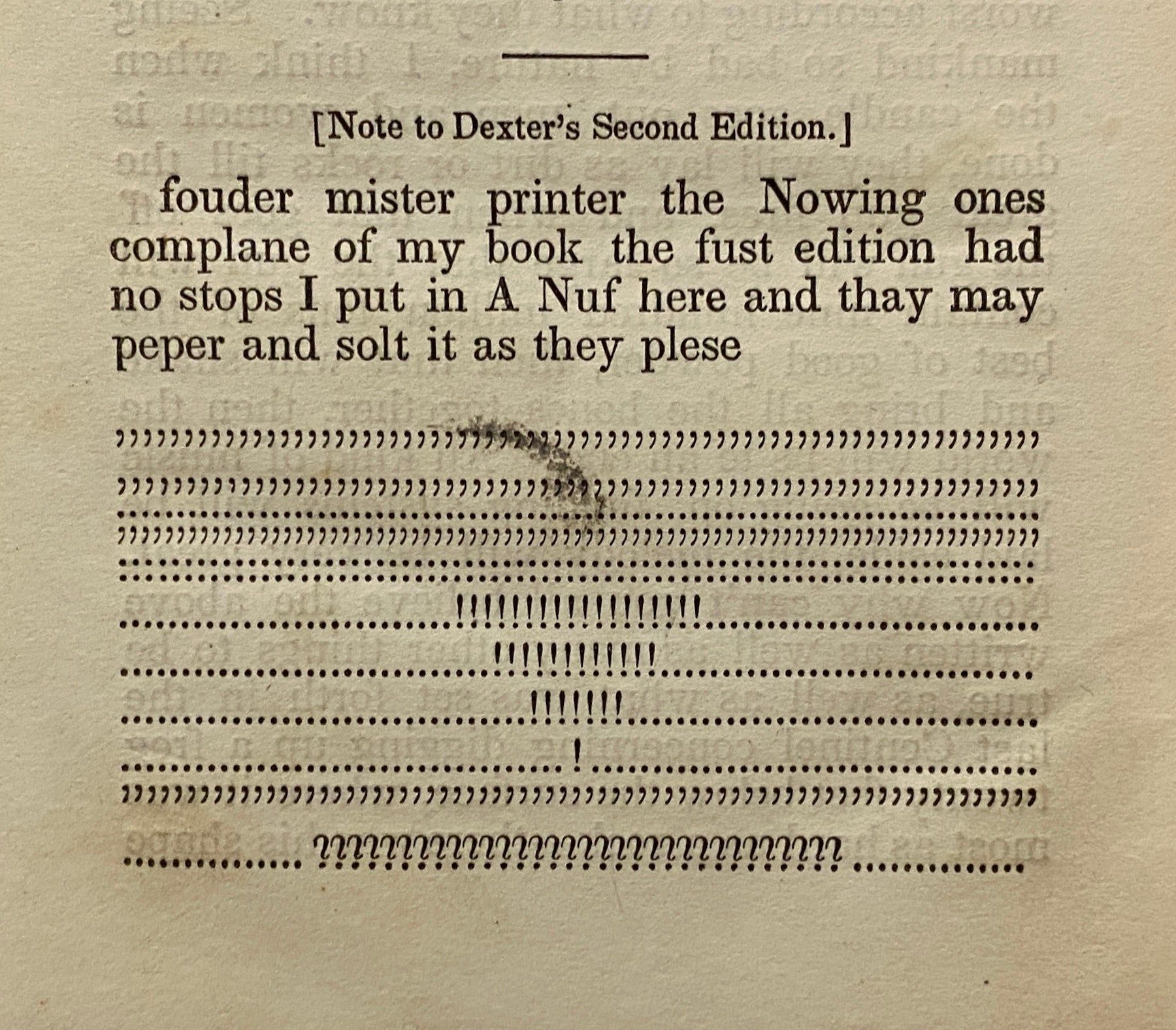
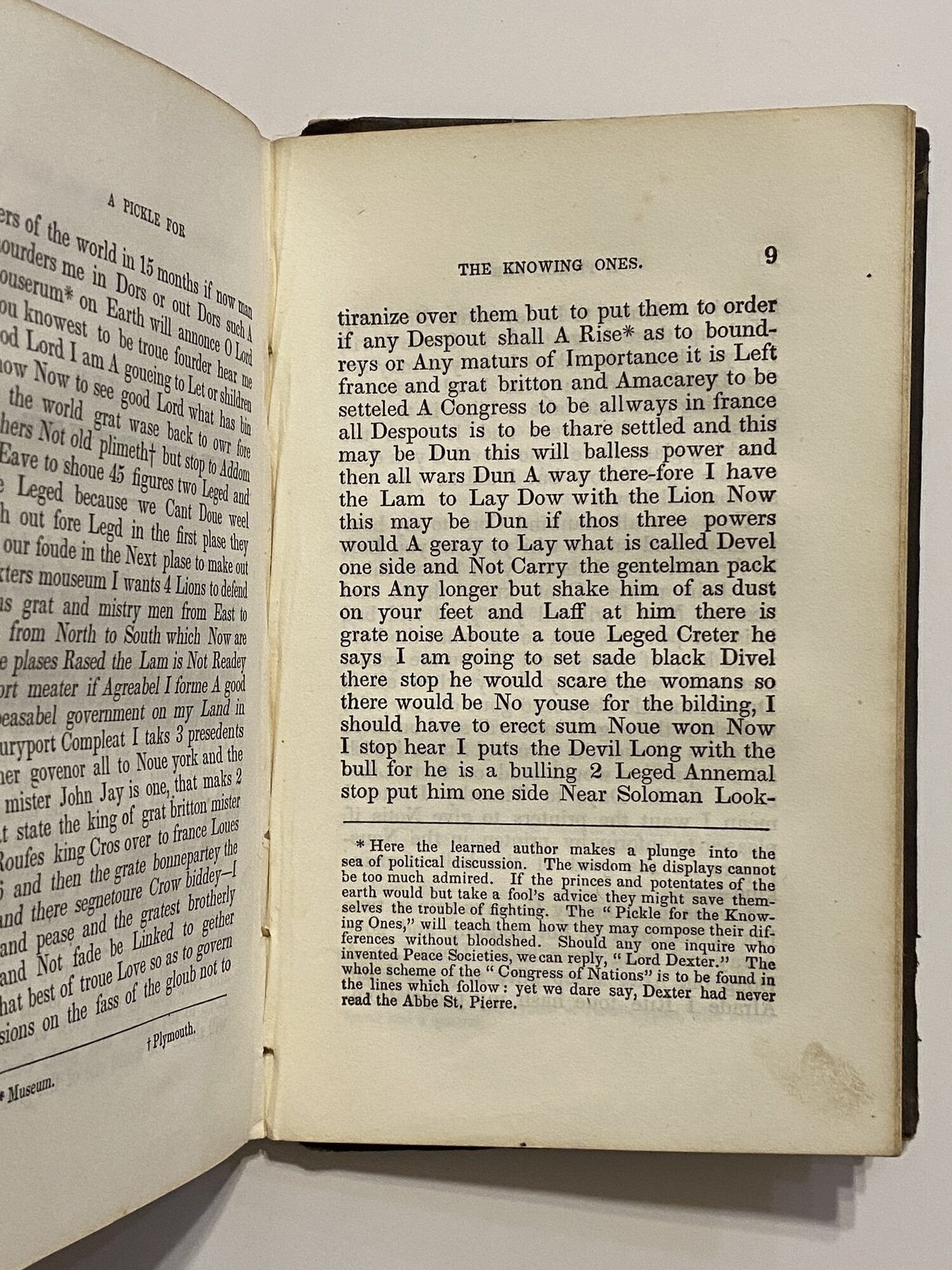
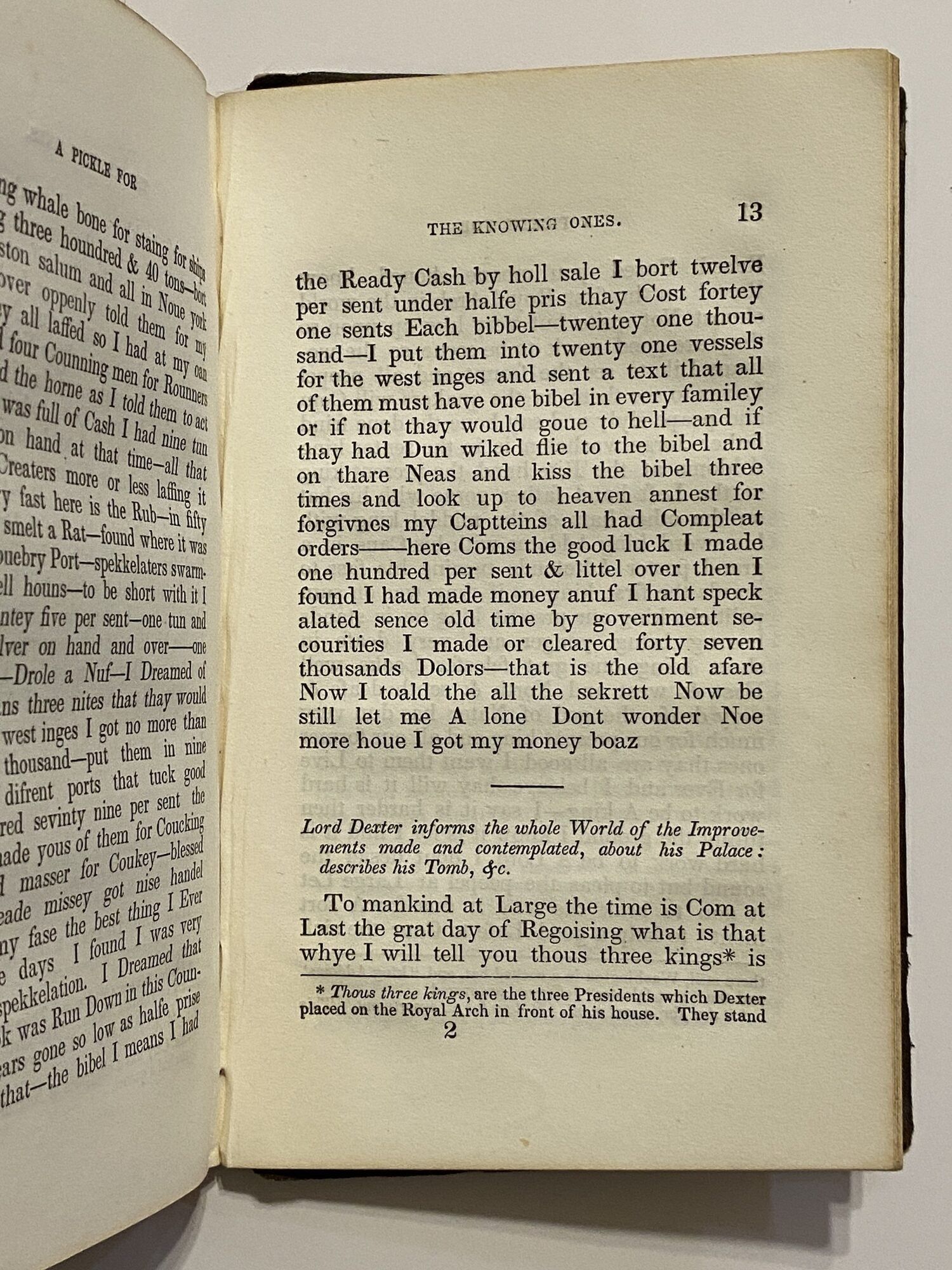
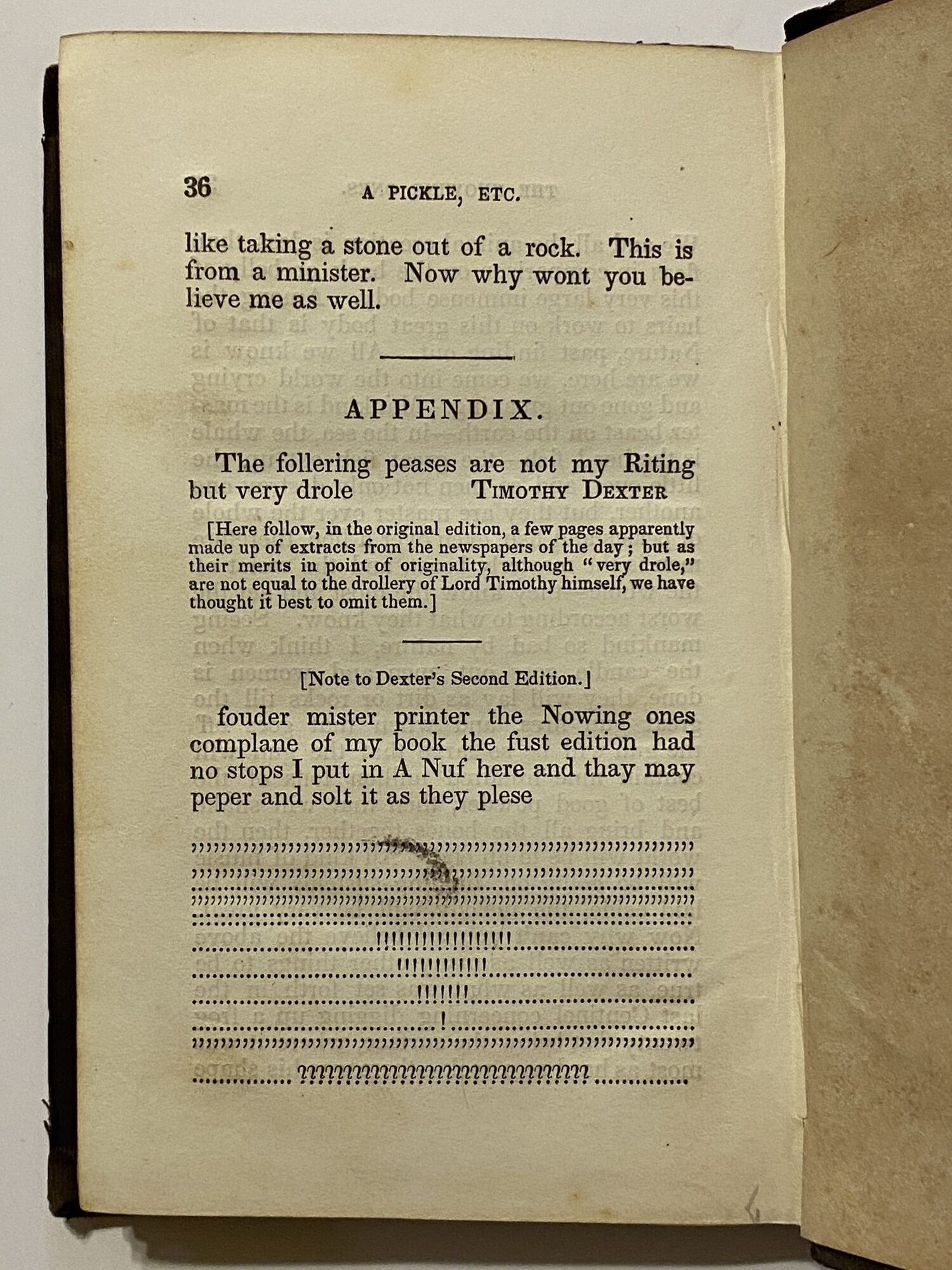
Dexter quit school at the age of eight. Eschewing editorial assistance, the words in his "Pickle for the Knowing Ones" are spelled phonetically. The first edition of 1802 was privately published and freely distributed by the author. Dexter was criticized to the point of ridicule. In response to complaints from readers about the absence of punctuation, in the second edition he instructed the printer to add multiple commas, periods, and exclamation points at the very end of the text (only) for readers to "peper and solt it as they plese."
Online, this extraordinary text has been justifiably described as "The First American Shitpost." It contains equal parts of inflated autobiography, nonsense tirade, and "aristocratic" decree. Our author attacks almost everyone: politicians, ministers, and even his wife whom he married for her wealth at the age of 18 (she was 32-year-old widow).
Incredibly, he grew immensely rich through blind investment decisions that should have been ruinous, for instance: spending his wife's fortune on Continental currency that had become nearly worthless; several years later its value (fortuitously) returned to parity; shipping coal to Newcastle (!) which fortuitously arrived during a miners' strike, and in doing so codified the phrase "selling coal to Newcastle"; sending 40,000 warming pans (!) to the West Indies where they sold out, having been fortuitously adapted for refining molasses; and to the same destination gloves (!), where they were bought en bloc by exporters to Siberia.
The book's madness mirrors Dexter's life. Always desperate for attention, he staged his own funeral to see who would show up. Seeing that his wife's expressions of grief were (in his opinion) insufficient, he chased from the church and beat her with his cane. During their unfortunate marriage he called her a "ghost" despite the fact that she was still alive. His vanity was just as unrestrained: he declared himself the greatest philosopher of his age and imagining himself worthy of becoming Emperor of the United States. His estate became a monument to self-worship: alongside 40 giant wooden statues of heroes and statesmen, Dexter positioned his own statue, pronouncing himself as "The Greatest Philosopher in the Western World." Sound familiar?
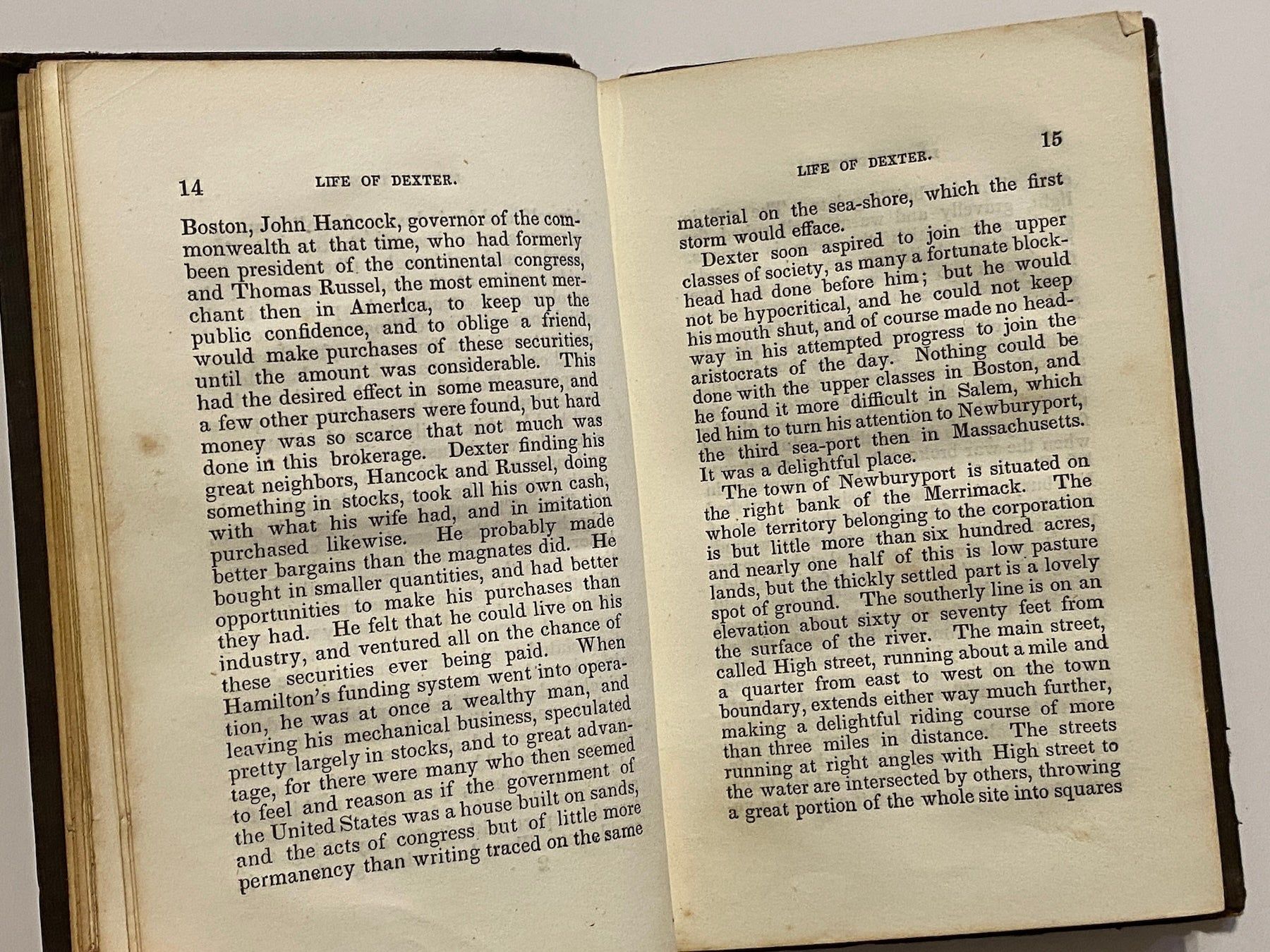
The present edition contains Samuel L. Knapp's highly entertaining biography of Dexter which is particularly valuable as it contains "Sketches Of The Eccentric Characters That Composed His Associates." These eccentrics are too numerous to name in full but include: Samuel Lord Dexter, Dexter's "imbecile" son; Nancy Bishop whose life deteriorates into "fatuity and wretchedness"; John P., the schoolmaster/astrologer, a "dare-devil" and "man of perpetual contradictions" who claimed powers in judicial astrology; Madam Hooper, a fortune-teller and "singularly bold, intelligent woman" who becomes one of Dexter's occult advisers; Moll Pitcher, the "celebrated" fortune-teller Dexter consults after Madam Hooper's death; Lucy Lancaster, the "female African" who had the greatest influence over Dexter's household and served as nurse/confidante/manager; T.B., the watchmaker who becomes a sounding board for Dexter's absurd metaphysics about time, God, ministers, and human nature; William Burley / "Dwarf Billy," a gigantic laborer hired by Dexter to do double work, eat double food, and serve as his fighter; the Dog-Town herb-women / "weird sisters," a collective of ragged women on skeletal horses, gathering herbs and distilling essences, and many more.
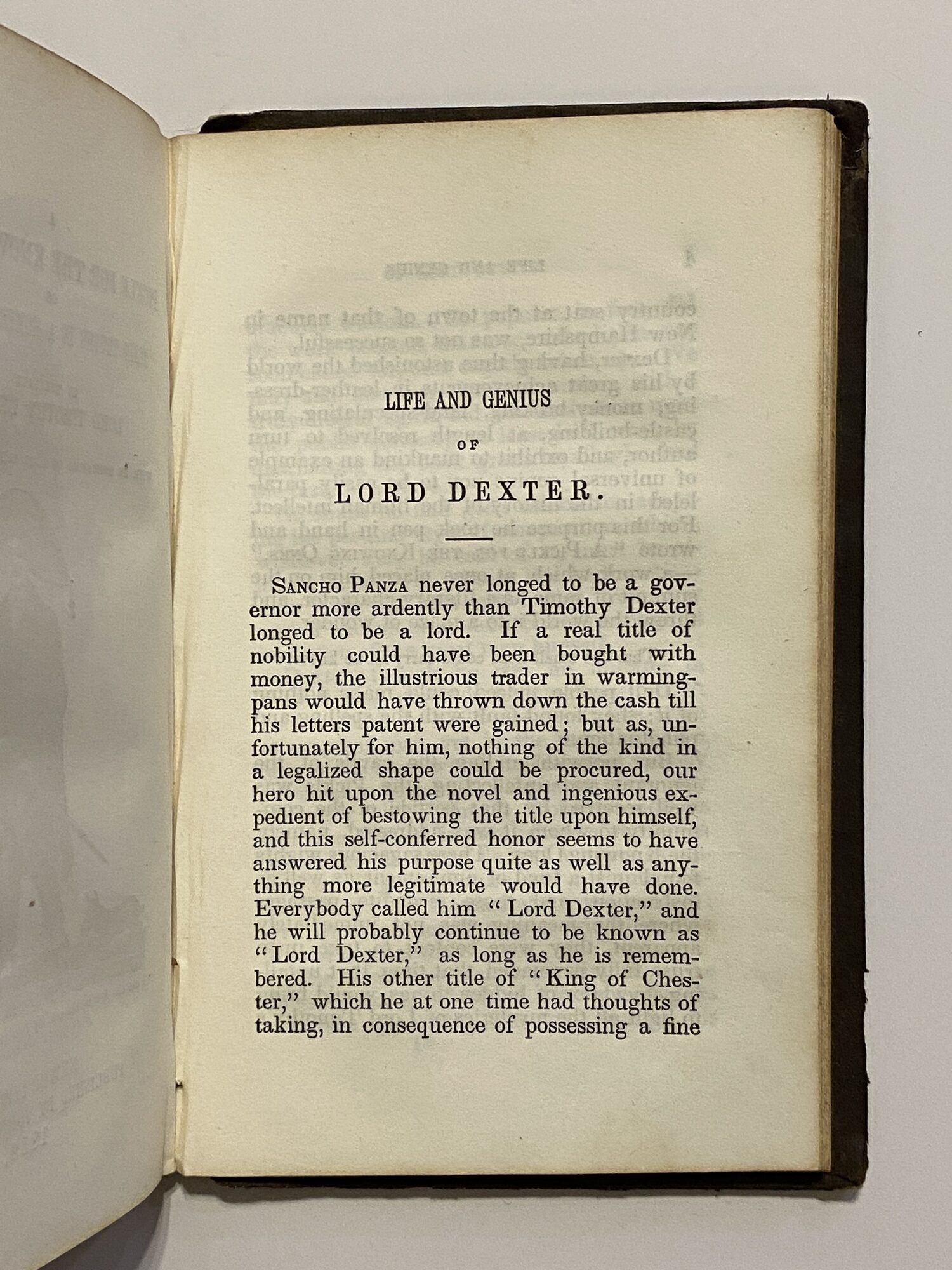
Preceeding Dexter's "Pickle for the Knowing Ones" is an absurdly aggrandized "Life and Genius of Lord Dexter" written by Dexter's "poet laureate" Jonathan Plummer.
MUST BE SEEN TO BE FULLY APPRECIATED.
THIS IS THE ONLY COPY OF ANY EARLY EDITION CURRENTLY ON THE MARKET.
Dexter quit school at the age of eight. Eschewing editorial assistance, the words in his "Pickle for the Knowing Ones" are spelled phonetically. The first edition of 1802 was privately published and freely distributed by the author. Dexter was criticized to the point of ridicule. In response to complaints from readers about the absence of punctuation, in the second edition he instructed the printer to add multiple commas, periods, and exclamation points at the very end of the text (only) for readers to "peper and solt it as they plese."
Online, this extraordinary text has been justifiably described as "The First American Shitpost." It contains equal parts of inflated autobiography, nonsense tirade, and "aristocratic" decree. Our author attacks almost everyone: politicians, ministers, and even his wife whom he married for her wealth at the age of 18 (she was 32-year-old widow).
Incredibly, he grew immensely rich through blind investment decisions that should have been ruinous, for instance: spending his wife's fortune on Continental currency that had become nearly worthless; several years later its value (fortuitously) returned to parity; shipping coal to Newcastle (!) which fortuitously arrived during a miners' strike, and in doing so codified the phrase "selling coal to Newcastle"; sending 40,000 warming pans (!) to the West Indies where they sold out, having been fortuitously adapted for refining molasses; and to the same destination gloves (!), where they were bought en bloc by exporters to Siberia.
The book's madness mirrors Dexter's life. Always desperate for attention, he staged his own funeral to see who would show up. Seeing that his wife's expressions of grief were (in his opinion) insufficient, he chased from the church and beat her with his cane. During their unfortunate marriage he called her a "ghost" despite the fact that she was still alive. His vanity was just as unrestrained: he declared himself the greatest philosopher of his age and imagining himself worthy of becoming Emperor of the United States. His estate became a monument to self-worship: alongside 40 giant wooden statues of heroes and statesmen, Dexter positioned his own statue, pronouncing himself as "The Greatest Philosopher in the Western World." Sound familiar?
The present edition contains Samuel L. Knapp's highly entertaining biography of Dexter which is particularly valuable as it contains "Sketches Of The Eccentric Characters That Composed His Associates." These eccentrics are too numerous to name in full but include: Samuel Lord Dexter, Dexter's "imbecile" son; Nancy Bishop whose life deteriorates into "fatuity and wretchedness"; John P., the schoolmaster/astrologer, a "dare-devil" and "man of perpetual contradictions" who claimed powers in judicial astrology; Madam Hooper, a fortune-teller and "singularly bold, intelligent woman" who becomes one of Dexter's occult advisers; Moll Pitcher, the "celebrated" fortune-teller Dexter consults after Madam Hooper's death; Lucy Lancaster, the "female African" who had the greatest influence over Dexter's household and served as nurse/confidante/manager; T.B., the watchmaker who becomes a sounding board for Dexter's absurd metaphysics about time, God, ministers, and human nature; William Burley / "Dwarf Billy," a gigantic laborer hired by Dexter to do double work, eat double food, and serve as his fighter; the Dog-Town herb-women / "weird sisters," a collective of ragged women on skeletal horses, gathering herbs and distilling essences, and many more.
Preceeding Dexter's "Pickle for the Knowing Ones" is an absurdly aggrandized "Life and Genius of Lord Dexter" written by Dexter's "poet laureate" Jonathan Plummer.
MUST BE SEEN TO BE FULLY APPRECIATED.
Details
Title
[AMERICAN "SHITPOST" 1852]. Life of Lord Timothy Dexter. [ISSUED WITH]: A Pickle for the Knowing Ones: or Plain Truths in a Homespun Dress
Author
[Dexter, Timothy]. Knapp, Samuel L.
Condition
Good
Publisher
John G. Tilton: Newburyport
Date
1852
Edition
Later edition