

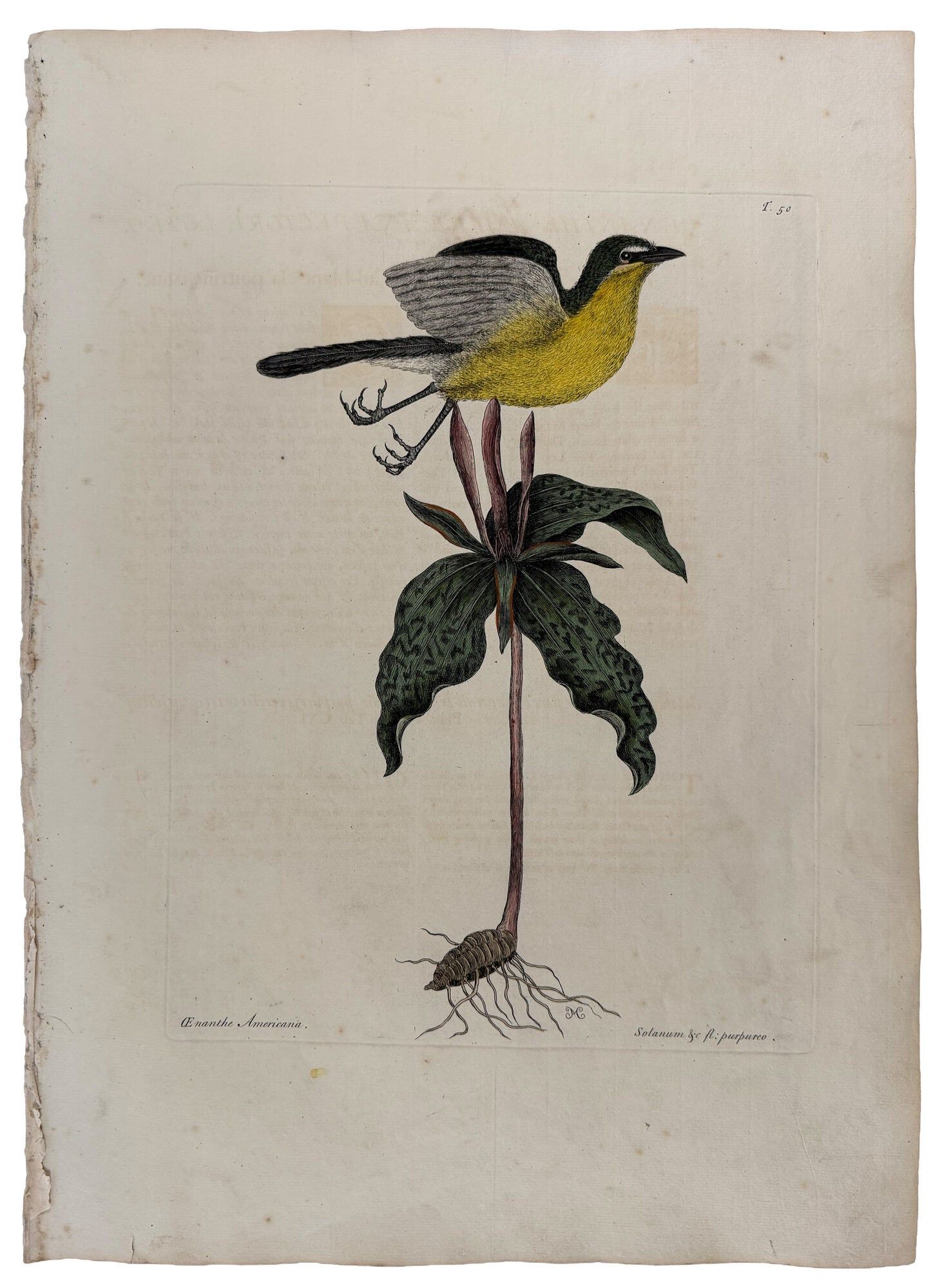
Oenanthe Americana & Solanum purpureo [Yellow Breasted Chat with Spotted Wakerobin]
- London: Printed for Charles Marsh, Thomas Wilcox and Benjamin Stichall, 1754
London: Printed for Charles Marsh, Thomas Wilcox and Benjamin Stichall, 1754. hand-coloured etched plate on fine laid paper. A fine plate of the Yellow-Breasted Chat and Spotted Wakerobin from the second edition of the "most famous colorplate book of American plant and animal life ... a fundamental and original work for the study of American species" (Hunt).
Trained as a botanist, Catesby travelled to Virginia in 1712 and remained there for seven years, sending back to England collections of plants and seeds. With the encouragement of Sir Hans Sloane and others, Catesby returned to America in 1722 to seek materials for his Natural History; he travelled extensively in Carolina, Georgia, Florida, and the Bahamas, sending back further specimens. His preface provides a lengthy account of the development of this work, including his decision to study with Joseph Goupy in order to learn to etch his copper plates himself to ensure accuracy and economy. The end result is encyclopaedic: Catesby provides information not only on the botany and ornithology of the area, but also on its history, climate, geology and anthropology. Catesby's plate brings together the yellow-breasted chat, now Icteria virens, with the purple-flowered plant identified as Trillium maculatum, the spotted wakerobin. The bird was one of Catesby's livelier subjects: in his text he described its loud chattering call from riverbanks, rocks, and cane swamps, and noted the "singular manner" of its flight with the legs extended. That observation explains the slightly startled, suspended posture here, with the feet drawn back and wings raised above the dark-spotted leaves and exposed root of the plant. The pairing is characteristic of Catesby at his best, combining ornithological behaviour, botanical form, and decorative design in a single image of American natural history.
Cf. Anker 95; cf. Clark I:55; cf. Dunthorne 72; cf. Fine Bird Books (1990), p. 86; cf. Great Flower Books (1990), p.85; cf. Meisel III:340; cf. Nissen BBI 336, IVB 177; cf. Sabin 11509; cf. Stafleu & Cowan TL2 1057; cf. Wood p. 282; cf. Amy Meyers and Margaret Pritchard, Empire's Nature, Mark Catesby's New World Vision, Williamsburg, 1998.
Trained as a botanist, Catesby travelled to Virginia in 1712 and remained there for seven years, sending back to England collections of plants and seeds. With the encouragement of Sir Hans Sloane and others, Catesby returned to America in 1722 to seek materials for his Natural History; he travelled extensively in Carolina, Georgia, Florida, and the Bahamas, sending back further specimens. His preface provides a lengthy account of the development of this work, including his decision to study with Joseph Goupy in order to learn to etch his copper plates himself to ensure accuracy and economy. The end result is encyclopaedic: Catesby provides information not only on the botany and ornithology of the area, but also on its history, climate, geology and anthropology. Catesby's plate brings together the yellow-breasted chat, now Icteria virens, with the purple-flowered plant identified as Trillium maculatum, the spotted wakerobin. The bird was one of Catesby's livelier subjects: in his text he described its loud chattering call from riverbanks, rocks, and cane swamps, and noted the "singular manner" of its flight with the legs extended. That observation explains the slightly startled, suspended posture here, with the feet drawn back and wings raised above the dark-spotted leaves and exposed root of the plant. The pairing is characteristic of Catesby at his best, combining ornithological behaviour, botanical form, and decorative design in a single image of American natural history.
Cf. Anker 95; cf. Clark I:55; cf. Dunthorne 72; cf. Fine Bird Books (1990), p. 86; cf. Great Flower Books (1990), p.85; cf. Meisel III:340; cf. Nissen BBI 336, IVB 177; cf. Sabin 11509; cf. Stafleu & Cowan TL2 1057; cf. Wood p. 282; cf. Amy Meyers and Margaret Pritchard, Empire's Nature, Mark Catesby's New World Vision, Williamsburg, 1998.
Details
Title
Oenanthe Americana & Solanum purpureo [Yellow Breasted Chat with Spotted Wakerobin]
Author
CATESBY, Mark (1683-1749)
Condition
Unknown
Publisher
Printed for Charles Marsh, Thomas Wilcox and Benjamin Stichall: London
Date
1754