

THE EDUCATION OF HENRY ADAMS.
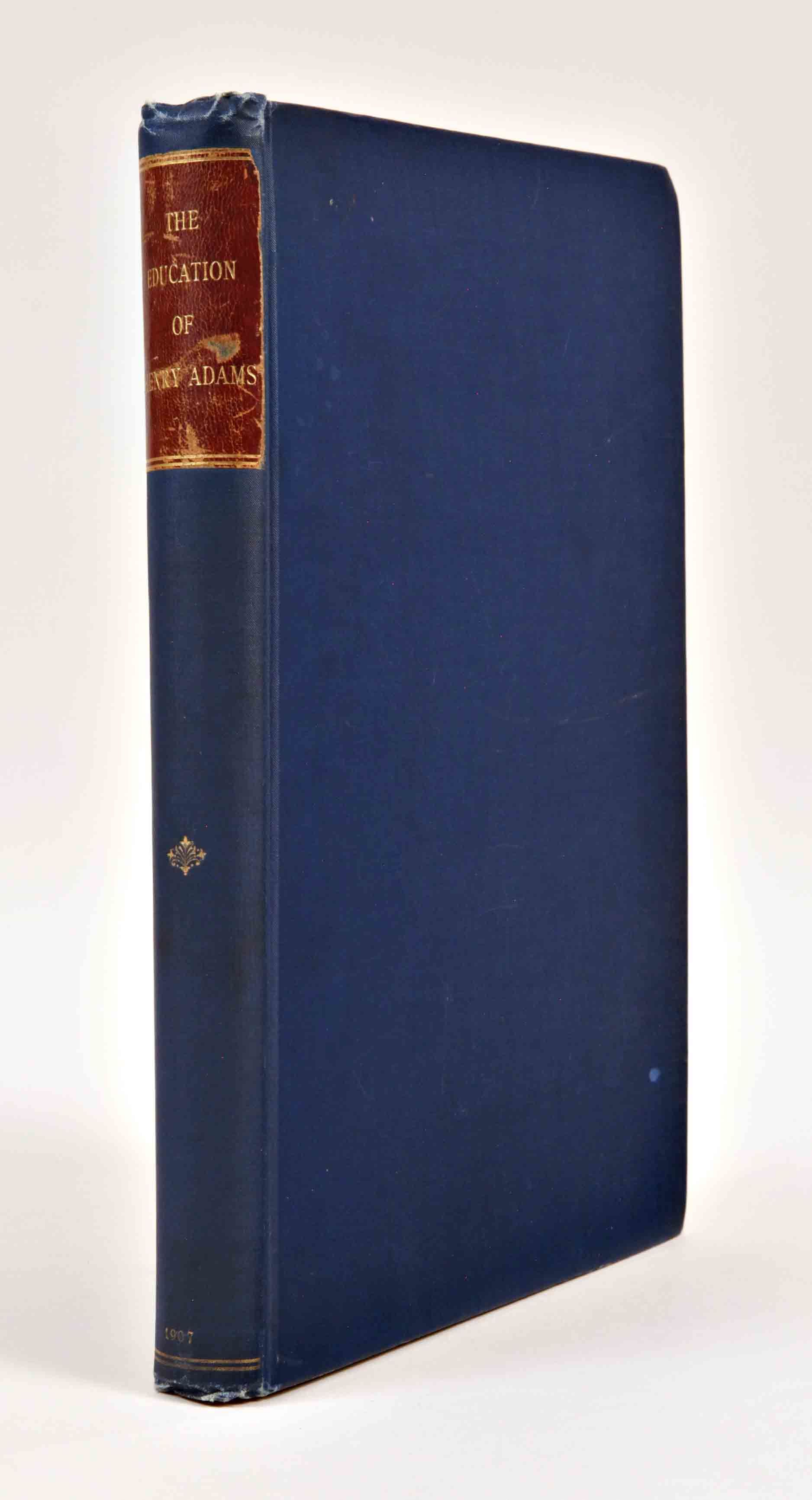
- Washington: [Printed for the Author], , 1907.
Washington: [Printed for the Author],, 1907.. Inscribed Copy of the First, Privately Published Edition First edition and likely second printing of what by anyone's measure is one of the great American books, privately published for distribution among friends and family, with this copy bearing a presentation inscription, likely dating to the period following Adams' stroke in 1912, from Adams to his friend and Lafayette Square neighbor Edith Eustis. A strong case has been made that Adams initially had forty copies printed for distribution within a small circle of interested readers whose feedback he solicited and then had a supplementary printing of sixty copies made at a later date, possibly as late as 1913 or 1914, to satisfy the additional demand from family and friends. The distinction between the two printings is only possible by inscriptions or provenance: most copies of the first printing were distributed in the period following the book's initial publication in February 1907, while copies from the later printing would have been included among those presented by Adams in the later years, prior to his death in 1918. The Education has been described as "one of the great American autobiographies....a rewarding book and an American classic" (Reese). Written in the third person, it serves in part as an exploration of the ways in which Adams' traditional education had proved inadequate to the technical and social challenges facing the modern world. An heir to one of America's most distinguished political families, Henry Adams (1838–1918) was the grandson of U.S. President John Quincy Adams and the great-grandson of President John Adams. His father, Charles Francis Adams, was a diplomat and during the Civil War served as ambassador to the United Kingdom, with young Henry accompanying him as his private secretary. After the war, Henry went on to work as a journalist, Harvard professor, novelist, and historian. Among his published works were two novels, Democracy (1880) and Esther (1884); a nine-volume History of the United States during the administrations of Jefferson and Madison (1889–1891); and two very personal works, both written in his sixties, Mont Saint Michel and Chartres (1904) and The Education of Henry Adams (1907). According to Adams, the two works were meant to function as companion pieces, with Mont Saint Michel and Chartres serving as a study in "thirteenth-century unity," expressed ultimately in the figure of the Virgin, and The Education as a study in "twentieth-century multiplicity," epitomized by the invention of the Dynamo. In 1872, Adams married Boston socialite Marian "Clover" Hooper, who would later become an accomplished photographer. The couple eventually moved to Washington, D.C., where their Lafayette Square salon became a fashionable gathering place for politicians, authors, artists, scientists, and thinkers. In December 1885, Clover, who had long been given to bouts of depression, took her own life by ingesting a vial of potassium cyanide, a chemical used in developing photographs. Devastated by the loss of his wife, Henry in the decades after her death came increasingly to reject the masculine worlds of politics and business, finding comfort and satisfaction in the social company of women, most notably his nieces and such friends and neighbors as Edith Eustis, to whom the present volume is inscribed. This copy bears the author's presentation inscription in pencil on the front free endpaper: "Edith Eustis from Henry Adams." The recipient, Edith Livingston Morton Eustis (1874–1964), was Adams' friend and a Lafayette Square neighbor. Writing to author Edith Wharton's sister-in-law, Mary Cadwalader Jones, in 1910, Adams went so far as to describe Eustis as one "[o]f my six most intimate women-friends here." Eustis was the daughter of U.S. Vice President Levi P. Morton. Her husband, William Corcoran Eustis, was the grandson of Washington banker, philanthropist, and art collector William W. Corcoran, who had rented Henry and Clover Adams their first home in Washington, D.C., upon their arrival there in 1877. Adams' hand shows a visible tremor, suggesting that the inscription dates to sometime after the stroke he suffered on April 24, 1912. According to Adams' biographer Elizabeth Stevenson, "his handwriting more than any other trait showed the seriousness of his illness. It had been of a beautiful copperplate perfection. It was shaky and straggling now, the words formed with difficulty, but the thought, as tart and as indelibly Henry Adams as ever." The likely date of the inscription suggests that this copy was probably produced as part of the later, supplementary printing. Further supporting this conclusion is the fact that Eustis had been one of only three recipients of The Education's initial printing known to have returned her copy as Adams had initially requested, for in a letter dated February 28, 1908, Adams thanked her "for the return of the volume." Given her "honesty," as Adams put it, Eustis would almost certainly have been guaranteed to receive a copy from among the book's second printing. In his letter to Eustis, Adams went on to explain that "The two volumes [the Education and Mont Saint Michel and Chartres] have not been done in order to teach others, but to educate myself in the possibilities of literary form." Only after Adams' death in 1918 was The Education made publicly available in an edition published that year by Houghton Mifflin. "Within six months," notes Adams' biographer Ernest Samuels, "the book had sold 12,000 copies. It was awarded the Pulitzer Prize posthumously. It has ever since retained its popularity as a classic of American literature." In 1998, The Education was ranked number one on the Modern Library's list of the 100 best non-fiction books published since 1900. A classic of Americana, here in the first, privately published edition, inscribed by the author. Large quarto. Original blue cloth, spine and leather labels gilt. Binding and extremities rubbed and a touch worn, leather labels worn and chipped, front hinge starting. Clean internally. Author's presentation inscription in pencil to Edith Eustis on front free endpaper. About very good. BAL 32. HOWES A52, "c." STREETER SALE 4220. REESE, NARRATIVES OF PERSONAL EXPERIENCE 2. REESE SALE 336. Henry Adams to Mary Cadwalader Jones, February 3, 1910, in The Letters of Henry Adams, Volume 6, 1906-1918, ed. J.C. Levenson, Ernest Samuels, et al. (Cambridge, MA: Harvard Univ. Press, 1988), p.307. Henry Adams to Edith Morton Eustis, February 28, 1908, ibid., p.122. Elizabeth Stevenson, Henry Adams: A Biography (New York: Macmillan Company, 1955), p.372. Ernest Samuels, Henry Adams (Cambridge, MA: Harvard Univ. Press, 1989), p.454.
Details
Title
THE EDUCATION OF HENRY ADAMS.
Author
Adams, Henry:
Condition
Unknown
Publisher
Washington: [Printed for the Author],
Date
1907.