

ANNO REGNI GEORGII III...AN ACT TO AMEND AND RENDER MORE EFFECTUAL, IN HIS MAJESTY'S DOMINIONS IN AMERICA, AN ACT PASSED IN THIS PRESENT SESSION OF PARLIAMENT, INTITULED, AN ACT FOR PUNISHING MUTINY AND DESERTION, AND FOR THE BETTER PAYMENT OF THE ARMY AND THEIR QUARTERS [caption title].
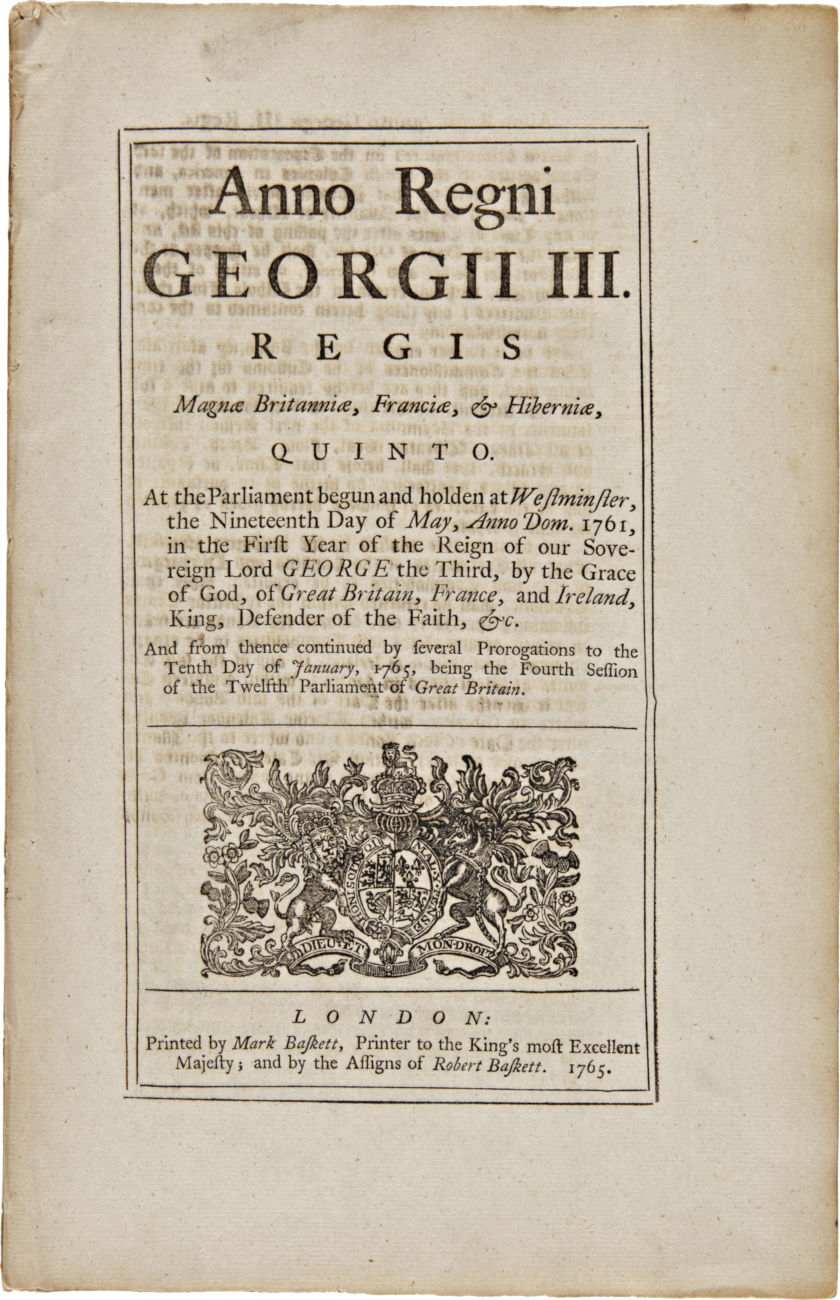
- London: Printed by Mark Baskett, , 1765.
London: Printed by Mark Baskett,, 1765.. The First Quartering Act: Stoking Tensions Between the Colonies and the Crown An attractive separate printing of the first Quartering Act issued by Parliament affecting Britain's North American colonies, setting the stage for the Intolerable Acts a decade later. The act stipulated that the government could house its soldiers in private residences, but if its soldiers outnumbered the housing available, it authorized them to occupy "inns, livery stables, ale houses, victualing houses, and the houses of sellers of wine and houses of persons selling of rum, brandy, strong water, cider or metheglin," as well as "uninhabited houses, outhouses, barns, or other buildings." Colonial authorities were required to pay the cost of housing and feeding these soldiers. Quartering troops at any time was not uncommon historically, but previous acts noted that citizens could not be compelled to quarter troops, and that they must be paid or reimbursed for their expenses. Likewise, local governments providing provisions and quartering troops was not uncommon during times of war, notably the French and Indian War. However, now that the war was over, General Thomas Gage, commander of forces in British North America, was having trouble persuading colonial assemblies to pay for ongoing quartering and feeding his troops on the march, and thus asked Parliament to do something. This act went far beyond what Gage had requested: now colonists were compelled to quarter troops and were forced to pay and feed them with no promise of reimbursement. No standing army had ever been kept in the colonies before the French and Indian War, indeed the existence of a standing army during peacetime was prohibited by the Bill of Rights of 1688/9. Thus, the colonists justly asked why a standing army was needed after the French had been defeated. When 1,500 British troops arrived in New York (headquarters for British colonial forces) in 1766, the New York Provincial Assembly refused to comply with the act; the troops had to remain aboard ship. Skirmishes broke out between soldiers and colonists, and Parliament threatened to suspend the New York governor and assembly in 1767 and 1769. Eventually, the assembly agreed to allocate funds for quartering in 1771. This Act was issued separately with a general titlepage (as here), and also as part of Anno Regni Georgii III...at the Parliament Begun...the Nineteenth Day of May, Anno Dom. 1761...and from Thence Continued by Several Prorogations to the Tenth Day of January, 1765.... An important document in the rise of tensions between the American Colonies and Great Britain. Folio. Dbd. Lacks stitching, gatherings mostly loose, some minor soiling and tanning. Else a bright and clean copy, very good or better. ESTC N56865.
Details
Title
ANNO REGNI GEORGII III...AN ACT TO AMEND AND RENDER MORE EFFECTUAL, IN HIS MAJESTY'S DOMINIONS IN AMERICA, AN ACT PASSED IN THIS PRESENT SESSION OF PARLIAMENT, INTITULED, AN ACT FOR PUNISHING MUTINY AND DESERTION, AND FOR THE BETTER PAYMENT OF THE ARMY AND THEIR QUARTERS [caption title].
Author
[American Revolution]: [Quartering Act]:
Condition
Unknown
Publisher
London: Printed by Mark Baskett,
Date
1765.