

Correspondence relative to the General Abolition of Slavery in Texas, and throughout the World; 1843-1844. (Mr. Hume.) [docket title]
- 7, [1] pp. Folio
- [London]: Ordered, by The House of Commons, to be Printed, 1848
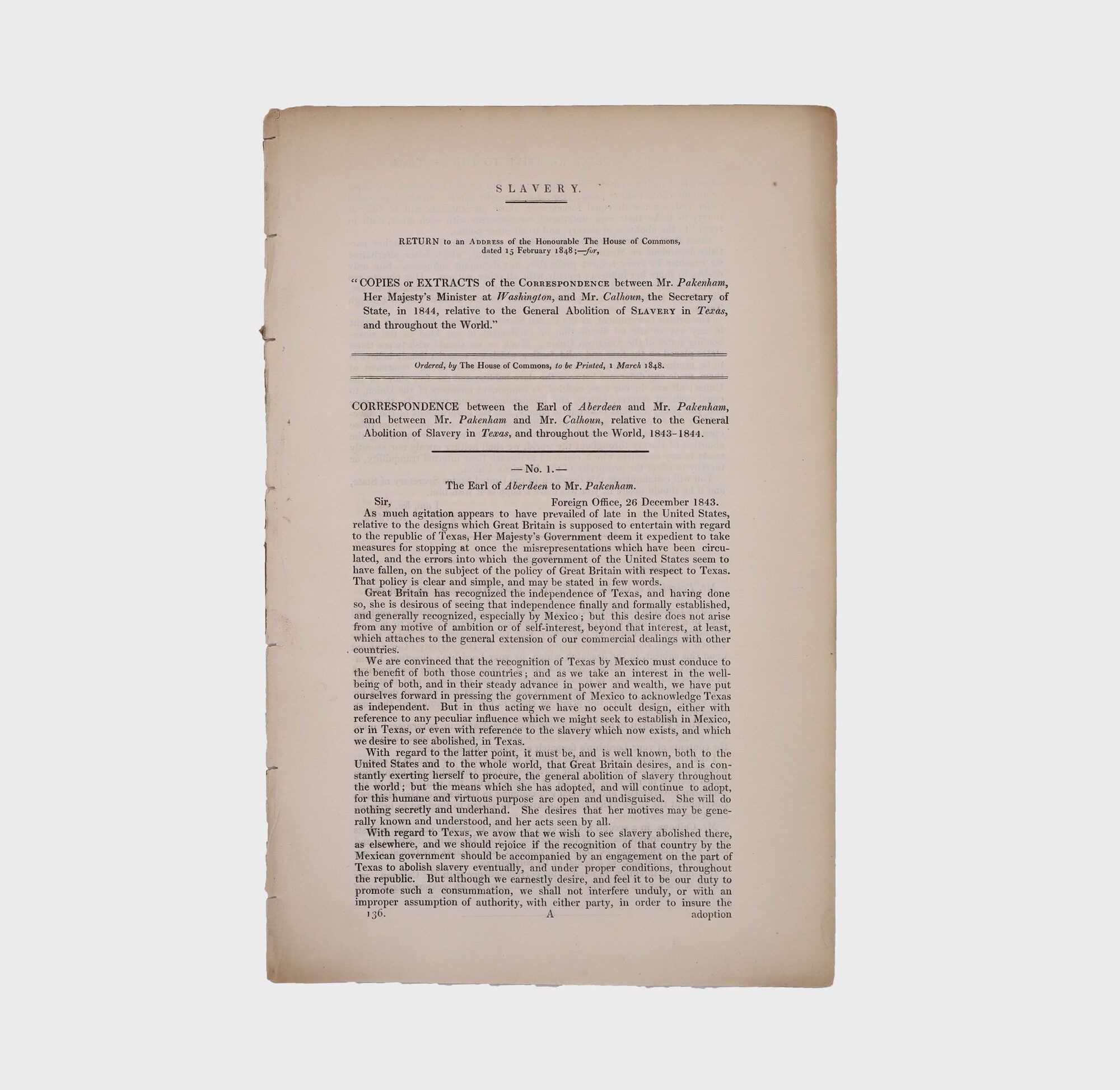
[London]: Ordered, by The House of Commons, to be Printed, 1848. 7, [1] pp. Folio. Disbound. 7, [1] pp. Folio. Remarkably revealing diplomatic correspondence between Sir Richard Pakenham and John C. Calhoun, written just before the annexation of Texas and published a month after the conclusion of the Mexican-American War. The letters were issued publicly at the request of Joseph Hume, a Radical MP but a moderate on the abolition of slavery, who was concerned over undue interference by Britain in American affairs.
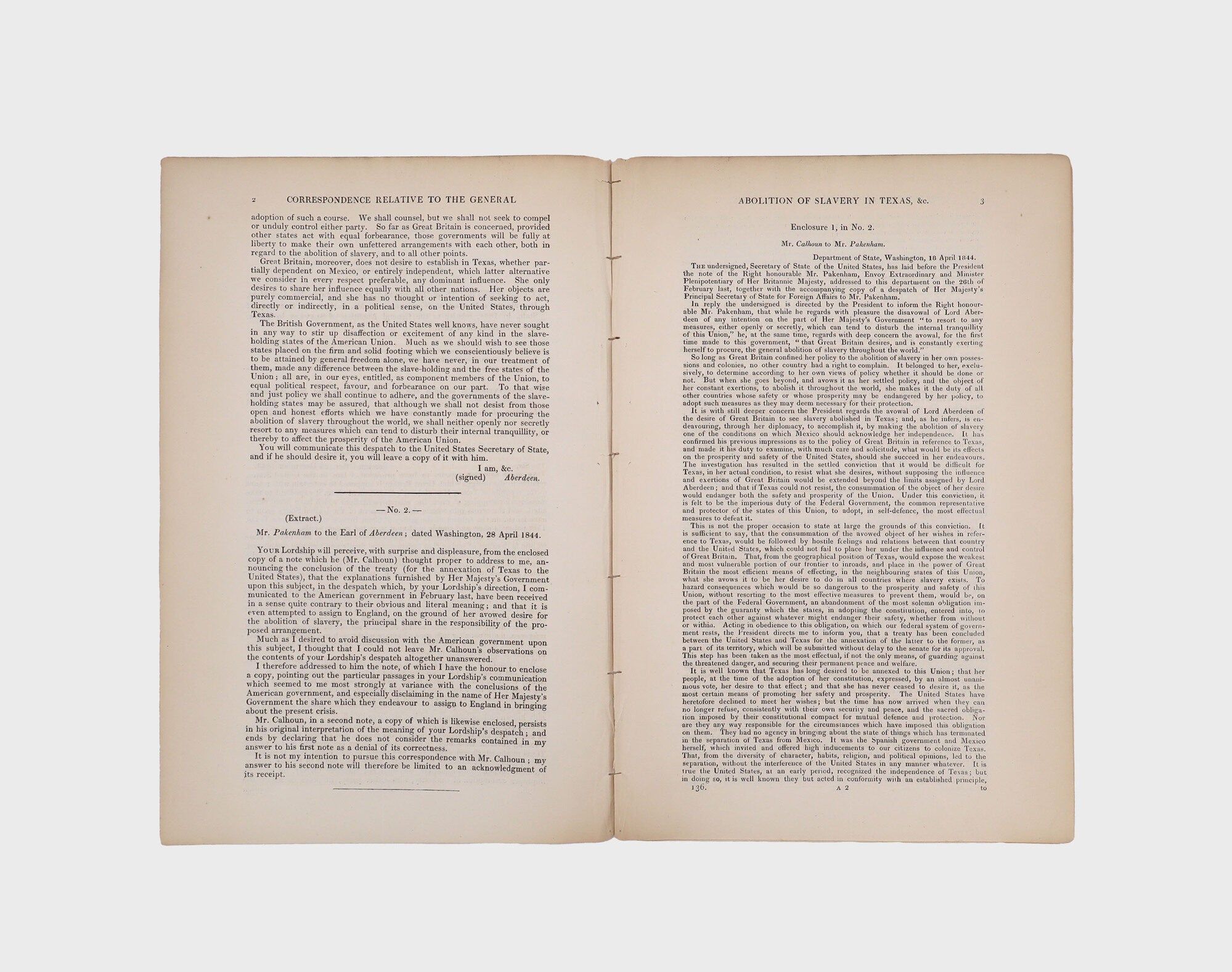
The first letter is from the Earl of Aberdeen, then-Foreign Secretary, to Pakenham, who was serving as Britain's ambassador to Mexico. He remarks that "much agitation appears to have prevailed of late in the United States, relative to the designs which Great Britain is supposed to entertain with regard to the republic of Texas" and requests that Pakenham communicate Britain's position of official neutrality: "although we shall not desist from those open and honest efforts which we have constantly made for procuring the abolition of slavery throughout the world," Britain would not seek "to act, directly or indirectly, in a political sense, on the United States, through Texas."
Unfortunately for Aberdeen and Pakenham, communicating this was far more complicated than either hoped. Calhoun regarded "with deep concern the avowal, for the first time made to this government, 'that Great Britain desires, and is constantly exerting herself to procure, the general abolition of slavery throughout the world.'"
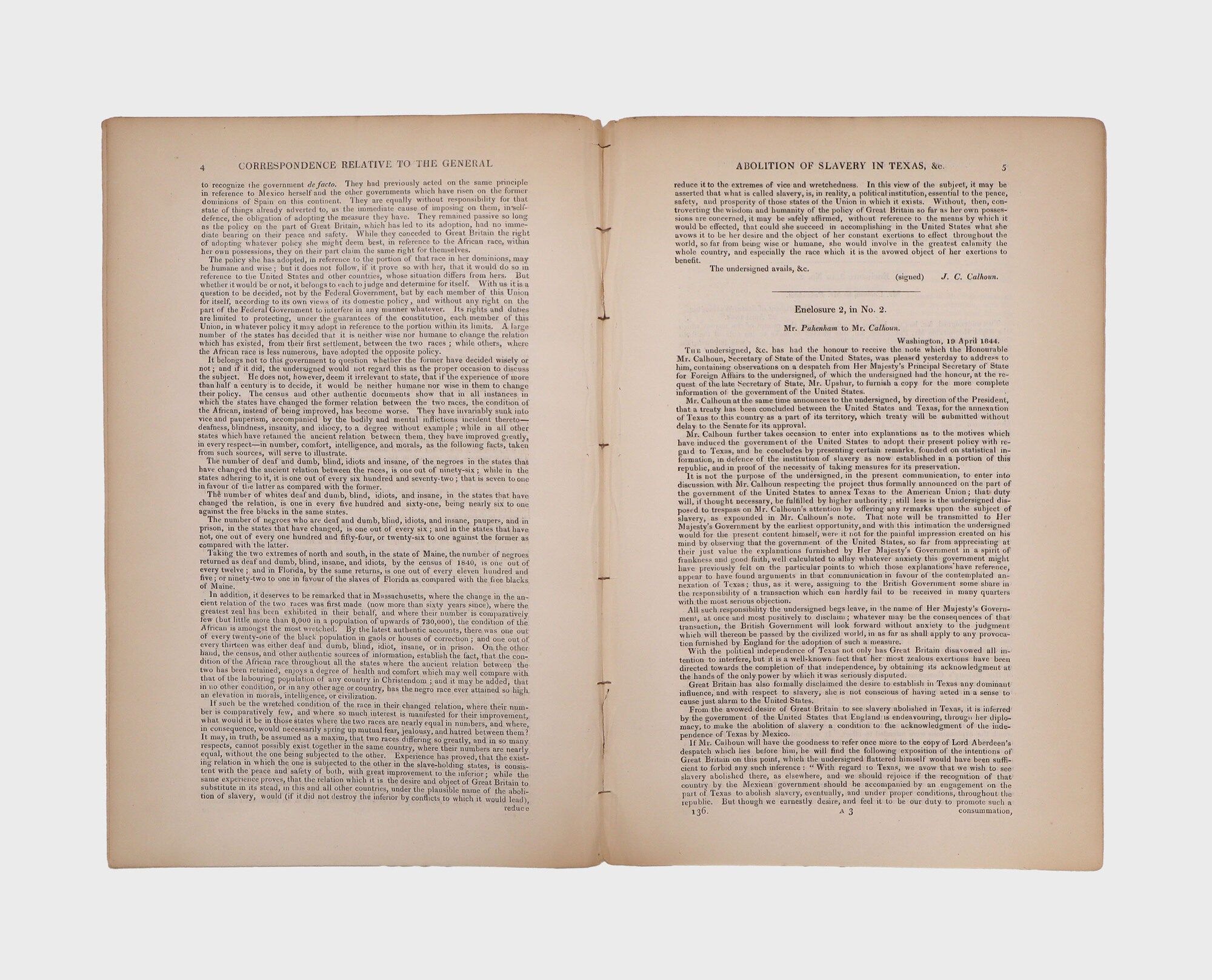
To Pakenham's "surprise and displeasure," this concern led Calhoun to embark on a full-throated defense of the principle of slavery: "It may, in truth, be assumed as a maxim, that two races differing so greatly, and in so many respects, cannot possibly exist together in the same country, where their numbers are nearly equal, without the one being subjected to the other. Experience has proved, that the existing relation...in the slave-holding states, is consistent with the peace and safety of both, with great improvement to the inferior." He provides a number of statistics to this effect and further concludes that "what is called slavery is, in reality, a political institution, essential to the peace, safety and prosperity of those states of the Union in which it exists."
OCLC locates three copies at Baylor University, Sul Ross State University (Texas), and UCLA.
The first letter is from the Earl of Aberdeen, then-Foreign Secretary, to Pakenham, who was serving as Britain's ambassador to Mexico. He remarks that "much agitation appears to have prevailed of late in the United States, relative to the designs which Great Britain is supposed to entertain with regard to the republic of Texas" and requests that Pakenham communicate Britain's position of official neutrality: "although we shall not desist from those open and honest efforts which we have constantly made for procuring the abolition of slavery throughout the world," Britain would not seek "to act, directly or indirectly, in a political sense, on the United States, through Texas."
Unfortunately for Aberdeen and Pakenham, communicating this was far more complicated than either hoped. Calhoun regarded "with deep concern the avowal, for the first time made to this government, 'that Great Britain desires, and is constantly exerting herself to procure, the general abolition of slavery throughout the world.'"
To Pakenham's "surprise and displeasure," this concern led Calhoun to embark on a full-throated defense of the principle of slavery: "It may, in truth, be assumed as a maxim, that two races differing so greatly, and in so many respects, cannot possibly exist together in the same country, where their numbers are nearly equal, without the one being subjected to the other. Experience has proved, that the existing relation...in the slave-holding states, is consistent with the peace and safety of both, with great improvement to the inferior." He provides a number of statistics to this effect and further concludes that "what is called slavery is, in reality, a political institution, essential to the peace, safety and prosperity of those states of the Union in which it exists."
OCLC locates three copies at Baylor University, Sul Ross State University (Texas), and UCLA.
Details
Title
Correspondence relative to the General Abolition of Slavery in Texas, and throughout the World; 1843-1844. (Mr. Hume.) [docket title]
Author
(Slavery)
Binding
7, [1] pp. Folio
Condition
Unknown
Publisher
Ordered, by The House of Commons, to be Printed: [London]
Date
1848