

[NIGERIAN WOMAN FABRIC ARTIST]. Batiks by Nike, Oshogbo, Nigeria
![[NIGERIAN WOMAN FABRIC ARTIST]. Batiks by Nike, Os](https://d3525k1ryd2155.cloudfront.net/h/933/054/1774054933.0.x.jpg)
- Denton, TX: Victoria Scott (P.O. Box 2955), 1981
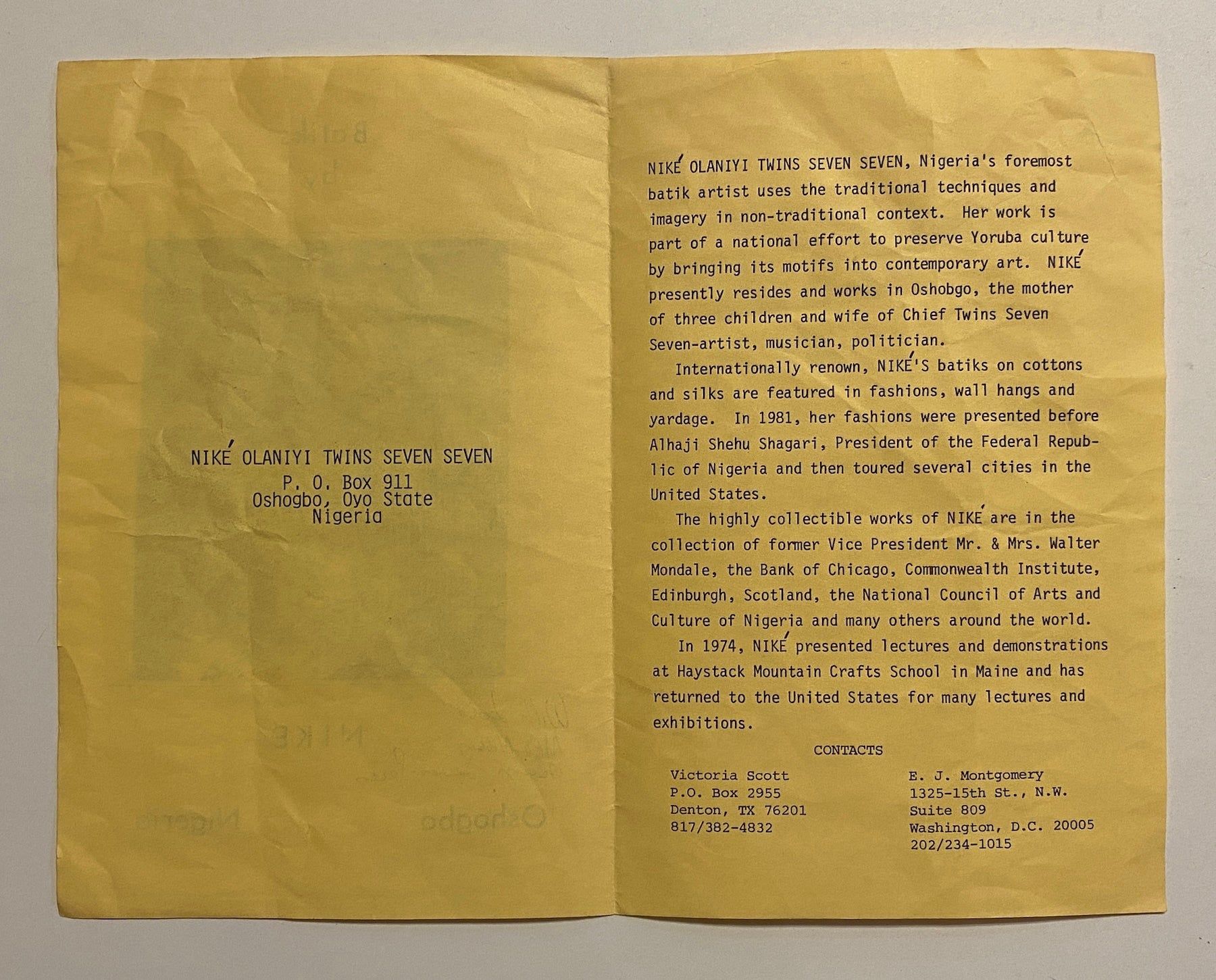
Denton, TX: Victoria Scott (P.O. Box 2955), 1981. Very good. Circular, 8.5" × S.5". Front panel signed, "with Love, Mrs. Niké Obuyi Seven Seven." Creased and a bit wrinkled, faint soiling. RARE AND EXTREMELY UNUSUAL CIRCULAR PRINTED IN DENTON, TX PROMOTING THE WORK OF A NIGERIAN WOMAN BATIK ARTIST. OURS, WHICH IS SIGNED, SEEMS TO BE THE ONLY SURVIVING EXAMPLE OF IT.
An apparently unrecorded handbill for a pioneering Nigerian cultural revivalist, documenting her attempts to promote Yoruba textile arts to Americans. It is unclear to us how, or why, the present ephemera was printed in Denton, TX. This leaflet advertises the work of "Nigeria's foremost batik artist," whose "uses the traditional techniques and imagery in non-traditional context. Her work is part of a national effort to preserve Yoruba culture by bringing its motifs into contemporary art." Nike's cotton and silk "batiks...are featured in fashions, wall hangs, and yardage."
The circular notes that in 1981, clothing made by Niké was "presented before Alhaji Shehu Shagari, President of the Federal Republic of Nigeria," before she left to tour the United States. The American collectors and institutions who appreciated Nike's work at an early stage were "Mr. & Mrs. Walter Mondale, the Bank of Chicago." In 1974, only a decade prior to this publication, Niké had "presented lectures and demonstrations at Haystack Mountain Crafts School in Maine," and had toured the United States on several occasions. Chief Nike Davies-Okundaye, referred to here as Nike Twins Seven Seven, was "born in 1951 in Ogidi-Ijumu, a small village in western Nigeria known for its spectacular rock formations and traditional art industry." She was the daughter of impoverished batik artisans, and "did not...receive any formal education in art or preparatory schooling," rather being "trained informally in the traditional crafts of her people through methods practised by women in her family for generations."
Among these crafts were "textile weaving and painting," which she developed while employed by a traveling theater that brought Niké to Nigeria's capital of Osogbo. It was here that she "first established herself as an adire" maker, that being the term for a Yoruba artist who extracts "indigo from the indigenous elu plant...followed by painting and resist-dyeing the fabric with a homemade cassava emulsion."
Niké began selling her art from her bedroom gallery in 1968, and quickly found an audience of eager American collectors who had expatriated to Africa, including "Alan Donovan...an aid worker during the Biafra War," who went on to become an acclaimed gallerist known for his collection of African art and artifacts. Through Donovan's support and her undeniable skill, Niké became one of the "first artists from Africa to travel to America in 1974."
Provenance: Pico Banerjee, to whom we are grateful for his preliminary research.
Sources Consulted: "The material of life according to textile queen Nike Davies-Okundaye" at ForbesAfrica online.
An apparently unrecorded handbill for a pioneering Nigerian cultural revivalist, documenting her attempts to promote Yoruba textile arts to Americans. It is unclear to us how, or why, the present ephemera was printed in Denton, TX. This leaflet advertises the work of "Nigeria's foremost batik artist," whose "uses the traditional techniques and imagery in non-traditional context. Her work is part of a national effort to preserve Yoruba culture by bringing its motifs into contemporary art." Nike's cotton and silk "batiks...are featured in fashions, wall hangs, and yardage."
The circular notes that in 1981, clothing made by Niké was "presented before Alhaji Shehu Shagari, President of the Federal Republic of Nigeria," before she left to tour the United States. The American collectors and institutions who appreciated Nike's work at an early stage were "Mr. & Mrs. Walter Mondale, the Bank of Chicago." In 1974, only a decade prior to this publication, Niké had "presented lectures and demonstrations at Haystack Mountain Crafts School in Maine," and had toured the United States on several occasions. Chief Nike Davies-Okundaye, referred to here as Nike Twins Seven Seven, was "born in 1951 in Ogidi-Ijumu, a small village in western Nigeria known for its spectacular rock formations and traditional art industry." She was the daughter of impoverished batik artisans, and "did not...receive any formal education in art or preparatory schooling," rather being "trained informally in the traditional crafts of her people through methods practised by women in her family for generations."
Among these crafts were "textile weaving and painting," which she developed while employed by a traveling theater that brought Niké to Nigeria's capital of Osogbo. It was here that she "first established herself as an adire" maker, that being the term for a Yoruba artist who extracts "indigo from the indigenous elu plant...followed by painting and resist-dyeing the fabric with a homemade cassava emulsion."
Niké began selling her art from her bedroom gallery in 1968, and quickly found an audience of eager American collectors who had expatriated to Africa, including "Alan Donovan...an aid worker during the Biafra War," who went on to become an acclaimed gallerist known for his collection of African art and artifacts. Through Donovan's support and her undeniable skill, Niké became one of the "first artists from Africa to travel to America in 1974."
Provenance: Pico Banerjee, to whom we are grateful for his preliminary research.
Sources Consulted: "The material of life according to textile queen Nike Davies-Okundaye" at ForbesAfrica online.
Details
Title
[NIGERIAN WOMAN FABRIC ARTIST]. Batiks by Nike, Oshogbo, Nigeria
Author
Nike (artist)
Condition
Very Good
Publisher
Victoria Scott (P.O. Box 2955): Denton, TX
Date
1981