

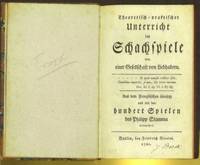
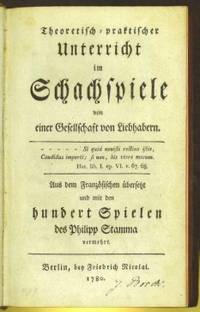
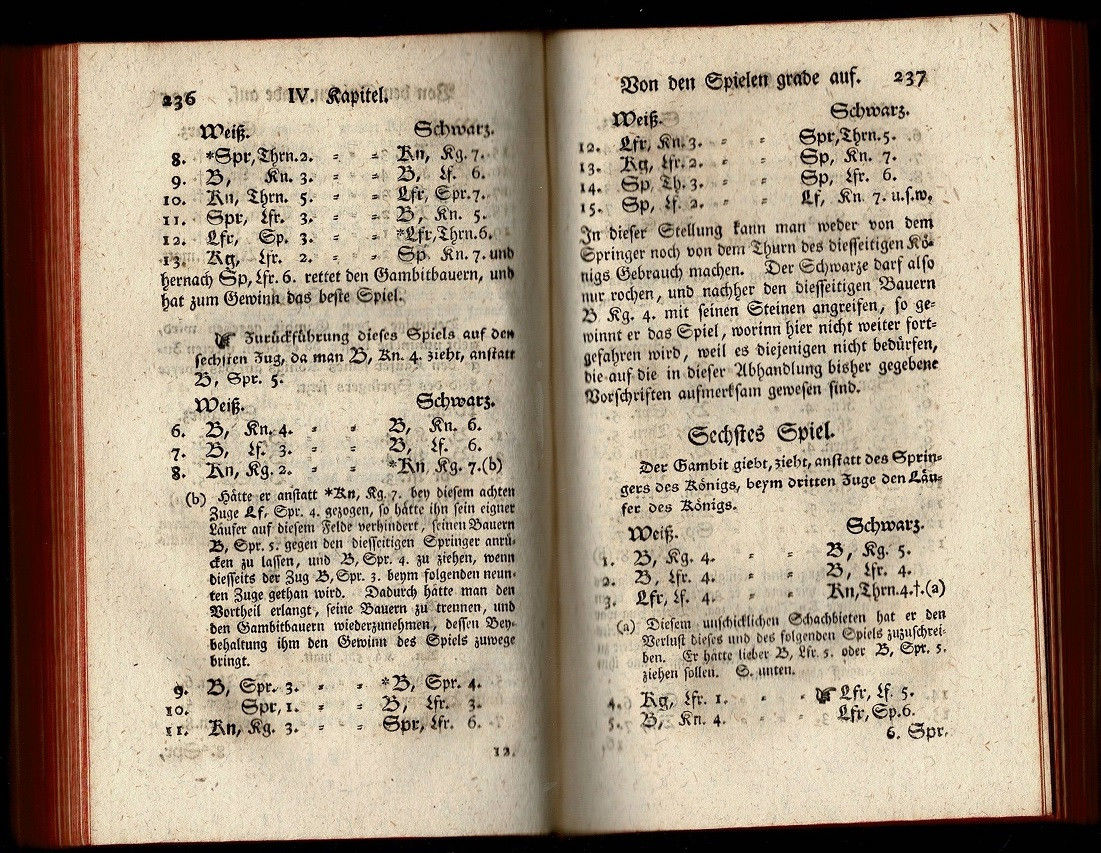
Theoretisch-praktischer Unterricht im Schachspiele von einer Gesellschaft von Liebhabern. Aus dem Französ. übersetzt und mit den hundert Spielen des Philipp Stamma vermehrt.
- Hardcover
- Berlin: Friedrich Nicolai, 1780
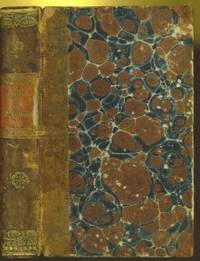
[i-viii]+430 pages. small octavo (7" x 4 1/2") bound in contemporary half leather with marbled boards. Foreword by Friedrich Nicolai, Translated by K F Trost. First published in French (Paris) in 1775 as Traite Theorique et Pratique du Jeu des Eches. From the library of Borje Borjesson. (Bibliotheca van der Linde-Niemeijeriana: 414) First German edition.
Le Traite des Amateurs is a chess treatise composed, by a "Society of Amateurs" contemporaries of Philidor; who all frequented the Cafe de la Regence, in Paris. Of these, the strongest players were Bernard, Carlier, Leger, and Verdoni. Philidor, constantly resident in London, took no part in writing the "Traite des Amateurs;" which in fact embodies many criticisms and comments upon his earlier printed book. Only four masters of the group, considered the strongest, are known: Bernard, Carlier, Leger and Verdoni. A part, partially, from Verdoni, who is the only one of the Amateurs with his own entry in the Oxford Companion to Chess, not very much is known about the life of these masters. Their first names, places and dates of birth or deaths (the year of death of Verdoni, tough, is known) are for instance unknown. They, however, appear periodically in the chess literature of the time and, consequently, it is possible to provide some details on their lives and styles. Concerning their games, several Verdoni's games are known, while only one game of Bernard and Carlier playing together and winning against Philidor, who gives to them the advantage of Pawn and Move, survived. Verdoni, Bernard, Carlier and Leger, although they didn't even approach Philidor's level, were considered the best in the world in the years following death of Philidor and, directly or indirectly (since Verdoni after the publication of Traite moved to London), have disputed each other the scepter of Philidor's successor. There are of course not records of their games and, consequently, it would be impossible for us to assess the relative strength of these player. Deschapelles, however, reported that Philidor classed Legalle as a player on even terms, Verdoni as one to receive pawn for the move, Bernard and Carlier as Pawn and move players. Bernard was probably the best chess player at the Cafe de la Regence around the end of the 18th century or at least until the arrival of Alexandre Deschapelles to the world chess scene in 1798 according to George Walker.(Murray)
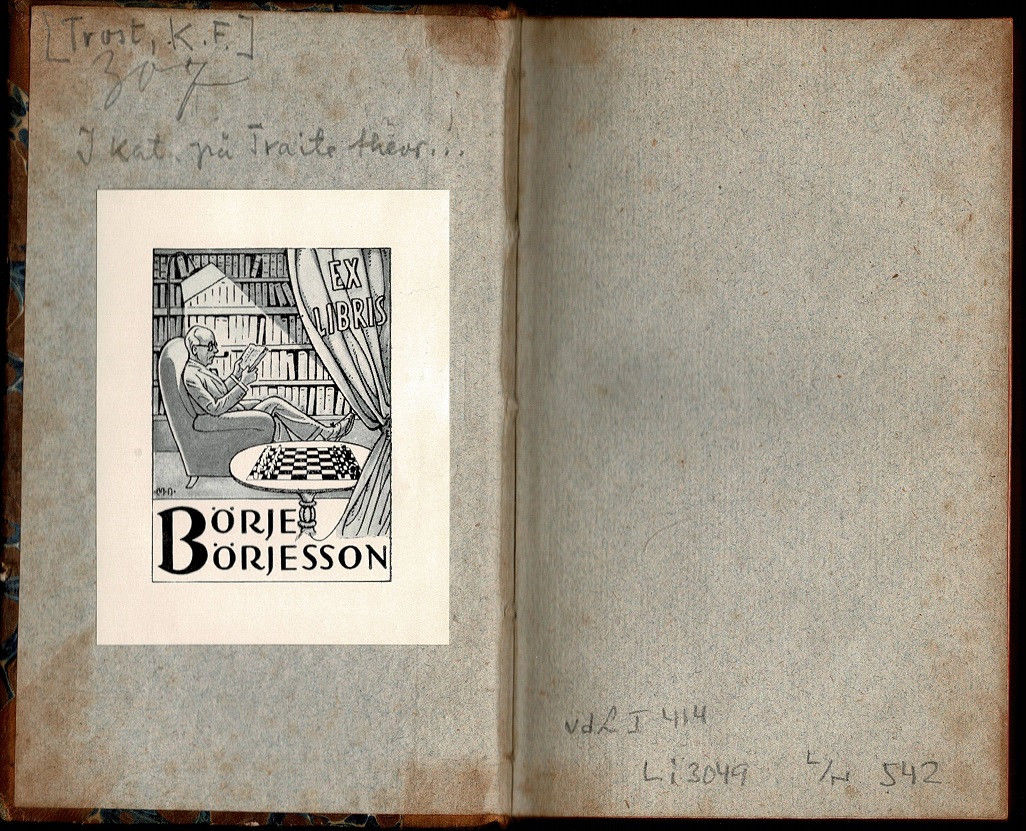
Borje Borjesson (1901-1980) was an avid chess collector and had decorative book plates designed for his collection. The article Chess Bookplates was printed in Bookplate International 1999, volume 6, Number 2 describing: "The chessboard of Borje Borjesson bookplate ranks among the luxury boards with black and gold squares as the background to some stylish chessmen. The elegant set was designed by the Swedish artist Arthur Sjogren in 1923 as seen in the book plate affixed to this copy.
Condition:
Spine ends rubbed, small crack at head and heal hinges, corners rubbed, book plate of Borje Borjesson on front paste down, old previous owner's neat name on title else about very good.
Details
Title
Theoretisch-praktischer Unterricht im Schachspiele von einer Gesellschaft von Liebhabern. Aus dem Französ. übersetzt und mit den hundert Spielen des Philipp Stamma vermehrt.
Author
Traité des Amateurs: Leger, Bernard, Carlier and Verdoni <b><font color=green>from the library of Borje Borjesson</b></font>
Binding
Hardcover
Condition
Very Good
Publisher
Friedrich Nicolai: Berlin
Date
1780
Edition
First German Edition
Size
Small octavo
Pages
B[i-viii]+430 pages