

De Natura Novi Orbis Libri duo, et de Promulgatione Evangelii, apud Barbaros, sive de Procuranda Indorum salute Libri sex

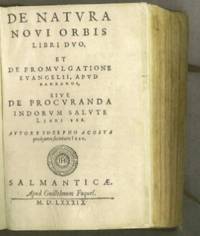
- Salamanca: Guillemun Foquel, 1589
[i-xx] [title, Dedication to Philip II, "Tassa" signed Christoual de Leon, "Erratas"]+1-640 pages [title to de Procuranda Indorum... dated 1588, Colophon dated 1588] Duodecimo (6 1/4" x 4 1/4") bound in contemporary full limp vellum with leather ties still intact. (Sabin 118) A reissue of the 1588 edition.
Jose de Acosta (September/October 1539 - February 15, 1600), was a Spanish 16th-century Jesuit missionary and naturalist in Latin America. Born at Medina del Campo in Spain, he became a novice in the Society of Jesus at the age of thirteen at the place of his birth. Four of his brothers successively joined the same order. Before leaving Spain, he was lecturer in theology at Ocana, and in April 1569, was sent to Lima, Peru, where the Jesuits had been established in the proceeding year. At Lima, Acosta again occupied the chair of theology; his fame as an orator had preceded him. In 1571 he went to Cuzco as a visitor of the college of the Jesuits then recently founded. Returning to Lima three years later, to again fill the chair of theology, he was elected provincial in 1576. He founded a number of colleges, among them those of Arequipa, Potosi, Chuquisaca, Panama and La Paz, but met with considerable opposition from the viceroy, Francisco de Toledo, Count of Oropesa. His official duties obliged him to investigate personally a very extensive range of territory, so that he acquired a practical knowledge of the vast province, and of its aboriginal inhabitants. At the provincial council of 1582, at Lima, Acosta played a very important part. Called to Spain by the King in 1585, he was detained in Mexico, where he dedicated himself to studies of the country and people; returning to Europe, he filled the chair of theology at the Roman college in 1594, as well as other important positions. At the time of his death, he was rector of the college at Salamanca. Aside from his publication of the proceedings of the provincial councils of 1567 and 1583, and several works of exclusively theological import, Acosta is best known as the writer of De Natura Novi Orbis, De promulgatione Evangelii apud Barbaros, sive De Procuranda Indorum salute and above all, the Historia natural y moral de las Indias. The first two appeared at Salamanca in 1588, the last at Seville in 1590, and soon after its publication translated into various languages. It is chiefly the Historia natural y moral that has established the reputation of Acosta. In a form more concise than that employed by his predecessors, Francisco Lopez de Gomara and Oviedo, he treated the natural and philosophic history of the New World from a broader point of view. In it, more than a century before Europeans learned of the Bering Strait, Acosta hypothesized that Latin America's indigenous peoples had migrated from Asia to Latin America. He also divided them into three barbarian categories. The Historia also described Inca and Aztec customs and history, as well as other information such as farming practices.
Condition:
iii-xvi, 639-640 pages skillfully repaired affecting some text, repaired worm hole affecting text throughout, end-papers renewed. Contemporary inscribed title to spine faded, some edge wear else a good to very good copy.
Jose de Acosta (September/October 1539 - February 15, 1600), was a Spanish 16th-century Jesuit missionary and naturalist in Latin America. Born at Medina del Campo in Spain, he became a novice in the Society of Jesus at the age of thirteen at the place of his birth. Four of his brothers successively joined the same order. Before leaving Spain, he was lecturer in theology at Ocana, and in April 1569, was sent to Lima, Peru, where the Jesuits had been established in the proceeding year. At Lima, Acosta again occupied the chair of theology; his fame as an orator had preceded him. In 1571 he went to Cuzco as a visitor of the college of the Jesuits then recently founded. Returning to Lima three years later, to again fill the chair of theology, he was elected provincial in 1576. He founded a number of colleges, among them those of Arequipa, Potosi, Chuquisaca, Panama and La Paz, but met with considerable opposition from the viceroy, Francisco de Toledo, Count of Oropesa. His official duties obliged him to investigate personally a very extensive range of territory, so that he acquired a practical knowledge of the vast province, and of its aboriginal inhabitants. At the provincial council of 1582, at Lima, Acosta played a very important part. Called to Spain by the King in 1585, he was detained in Mexico, where he dedicated himself to studies of the country and people; returning to Europe, he filled the chair of theology at the Roman college in 1594, as well as other important positions. At the time of his death, he was rector of the college at Salamanca. Aside from his publication of the proceedings of the provincial councils of 1567 and 1583, and several works of exclusively theological import, Acosta is best known as the writer of De Natura Novi Orbis, De promulgatione Evangelii apud Barbaros, sive De Procuranda Indorum salute and above all, the Historia natural y moral de las Indias. The first two appeared at Salamanca in 1588, the last at Seville in 1590, and soon after its publication translated into various languages. It is chiefly the Historia natural y moral that has established the reputation of Acosta. In a form more concise than that employed by his predecessors, Francisco Lopez de Gomara and Oviedo, he treated the natural and philosophic history of the New World from a broader point of view. In it, more than a century before Europeans learned of the Bering Strait, Acosta hypothesized that Latin America's indigenous peoples had migrated from Asia to Latin America. He also divided them into three barbarian categories. The Historia also described Inca and Aztec customs and history, as well as other information such as farming practices.
Condition:
iii-xvi, 639-640 pages skillfully repaired affecting some text, repaired worm hole affecting text throughout, end-papers renewed. Contemporary inscribed title to spine faded, some edge wear else a good to very good copy.
Details
Title
De Natura Novi Orbis Libri duo, et de Promulgatione Evangelii, apud Barbaros, sive de Procuranda Indorum salute Libri sex
Author
Acosta, Jose de (1539-1600)
Condition
Unknown
Publisher
Guillemun Foquel: Salamanca
Date
1589
Edition
Reissue
Size
Duodecimno
Pages
[i-xx] [title, Dedication to Philip II, "Tassa" signed Christoual de Leon, "Erratas"]+1-640 pages [title to de Procuranda Indoru