

La Araucana de D. Alonso de Ercilla y Zúñiga Edición del centenario, ilustrada con grabados, documentos, notas históricas y bibliográficas y una biografía del autor
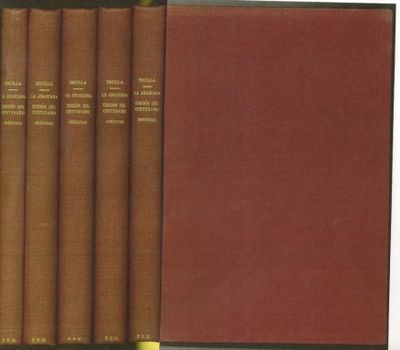
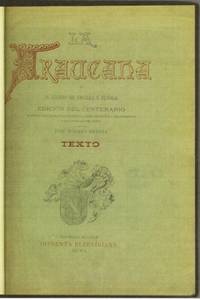
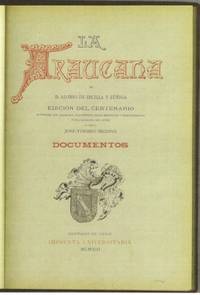
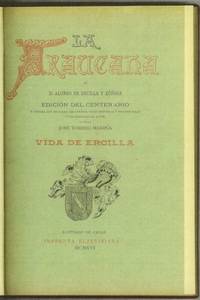
- Santiago, Chile: Imprenta elzeviriana, 1910-1918
5 volumes: volume 1 Texto: xx+607 pages with frontispiece, portraits, illustrations, facsimiles, maps and plates; volume 2 Documentos: 552 pages; volume 3 Vida de Ercilla: 337 pages with portraits, illustrations and index; volumes 4-5 Illustrations: 512 pages with facsimile titles to the first publications; 559 pages with facsimile signatures, plates and index. Folio (15" x 10 3/4") with original wrappers bound in to cloth binding. Compiled and arranged by Jose Toribio Medina. First edition.
La Araucana is an epic poem in Spanish about the Spanish conquest of Chile, by Alonso de Ercilla; it is also known in English as The Araucaniad. It was considered the national epic of the Kingdom of Chile and one of the most important works of the Spanish Golden Age (Siglo de Oro). The poem consists of 37 cantos that are distributed across the poem's three parts. The first part was published in 1569; the second part appeared in 1578, when it was published with the first part; the third part was published with the first and second parts in 1589. The poem shows Ercilla to be a master of the octava real, the complicated stanza in which many other Renaissance epics in Castilian were written. A difficult eight-line unit of 11-syllable verses that are linked by a tight rhyme scheme, the octava real was a challenge few poets met. It had been adapted from Italian only in the 16th century, and it produces resonant, serious-sounding verse that is appropriate to epic themes. The work describes the initial phase of the Arauco War which was born as a Spanish conquests attempt, not at all comparable in importance to those of Hernán Cortés, who helped conquer the Aztec empire, and Francisco Pizarro, who initiated the overthrow the Inca empire. Contrary to the epic conventions of the time, however, Ercilla placed the lesser conquests of the Spanish in Chile at the core of his poem, because the author was a participant in the conquest and the story is based on his experiences there. On scraps of paper in the lulls of fighting, Ercilla jotted down versified octaves about the events of the war and his own part in it. These stanzas he later gathered together and augmented in number to form his epic. It was the first poem of its kind written by a participant in the course of the events narrated and the first to immortalize the beginnings of a modern country. In the minds of the Chilean people La Araucana is a kind of Iliad that exalts the heroism, pride, and contempt of pain and death of the legendary Araucanian leaders and makes them national heroes today. Thus we see Ercilla appealing to the concept of the "noble savage," which has its origins in classical authors and took on a new lease of life in the renaissance - c.f. Montaigne's essay Des Canibales, and was destined to have wide literary currency in European literature two centuries later. He had, in fact, created a historical poem of the war in Chile which immediately inspired many imitations.
La Araucana is deliberately literary and includes fantastical elements reminiscent of medieval stories of chivalry. The narrator is a participant in the story, at the time a new development for Spanish literature. Influences include Orlando furioso by Ludovico Ariosto. Also features extended description of the natural landscape. La Araucana's successes—and weaknesses—as a poem stem from the uneasy coexistence of characters and situations drawn from Classical sources (primarily Virgil and Lucan, both translated into Spanish in the 16th century) and Italian Renaissance poets (Ludovico Ariosto and Torquato Tasso) with material derived from the actions of contemporary Spaniards and Araucanians. The mixture of Classical and Araucanian motifs in La Araucana often strikes the modern reader as unusual, but Ercilla's turning native peoples into ancient Greeks, Romans, or Carthaginians was a common practice of his time. For Ercilla, the Araucanians were noble and brave—only lacking, as their Classical counterparts did, the Christian faith. Caupolicán, the Indian warrior and chieftain who is the protagonist of Ercilla's poem, has a panoply of Classical heroes behind him. His valour and nobility give La Araucana grandeur, as does the poem's exaltation of the vanquished: the defeated Araucanians are the champions in this poem, which was written by one of the victors, a Spaniard. Ercilla's depiction of Caupolicán elevates La Araucana above the poem's structural defects and prosaic moments, which occur toward the end when Ercilla follows Tasso too closely and the narrative strays from the author's lived experience. Ercilla, the poet-soldier, eventually emerges as the true hero of his own poem, and he is the figure that gives the poem unity and strength. The story is considered to be the first or one of the first works of literature in the New World (cf. Cabeza de Vaca's Naufragios—Shipwrecked or Castaways) for its fantastical/religious elements, it is arguable whether that is a "traveler's account" or actual literature; and Bernal Díaz del Castillo's Historia verdadera de la conquista de Nueva España (The Conquest of New Spain). La Araucana's more dramatic moments also became a source of plays. But the Renaissance epic is not a genre that has, as a whole, endured well, and today Ercilla is little known and La Araucana is rarely read except by specialists and students of Spanish and Latin American literatures, and of course in Chile, where it is subject of special attention in the elementary schools education both in language and history. La Araucana makes Chile the only American country that was founded under the lights of an epic poem.
Condition:
Bound in red cloth with original wrappers bound in. Volume one first 15 pages closed tear at heal repaired, back page fore edge repaired. A very good set.
La Araucana is an epic poem in Spanish about the Spanish conquest of Chile, by Alonso de Ercilla; it is also known in English as The Araucaniad. It was considered the national epic of the Kingdom of Chile and one of the most important works of the Spanish Golden Age (Siglo de Oro). The poem consists of 37 cantos that are distributed across the poem's three parts. The first part was published in 1569; the second part appeared in 1578, when it was published with the first part; the third part was published with the first and second parts in 1589. The poem shows Ercilla to be a master of the octava real, the complicated stanza in which many other Renaissance epics in Castilian were written. A difficult eight-line unit of 11-syllable verses that are linked by a tight rhyme scheme, the octava real was a challenge few poets met. It had been adapted from Italian only in the 16th century, and it produces resonant, serious-sounding verse that is appropriate to epic themes. The work describes the initial phase of the Arauco War which was born as a Spanish conquests attempt, not at all comparable in importance to those of Hernán Cortés, who helped conquer the Aztec empire, and Francisco Pizarro, who initiated the overthrow the Inca empire. Contrary to the epic conventions of the time, however, Ercilla placed the lesser conquests of the Spanish in Chile at the core of his poem, because the author was a participant in the conquest and the story is based on his experiences there. On scraps of paper in the lulls of fighting, Ercilla jotted down versified octaves about the events of the war and his own part in it. These stanzas he later gathered together and augmented in number to form his epic. It was the first poem of its kind written by a participant in the course of the events narrated and the first to immortalize the beginnings of a modern country. In the minds of the Chilean people La Araucana is a kind of Iliad that exalts the heroism, pride, and contempt of pain and death of the legendary Araucanian leaders and makes them national heroes today. Thus we see Ercilla appealing to the concept of the "noble savage," which has its origins in classical authors and took on a new lease of life in the renaissance - c.f. Montaigne's essay Des Canibales, and was destined to have wide literary currency in European literature two centuries later. He had, in fact, created a historical poem of the war in Chile which immediately inspired many imitations.
La Araucana is deliberately literary and includes fantastical elements reminiscent of medieval stories of chivalry. The narrator is a participant in the story, at the time a new development for Spanish literature. Influences include Orlando furioso by Ludovico Ariosto. Also features extended description of the natural landscape. La Araucana's successes—and weaknesses—as a poem stem from the uneasy coexistence of characters and situations drawn from Classical sources (primarily Virgil and Lucan, both translated into Spanish in the 16th century) and Italian Renaissance poets (Ludovico Ariosto and Torquato Tasso) with material derived from the actions of contemporary Spaniards and Araucanians. The mixture of Classical and Araucanian motifs in La Araucana often strikes the modern reader as unusual, but Ercilla's turning native peoples into ancient Greeks, Romans, or Carthaginians was a common practice of his time. For Ercilla, the Araucanians were noble and brave—only lacking, as their Classical counterparts did, the Christian faith. Caupolicán, the Indian warrior and chieftain who is the protagonist of Ercilla's poem, has a panoply of Classical heroes behind him. His valour and nobility give La Araucana grandeur, as does the poem's exaltation of the vanquished: the defeated Araucanians are the champions in this poem, which was written by one of the victors, a Spaniard. Ercilla's depiction of Caupolicán elevates La Araucana above the poem's structural defects and prosaic moments, which occur toward the end when Ercilla follows Tasso too closely and the narrative strays from the author's lived experience. Ercilla, the poet-soldier, eventually emerges as the true hero of his own poem, and he is the figure that gives the poem unity and strength. The story is considered to be the first or one of the first works of literature in the New World (cf. Cabeza de Vaca's Naufragios—Shipwrecked or Castaways) for its fantastical/religious elements, it is arguable whether that is a "traveler's account" or actual literature; and Bernal Díaz del Castillo's Historia verdadera de la conquista de Nueva España (The Conquest of New Spain). La Araucana's more dramatic moments also became a source of plays. But the Renaissance epic is not a genre that has, as a whole, endured well, and today Ercilla is little known and La Araucana is rarely read except by specialists and students of Spanish and Latin American literatures, and of course in Chile, where it is subject of special attention in the elementary schools education both in language and history. La Araucana makes Chile the only American country that was founded under the lights of an epic poem.
Condition:
Bound in red cloth with original wrappers bound in. Volume one first 15 pages closed tear at heal repaired, back page fore edge repaired. A very good set.
Details
Title
La Araucana de D. Alonso de Ercilla y Zúñiga Edición del centenario, ilustrada con grabados, documentos, notas históricas y bibliográficas y una biografía del autor
Author
Ercilla y Zúñiga, Alonso de (1533–1594)
Condition
Very Good
Publisher
Imprenta elzeviriana: Santiago, Chile
Date
1910-1918
Edition
Limited
Size
Folio
Pages
5 volumes