

Dresden theater
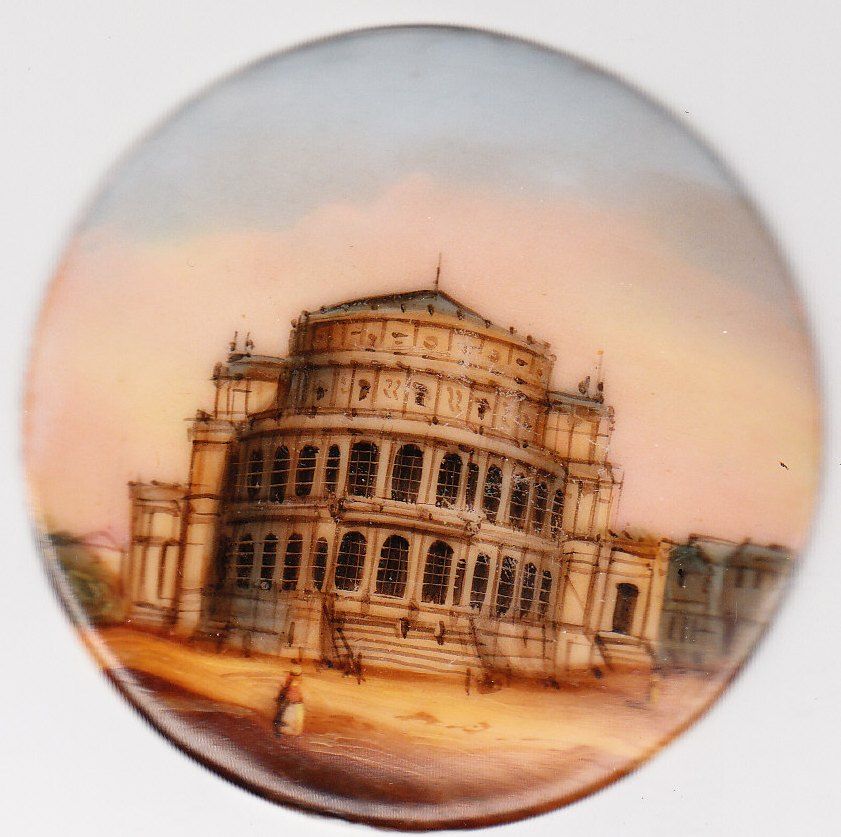
- Contemporary ebony (?) frame.
- [Dresden ?]: Not published., ca 1845
[Dresden ?]: Not published., ca 1845. Unique.. Contemporary ebony (?) frame.. Very good.. 68 mm diameter
An early painted rendering on a bisque porcelain disk of what has come to be known as the Semperoper Dresden. The building was designed by Gottfried Semper, arguably the most important German architect of the Victorian era, and opened in 1841. This was his first major building - a neo Renaissance theater with subdued ornamentation and an exterior that clearly expressed its internal spaces - and the introduction of Semper's revolutionary ideas that were, ' ... to change the course of theater design.' The Bayreuth Festspielhaus was the last expression of these design concepts. Semper was the original architect but was dismissed by Wagner before the project was complete. The Semperoper of Dresden burned to the ground in 1861.Contemporary renderings of the building are all that remain. The disk bears a contemporary identification on the back: 'Koenig Theater / zu Dresden'. It is mounted in a contemporary wooden (ebony?) frame and held in place with a stamped, gilt bezel. The verso of the frame is marked with a letter M and the number 30 impressed in the wood. As if to emphasize the revolutionary aspects of Semper's design the painter illustrated the theater building from the stage side, a unique perspective when judged by the few contemmporary illustrations of the building. Given that the Meissen works were within 25 km of Dresden one assumes the bisque porcelain disk is Meissen, but it bears none of the usual marks of the great manufactory. See Mullin, The Development of the Playhouse.
An early painted rendering on a bisque porcelain disk of what has come to be known as the Semperoper Dresden. The building was designed by Gottfried Semper, arguably the most important German architect of the Victorian era, and opened in 1841. This was his first major building - a neo Renaissance theater with subdued ornamentation and an exterior that clearly expressed its internal spaces - and the introduction of Semper's revolutionary ideas that were, ' ... to change the course of theater design.' The Bayreuth Festspielhaus was the last expression of these design concepts. Semper was the original architect but was dismissed by Wagner before the project was complete. The Semperoper of Dresden burned to the ground in 1861.Contemporary renderings of the building are all that remain. The disk bears a contemporary identification on the back: 'Koenig Theater / zu Dresden'. It is mounted in a contemporary wooden (ebony?) frame and held in place with a stamped, gilt bezel. The verso of the frame is marked with a letter M and the number 30 impressed in the wood. As if to emphasize the revolutionary aspects of Semper's design the painter illustrated the theater building from the stage side, a unique perspective when judged by the few contemmporary illustrations of the building. Given that the Meissen works were within 25 km of Dresden one assumes the bisque porcelain disk is Meissen, but it bears none of the usual marks of the great manufactory. See Mullin, The Development of the Playhouse.
Details
Title
Dresden theater
Author
[Semper, Gottffried] - THEATER - OPERA
Binding
Contemporary ebony (?) frame.
Condition
Very Good
Publisher
Not published.: [Dresden ?]
Date
ca 1845
Edition
Unique.