

THE WORKS OF MR ABRAHAM COWLEY [bound with] THE SECOND AND THIRD PARTS OF THE WORKS OF MR ABRAHAM COWLEY
![THE WORKS OF MR ABRAHAM COWLEY [bound with] THE SE](https://d3525k1ryd2155.cloudfront.net/h/956/731/940731956.0.x.jpg)
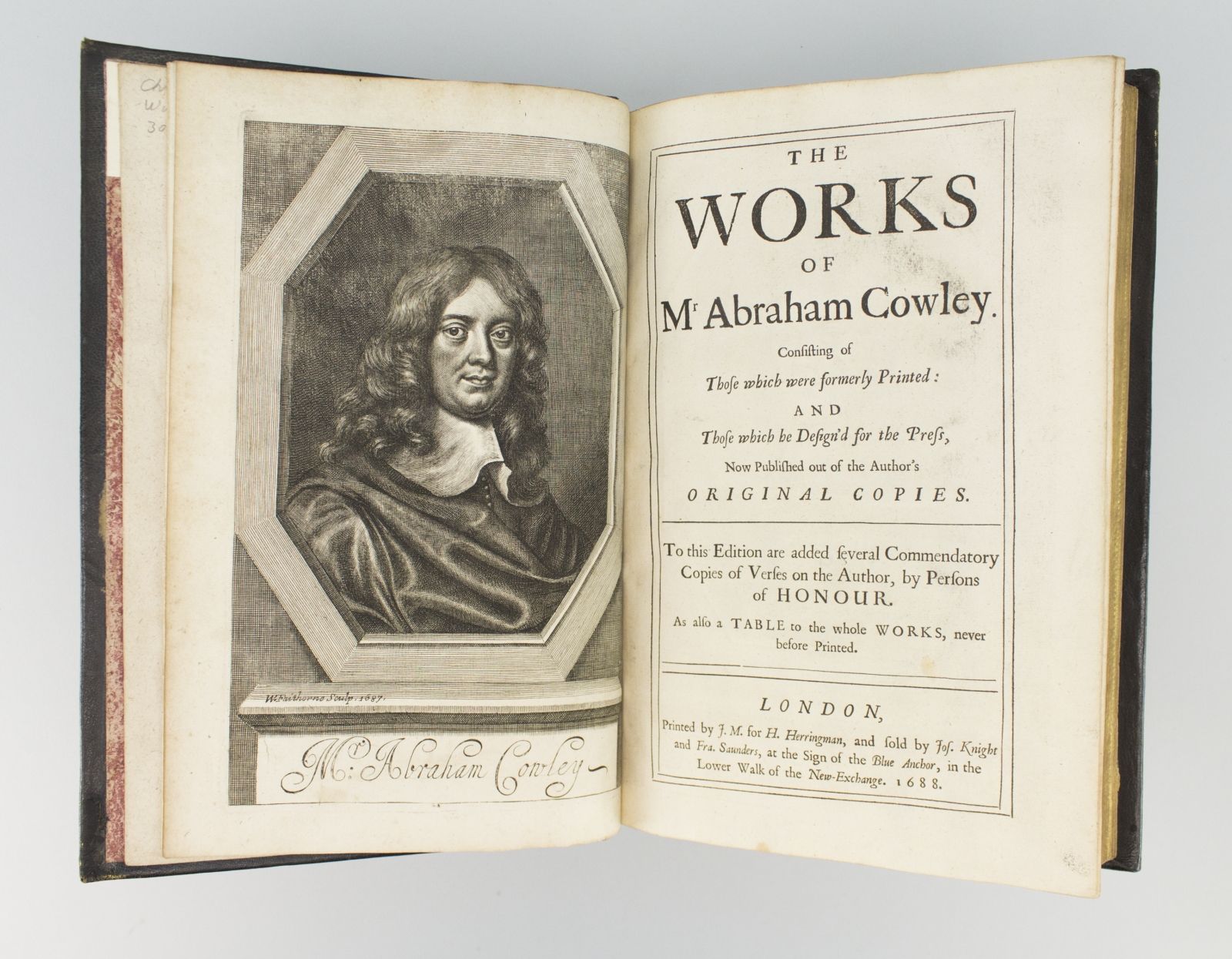
- London: J. M. for Henry Herringman; Mary Clark for Charles Harper, 1688; 1689
London: J. M. for Henry Herringman; Mary Clark for Charles Harper, 1688; 1689. FIRST EDITION of Part III. 304 x 202 mm. (12 x 8"). [58], 41, [1] (blank), 80, [4], 70 [i.e., 68], 154, 23, [1] (blank), 148; [16], 161, [21], 166 (pp. 148-9 misnumbered 140-1), [2] pp. Two works bound together in one volume..
Very attractive contemporary black morocco, handsomely gilt. Frontispiece portrait of the author. Separate title pages for each section (those in the first work dated 1687). Front pastedown with armorial bookplate of Archibald Philip, Earl of Rosebery and the book label of Lawrence Strangman, front free endpaper with bookplate of Robert S. Pirie (see below for these three). Perkin B1; Wing C-6658, C-6664B, and C-6665. One open tear just touching printed marginal notation, small hole affecting two words, light and very sparse foxing (a touch heavier on a few signatures), and some negligible spotting here and there, otherwise A VERY CLEAN AND ATTRACTIVE COPY with only the most trivial wear.
From a distinguished collection, in pleasing condition, and in a contemporaneous binding, this volume contains the works of Abraham Cowley, one of the most precocious poets in the annals of English literature. Cowley (1616-67) was producing poetic works of inexplicable sophistication before he had settled into puberty; he published his first volume of verse at 15; and he went on to become one of the most popular poets of his day. Cowley was a staunch royalist who served in the exiled court of Charles I's queen, Henrietta Maria, where he helped to encode and decipher messages sent between the monarchy's supporters, including the royal couple themselves. Despite having been arrested and imprisoned as a royalist agent at one point, Cowley escaped the Cromwell years largely unscathed and retired to the countryside in 1663. Upon his death, Cowley was not only given the extraordinary honor of burial in Westminster Abbey (noted by the DNB as "the most lavish funeral which had ever been given to a mere man of letters in England"), but was also afforded a privileged spot next to the graves of Spenser and Chaucer. Cowley's influence on contemporary poetry was demonstrably deep; his funerary monument refers to him as "the English Virgil," and Perkin asserts that his "fame as a poet exceeded even that of Milton" during the waning years of the Restoration. The first part here contains the poet's best-known mature works, while the second is composed of his early efforts, and the third his writings on plants. Our volume is from the collection of Robert S. Pirie (1934-2015), an extremely successful lawyer and investment banker who amassed the finest library of 16th and 17th century English literature in private hands during his lifetime. In 1984, he was elected one of the 40 members of the Roxburghe Club, the world's oldest society of bibliophiles. Our volume has a thrice-distinguished provenance. The first recorded owner is Archibald Philip Primrose, 5th Earl of Rosebery (1847-1929), Prime Minister of the United Kingdom during 1894-95. Earlier, he had been Foreign Secretary twice, as well as Leader of the Opposition. As stated in the British Armorial Bindings database, Rosebery was an "ardent and discriminating book collector." Afterwards the present volume became the property of Bombay-born and Cambridge-educated Lawrence Strangman (1907-80), son of Sir Thomas Strangman, Q.C., and Lady Winifred Strangman. Much of his celebrated collection went to his alma mater, Trinity Hall in the University of Cambridge, where it is maintained as the Strangman Collection in Jerwood Library, while other portions were handled by Sotheby’s. A captain in WWII, Strangman served as a distinguished Intelligence Officer. Our third recorded owner is Robert S. Pirie (1934-2015), an extremely successful lawyer and investment banker who amassed the finest library of 16th and 17th century English literature in private hands during his lifetime. In 1984, he was elected one of the 40 members of the Roxburghe Club, the world’s oldest society of bibliophiles..
Very attractive contemporary black morocco, handsomely gilt. Frontispiece portrait of the author. Separate title pages for each section (those in the first work dated 1687). Front pastedown with armorial bookplate of Archibald Philip, Earl of Rosebery and the book label of Lawrence Strangman, front free endpaper with bookplate of Robert S. Pirie (see below for these three). Perkin B1; Wing C-6658, C-6664B, and C-6665. One open tear just touching printed marginal notation, small hole affecting two words, light and very sparse foxing (a touch heavier on a few signatures), and some negligible spotting here and there, otherwise A VERY CLEAN AND ATTRACTIVE COPY with only the most trivial wear.
From a distinguished collection, in pleasing condition, and in a contemporaneous binding, this volume contains the works of Abraham Cowley, one of the most precocious poets in the annals of English literature. Cowley (1616-67) was producing poetic works of inexplicable sophistication before he had settled into puberty; he published his first volume of verse at 15; and he went on to become one of the most popular poets of his day. Cowley was a staunch royalist who served in the exiled court of Charles I's queen, Henrietta Maria, where he helped to encode and decipher messages sent between the monarchy's supporters, including the royal couple themselves. Despite having been arrested and imprisoned as a royalist agent at one point, Cowley escaped the Cromwell years largely unscathed and retired to the countryside in 1663. Upon his death, Cowley was not only given the extraordinary honor of burial in Westminster Abbey (noted by the DNB as "the most lavish funeral which had ever been given to a mere man of letters in England"), but was also afforded a privileged spot next to the graves of Spenser and Chaucer. Cowley's influence on contemporary poetry was demonstrably deep; his funerary monument refers to him as "the English Virgil," and Perkin asserts that his "fame as a poet exceeded even that of Milton" during the waning years of the Restoration. The first part here contains the poet's best-known mature works, while the second is composed of his early efforts, and the third his writings on plants. Our volume is from the collection of Robert S. Pirie (1934-2015), an extremely successful lawyer and investment banker who amassed the finest library of 16th and 17th century English literature in private hands during his lifetime. In 1984, he was elected one of the 40 members of the Roxburghe Club, the world's oldest society of bibliophiles. Our volume has a thrice-distinguished provenance. The first recorded owner is Archibald Philip Primrose, 5th Earl of Rosebery (1847-1929), Prime Minister of the United Kingdom during 1894-95. Earlier, he had been Foreign Secretary twice, as well as Leader of the Opposition. As stated in the British Armorial Bindings database, Rosebery was an "ardent and discriminating book collector." Afterwards the present volume became the property of Bombay-born and Cambridge-educated Lawrence Strangman (1907-80), son of Sir Thomas Strangman, Q.C., and Lady Winifred Strangman. Much of his celebrated collection went to his alma mater, Trinity Hall in the University of Cambridge, where it is maintained as the Strangman Collection in Jerwood Library, while other portions were handled by Sotheby’s. A captain in WWII, Strangman served as a distinguished Intelligence Officer. Our third recorded owner is Robert S. Pirie (1934-2015), an extremely successful lawyer and investment banker who amassed the finest library of 16th and 17th century English literature in private hands during his lifetime. In 1984, he was elected one of the 40 members of the Roxburghe Club, the world’s oldest society of bibliophiles..
Details
Title
THE WORKS OF MR ABRAHAM COWLEY [bound with] THE SECOND AND THIRD PARTS OF THE WORKS OF MR ABRAHAM COWLEY
Author
COWLEY, ABRAHAM
Condition
Unknown
Publisher
J. M. for Henry Herringman; Mary Clark for Charles Harper: London
Date
1688; 1689
Edition
FIRST EDITION of Part III