

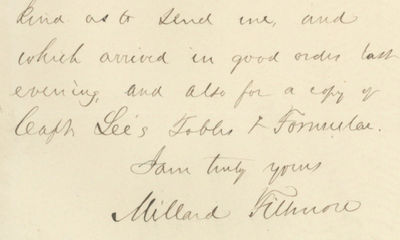
Millard Fillmore, Collector of Maps, Thanks the Head of the Corps of Topographical Engineers for Sending Him New Charts and a Collection of Tables Useful in Surveying and the Projection of Maps
by Millard Fillmore
07/10/1853. The Army Corps of Topographical Engineers was responsible for mapping and engineering, and for the design and construction of federal civil works such as lighthouses and other coastal fortifications and navigational routes. Members included such officers as George G. Meade and John C. Fremont. Col. John James Abert was a U.S. Army officer who headed the Corps for 32 years, during which time he supervised many early national engineering projects. He also organized the mapping of the American... Read More
Offered by The Raab Collection, LLC
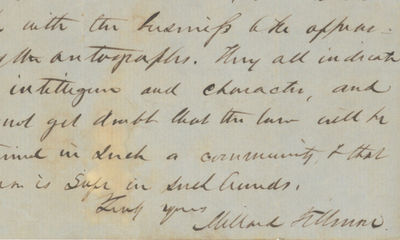
President Millard Fillmore Writes Daniel Webster on the Compromise of 1850
by Millard Fillmore
19/12/1850. The annexation of Texas to the United States and the gain of immense new lands at the close of the Mexican War in 1848 brought to a flaming pitch the hostility between North and South concerning the extension of slavery into the territories. With the North strongly opposing the extension, the South demanded guarantees of an equal position for slavery, as well as the more active execution of fugitive slave laws. There were threats that unless the southern... Read More
Offered by The Raab Collection, LLC
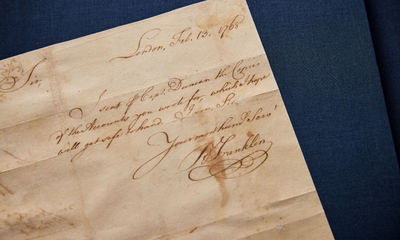
"B. Free Franklin,"" An American Emblem of Defiance and Patriotism: Benjamin Franklin Works to Negotiate the Treaty of Ft. Stanwix After Pontiac's Rebellion
by Benjamin Franklin
13/02/1768. We are not aware of any other ""B Free Franklin"" signature in private hands still attached to the autograph letter it accompanied This letter belonged to the Townsend family, an early American merchant family. ""I am fascinated by Franklin’s use of the moniker, 'B. Free Franklin.' He was brilliant and defiant all in the same breath,"" writes presidential descendant Massee McKinleyhttps://vimeo.com/1012298456?share=copy The British victory in the French and Indian War resulted in the ejection of the French from lands presently part... Read More
Offered by The Raab Collection, LLC

Benjamin Franklin, the Day Before News of Saratoga Arrives in France, Works to Secure Clandestine Supplies and Troops for the American Cause
by Benjamin Franklin
03/12/1777. This was an important moment in the relations between the two countries and the story of the American Revolution Franklin's efforts resulted in an agreement in France just 7 days after news of Saratoga had reached Passy, the first such agreement in Europe after the great victory changed the face of the Revolutionhttps://vimeo.com/913107222?share=copy Provenance: Historical Society of PennsylvaniaWhen news reached France of the Declaration of Independence of the thirteen colonies, it was perceived by many as the incarnation of the... Read More
Offered by The Raab Collection, LLC
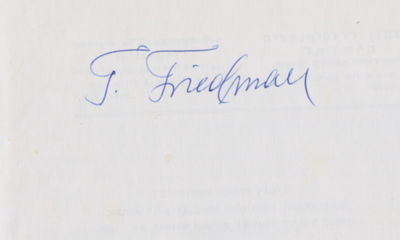
Tuviah Friedman - Renowned Nazi Hunter and Yad Vashem Director: His Personal, Signed Account of His Audacious Letter to Adolf Eichmann, Seeking Evidence to Convict Former Nazis in Germany; with Eichmann’s Original Manuscript Response to Friedman, One of Enormous Historical Importance in the History of the Holocaust
by Tuviah Friedman
29/01/1962. He also discusses who issued the deportation orders, the Nazi apparatus and chains of command, etc. The letter of Eichmann, from Friedman’s files, is still present This very letter of Eichmann helped Friedman have three Gestapo officers arrested and imprisonedThe name Tuviah Friedman is synonymous with the appellation ""Nazi hunter."" Friedman was born in Radom, Poland, and passed away in January 2011 at the age of 89. In the spring of 1941, along with the rest of Radom's Jewish population,... Read More
Offered by The Raab Collection, LLC
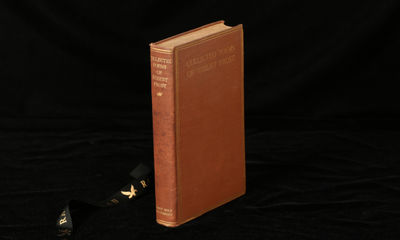
Robert Frost Signs His Collected Works, Penning an Iconic Line From One of His Great Poems: ""We have ideas yet that we haven't tried""
by Robert Frost
1930. Robert Frost is perhaps the most popular and critically respected American poets of the twentieth century, authoring such memorable poems as Stopping by Woods on a Snowy Evening, Fire and Ice, and The Road Not Taken. He was honored frequently during his lifetime, receiving four Pulitzer Prizes for Poetry, an extraordinary achievement. According to “Contemporary Literary Criticism”, Frost became one of America’s rare “public literary figures, almost an artistic institution.” He was awarded the Congressional Gold Medal in... Read More
Offered by The Raab Collection, LLC
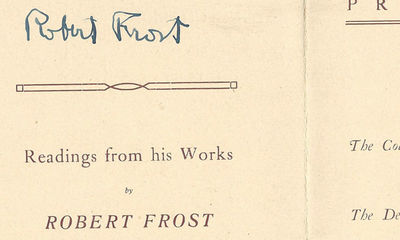
Signed Program From One of Robert Frost’s First Public Readings
by Robert Frost
19/11/1915. From his landmark year of 1915, what his biographer calls his first year of triumphRobert Frost was an English teacher at Pinkerton Academy in New Hampshire from 1906 to 1911. It was here that he developed the poetic voice which later won him the Pulitzer Prize for poetry four times, and world fame as one of America’s foremost poets. Frost’s residence while teaching at Pinkerton - Derry Farm - is now a state museum.Frost’s time at Pinkerton was... Read More
Offered by The Raab Collection, LLC
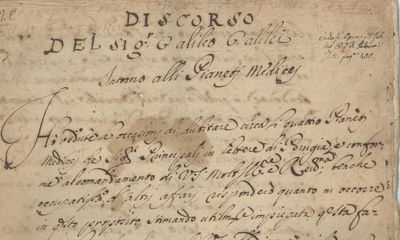
Galileo's Letter to the Vatican in Defense of His Astronomical Work, a Copy Created During the Banishment of his Work
by Galileo Galilei
01/01/1700. An anonymous copy, almost certainly written at a time when only manuscript copies were being circulated, late 17th century to early 18th centuryIn 1610, Galileo published his Sidereus Nuncius (Starry Messenger), describing the observations that he had made with his new, much stronger telescope, amongst them, the Galilean moons of Jupiter. With these observations and additional observations that followed, such as the phases of Venus, he promoted the heliocentric theory of Nicolaus Copernicus published in De revolutionibus orbium... Read More
Offered by The Raab Collection, LLC
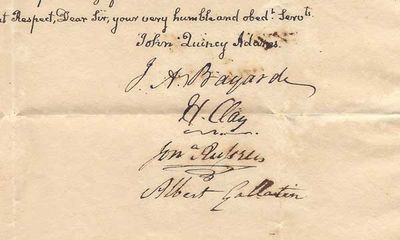
An Important Diplomatic Communique Written and Signed by John Quincy Adams, as well as Henry Clay, Albert Gallatin, Jonathan Russell, and James Bayard
by John Q. Adams|Henry Clay|Jonathan Russell|Albert Gallatin
02/12/1814. On August 8, 1814, talks began at Ghent, Belgium, that would ultimately result in a treaty ending the War of 1812. The head of the American negotiating team was John Quincy Adams, the U.S.’s most experienced diplomat. The four men who served with him were carefully selected by President Madison to reflect the varieties of political sentiment in the United States. Foremost among them was Henry Clay, Speaker of the House of Representatives, and a noted War Hawk.... Read More
Offered by The Raab Collection, LLC
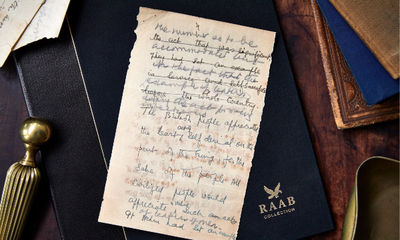
The Last Thing the Revered Mahatma Gandhi Ever Wrote Known to Be in Private Hands
by Mahatma Gandhi
22/01/1948. This fragment states that “leaders doing the [right thing] was proving infectious”Mahatma Gandhi was assassinated on January 30, 1948. Gandhi had been an astute political campaigner who fought for and won Indian independence from British rule, and championed the rights of the Indian poor. His example of non-violent protest set the example for Martin Luther King and others, and is still revered throughout the world today.Gandhi’s biography states: “He stopped at the thresholds of the huts of the... Read More
Offered by The Raab Collection, LLC

Gandhi Aims to Advise a Nurse Who Wanted to Help the Poor and Underprivileged and Aid in Their Medical Care
by Mahatma Gandhi
20/12/1927. “I cannot think of anything better than that you should attach yourself to some hospital where you could easily come in contact with those whom you have in view.” This letter links Gandhi's lifelong interest in medical care with his desire to improve the lot of average citizensThough Gandhi’s role and contributions to the political arena are well known, what is less known is his contributions towards health. Not many people are aware that he was interested in studying... Read More
Offered by The Raab Collection, LLC
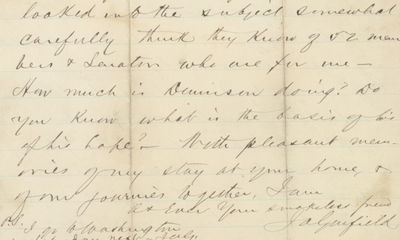
James A. Garfield Electioneering: ""Our victories have justified our fondest hopes and now I believe that 1880 is within our grasp if we act wisely""
by James A. Garfield
10/11/1879. He would get elected to the Senate seat, but before he could take that seat, he was elected presidentIn 1879, James A. Garfield had been in the House of Representatives for nearly 16 years, and he emerged as the primary Republican voice in the House against Democrats who attempted to attach riders to appropriations bills to eliminate oversight of federal elections in the South. Moreover, his powerful March 29, 1879, speech defending federalism unified the Republican party, securing... Read More
Offered by The Raab Collection, LLC
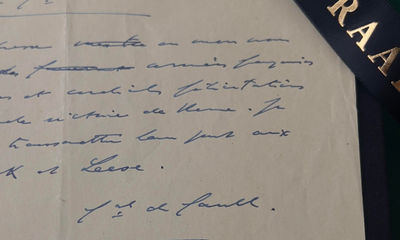
Charles DeGaulle, Leader of the Free French, Sends the Gratitude of the French People to Allied Commander in Italy General Harold Alexander on the Taking of Rome
by Charles de Gaulle
Jun-44. ALSs of DeGaulle from during World War II are extremely rare, this being our first everThe Allies’ northward advance up the Italian peninsula to Rome was an important part of the plan to create a southern front and draw German troops to Italy to oppose them, even as the landing on D-Day approached. This would also liberate portions of Italy, and make the reclamation of France all the more likely. To bypass the German line in their way,... Read More
Offered by The Raab Collection, LLC
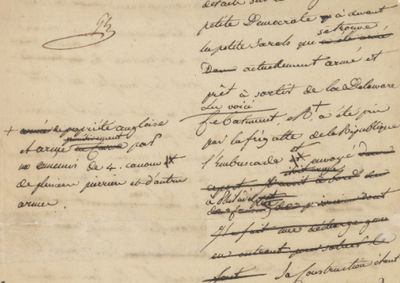
The Original Memo, Prepared by Citizen Genet at the Direct Request of Thomas Jefferson, Presented to President Washington, In One of America's First Major Foreign Policy Crises
by Edmond-Charles Genêt
09/07/1793. Following the execution of King Louis XVI and Marie Antoinette in January 1793, the French revolutionary government found itself at war with Spain, the Netherlands and Great Britain. It dispatched Edmond Charles Genêt as minister to the United States, for the purpose of enlisting American assistance to the fullest extent possible. Genêt arrived in Charleston, South Carolina on April 8, 1793 – calling himself “Citizen Genêt” to emphasize the revolutionary title. He received a warm welcome and immediately... Read More
Offered by The Raab Collection, LLC
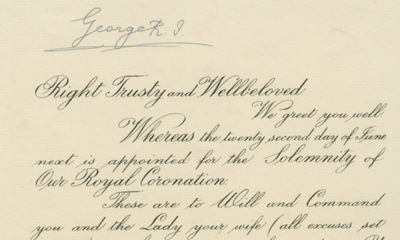
An Invitation to the Coronation of King George V, Signed by Him
by George V
24/05/1911. Very uncommon, the first such invitation we have hadThe Edwardian Age - the years of the reign of King Edward VII - lasted from 1901-1910. It was a romantic golden age of long summer afternoons and garden parties, basking in a sun that never set on the British Empire. Britannia ruled the waves, and the carnage of World War I was unimaginable and still in the future. Rapid industrialization increased economic opportunity, creating conditions that allowed for more... Read More
Offered by The Raab Collection, LLC
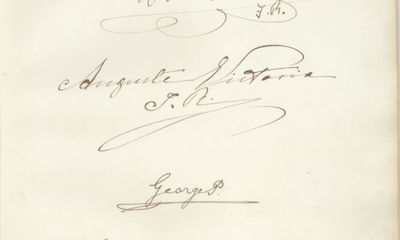
Family and Foe of World War I: An Album Leaf Signed by Royal leaders Kaiser Wilhelm II of Germany and His First Cousin King George V of Britain
by George V
1/1/07. An extraordinary rarity, this is the first time we have ever seen on one sheet the signatures of these two leaders in World War I along with their QueensWorld War One was a war not merely of nations, but also one within a family. Britain and Germany may have been swept up in jingoistic fervor against one another, but what’s often forgotten is that the British monarch at the time, King George V, was the first cousin of... Read More
Offered by The Raab Collection, LLC
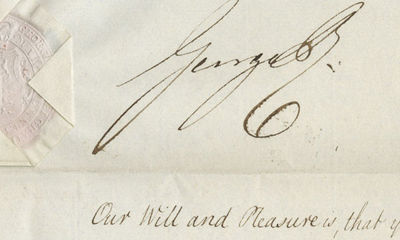
The Last Act of the Napoleonic Wars: Approving the End of the Allied Occupation of France After the Napoleonic Wars, King George IV Consents to a State’s Accession to the Convention of Aix-la-Chapelle, Which Ended That Occupation
by George IV
31/12/1820. It also permits the free city of Frankfort to join the European community established by the ConventionThe Napoleonic Wars, which lasted well over two decades, completely disrupted Europe. By its close, France, led by Napoleon, had conquered (at one time or another) much of the continent, and spread its influence pervasively throughout. Virtually no aspect of life in Europe was unaffected. On March 31, 1814, the Allied forces entered Paris, compelling Napoleon to abdicate. The Treaty of Paris,... Read More
Offered by The Raab Collection, LLC
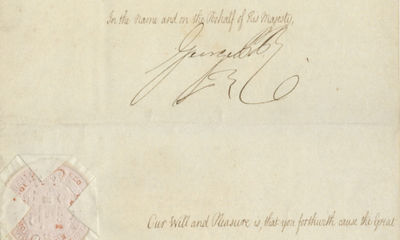
An Auxiliary Agreement to the Congress of Vienna Treaty, Which Sought to End Napoleon's Rule, Signed by King George IV
by George IV
16/12/1816. By 1792 the French Revolution was in the hands of its radicals and the other governments in Europe were convinced they had to intervene to prevent its spread. They invaded France, thus commencing a war that would not end for well over two decades. By its close, France, led by Napoleon, had conquered (at one time or another) much of the continent, and spread its influence pervasively throughout. Virtually no aspect of life in Europe was unaffected by... Read More
Offered by The Raab Collection, LLC
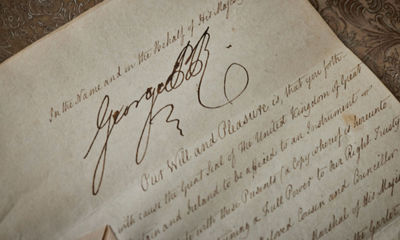
The Original Appointment of the Duke of Wellington to Negotiate at the Congress of Vienna, Which Established the European Balance of Power for a Century, Signed by Future King George IV
by George IV
18/01/1815. By 1792 the French Revolution was in the hands of its radicals, and the other governments in Europe were convinced they had to intervene to prevent its spread. They invaded France, thus commencing a war that would not end for well over two decades. By its close, France, led by Napoleon, had conquered (at one time or another) much of the continent, and spread its influence pervasively throughout. Virtually no aspect of life in Europe was unaffected by... Read More
Offered by The Raab Collection, LLC
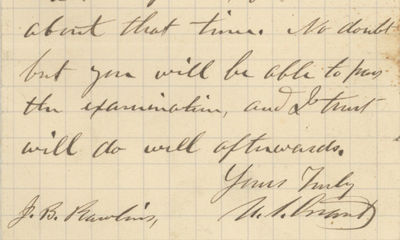
Just Days After Announcing He Would Not Seek a 3rd Term, President Ulysses S. Grant Writes the Son of His Confidant and Longtime Aide, John Rawlins, Wishing Him Luck on the West Point Graduation Examination
by Ulysses S. Grant
05/06/1875. An uncommon handwritten letter as President, showing Grant supporting Rawlins son after the General's deathUlysses S. Grant met John Rawlins in Galena, Ill., where they both lived before the Civil War. Rawlins was a lawyer who did work for the Grant family business and the two men became close. When Grant was appointed brigadier general in August 1861, he immediately added Rawlins onto his staff as adjutant; Rawlins effectively acted as Grant’s chief of staff for the rest... Read More
Offered by The Raab Collection, LLC
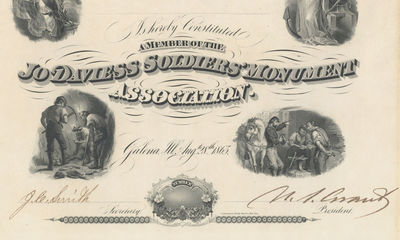
A Decorative Soldiers Monument Association Membership Certificate, with Vignettes of Lincoln, Flags, and Soldiers, Signed by U.S. Grant as Association President
by Ulysses S. Grant
28/08/1865. Ulysses S. Grant was living in Galena, Illinois when the Civil War broke out. The Civil War won, on August 18, 1865, Galena celebrated Grant’s heroic return. Following a jubilant procession with much flag waving and speeches, a group of Galena citizens presented the General with a handsome furnished house on Bouthillier Street. Today the house is managed by the Illinois Historic Preservation Agency as the U.S. Grant Home State Historic Site.The Soldiers Monument Association was a group... Read More
Offered by The Raab Collection, LLC
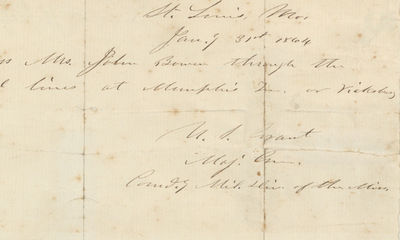
Maj. Gen. Ulysses S. Grant Gives a Pass Through the Union Lines, Likely for the Wife of His Respected Adversary at Vicksburg, Conf. General John Bowen
by Ulysses S. Grant
31/01/1864. Written by Grant while on a visit to his family in St. Louis, as he awaited his promotion to Lieutenant GeneralHis great victory at the Battle of Chattanooga in November 1863 made Major General Ulysses S. Grant the most prominent Union general. Soon legislation would be introduced in Congress to revive the rank of Lieutenant General—previously held only by George Washington and Winfield Scott—specifically to give Grant command of all Union armies. This Congress did on February 29,... Read More
Offered by The Raab Collection, LLC

President Ulysses S. Grant Nominates the Chief Justice of the Dakota Territory
by Ulysses S. Grant
06/04/1869. The Dakota Territory was created by an Act of Congress on March 2, 1861. Boundaries of the Dakota Territory changed on a number of occasions. Originally, the territory comprised an area that included the present states of North Dakota, South Dakota, and much of Montana and Wyoming. From 1863 to 1864, the area of the territory was limited to the present day Dakotas. The territory included most of the present state of Wyoming and the Dakotas from 1864... Read More
Offered by The Raab Collection, LLC
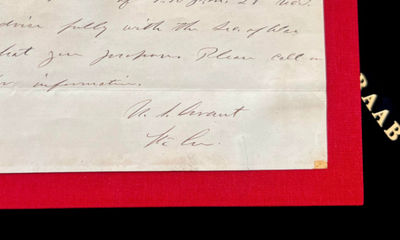
At President Lincoln's Urging, General U.S. Grant Prepares to Take Fort Fisher, Key to Union Successes at the End of the War
by Ulysses S. Grant
30/12/1864. Welles had written at the President's suggestion: ""The largest naval force ever assembled is ready""Fort Fisher guarded the port of Wilmington, NC, the last port open to blockade runners supplying Robert E. Lee’s Confederate forces in Virginia As 1864 dawned, Wilmington, North Carolina, protected by Fort Fisher, was one of the Confederacy’s last remaining major ports on the Atlantic open to blockade runners, and was the chief supply line for General Robert E. Lee’s Army of Northern Virginia. Navy... Read More
Offered by The Raab Collection, LLC

The Civil War Won, General Ulysses S. Grant Praises Union Troops for Saving the Union
by Ulysses S. Grant
06/06/1865. He is confident that “the men will do me the justice to believe that all my sympathies are with them.”Ulysses S. Grant, through his intelligence, determination, iron will, and patriotism, was the military man most responsible for leading the United States through the greatest time of crisis and chaos in the nation’s history. As general of the Army during the Civil War, he commanded hundreds of thousands of soldiers, leading the Union Army to victory over the Confederacy.... Read More
Offered by The Raab Collection, LLC