

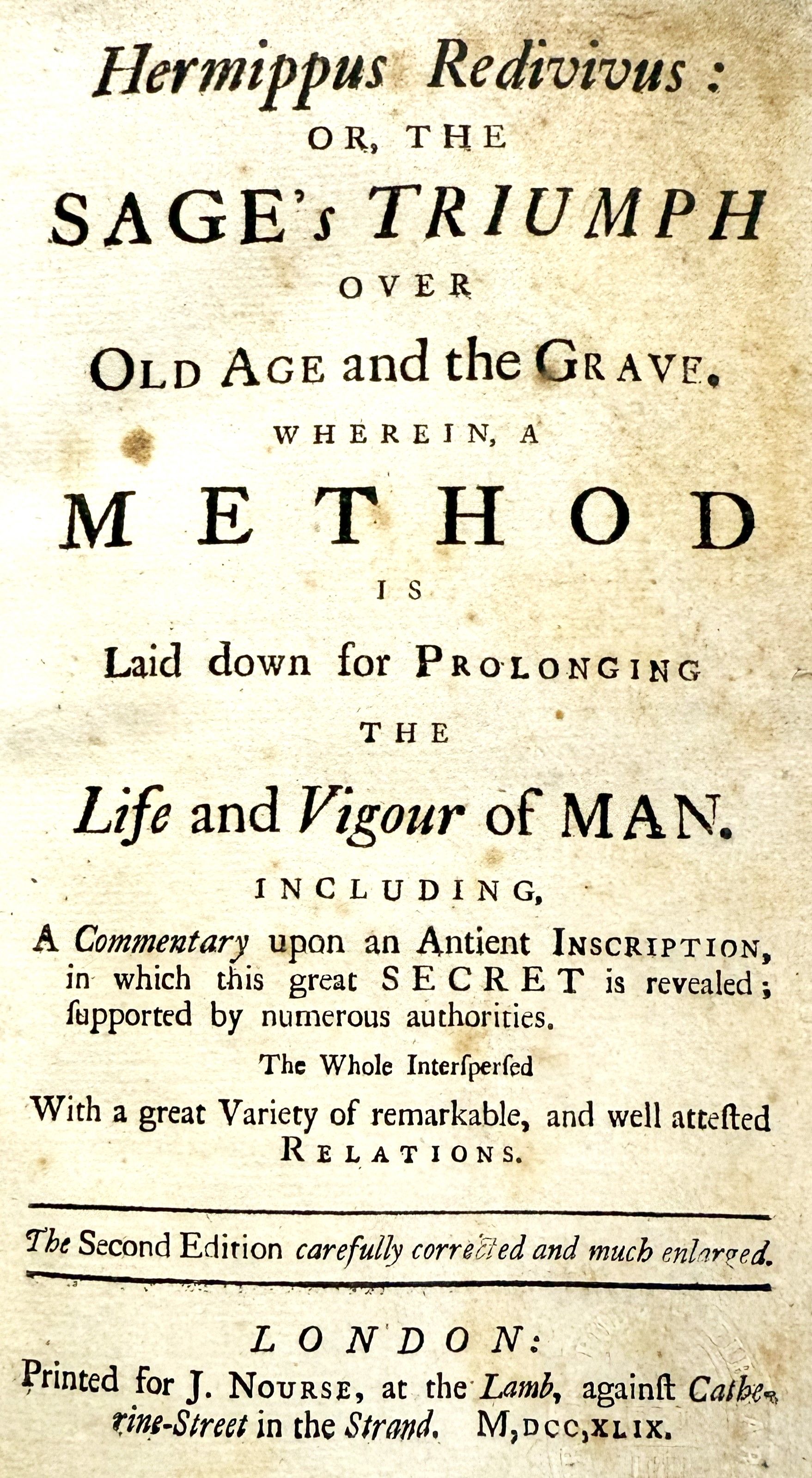
Hermippus redivivus, or the sage’s triumph over old age and the grave. Wherein a method is laid down for prolonging the life and vigour of man. Including a commentary upon an antient inscription, in which this great secret is revealed; supported by numerous authorities. The whole interpreted with a great variety of remarkable, and well attested relations
- London: J. Nourse, 1749
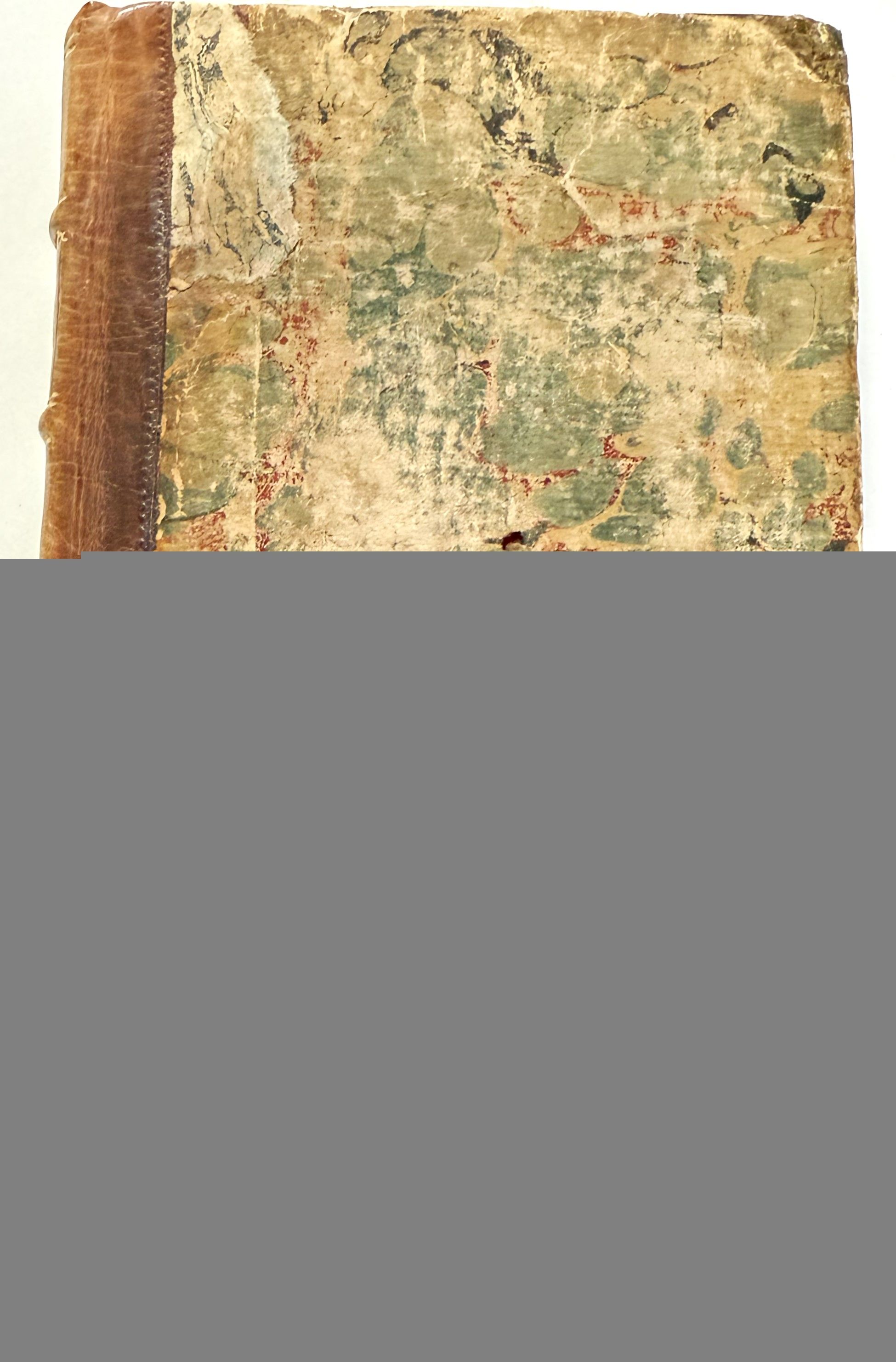
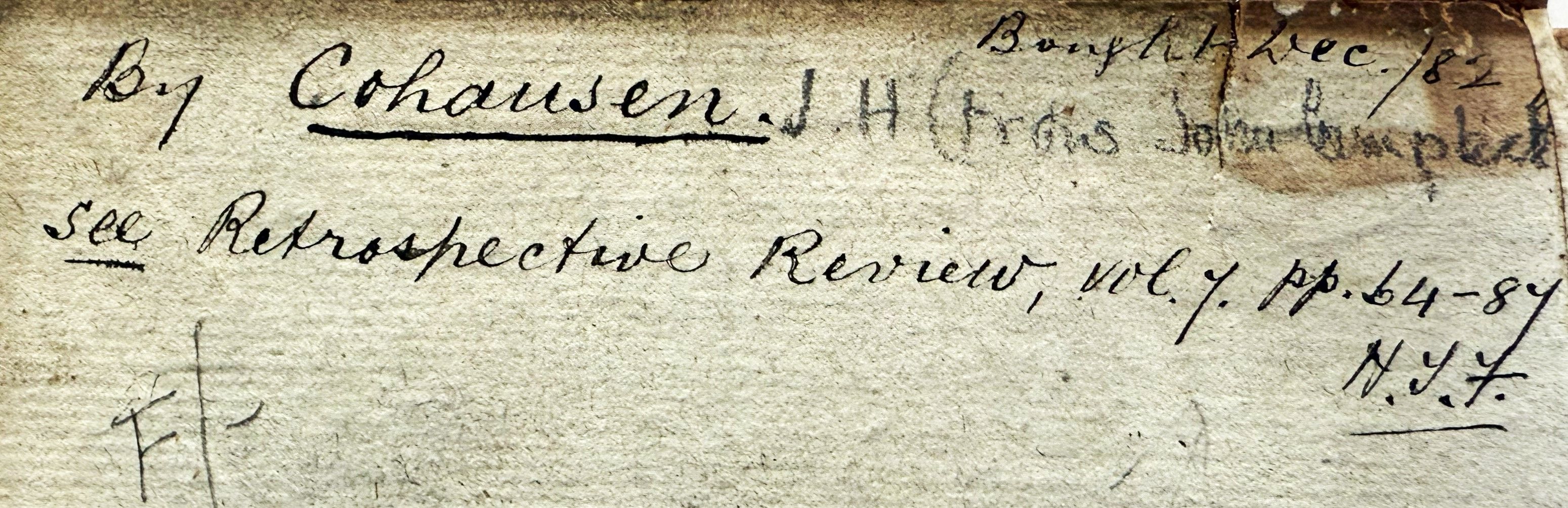
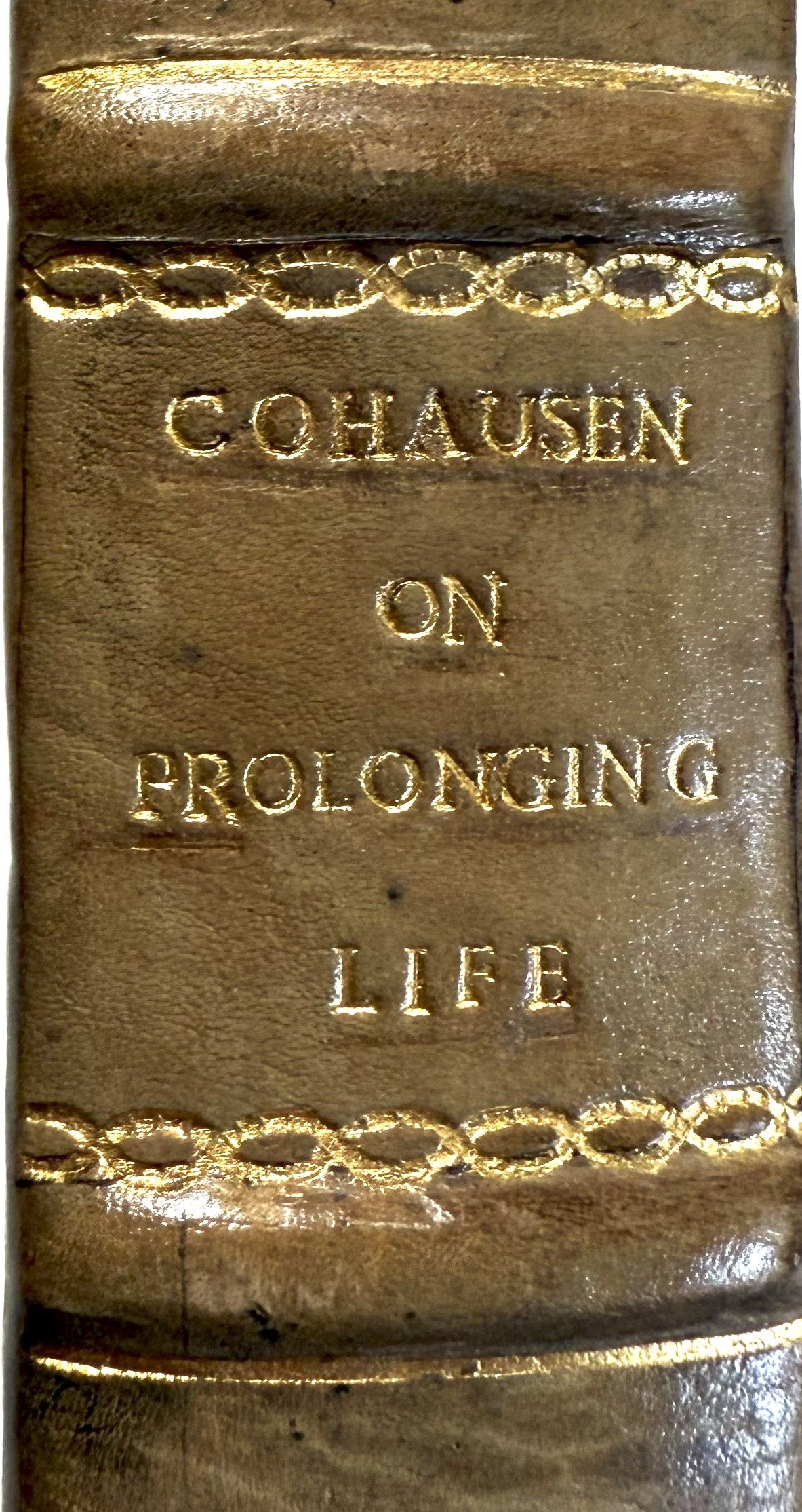
London: J. Nourse, 1749. SECOND EDITION IN ENGLISH. Woodcut headpiece and initial. Contemporary marbled boards, rebacked, spine in compartments with author and title in gilt. An excellent copy. Second edition, revised and enlarged by the addition of new material expanding it by 80 pages from the first printing in 1742. “A curious and rare book, according to which human life could be prolonged beyond normal limits, by a sort of elegant vampirism which combines with the most scientific conclusions. Hermeticism occupies a large place in this work which also contains astonishing revelations on Nicolas Flamel who, according to the author, was still alive in his time” (Caillet), as well as other Hermetic philosophers such as Basil Valentine, Thomas Vaughan, Raymond Lulle and Artephius. Cohausen maintained he possessed the formula for prolonging old age through at least 115 years.
“Cohausen admitted at the end of the Hermippus that he wrote it in a humorous vein for his own enjoyment (and probably in hope of book sales), but he also knew that recently accepted medical beliefs and applications formed the basis of his work, which made his satire all the more effective. Cohausen simply modified the traditional literary conceit of satirizing the search for the philosophers’ stone with a humorous treatment of more current iatrochymical analyses of respiration and longevity, taking these ideas to outrageous conclusions. Ironically, because of Cohausen’s skilfulness in presenting medical concepts in the Hermippus, further analysis of the intellectual context of his ironic treatise also aids our understanding of early modern theories of longevity and iatrochymistry” (Roos).
This was Cohausen’s best-known work, a translation of Exercitatio physico-medica curiosa de methodo rara ad CXV annos prorogandae senectutis (1742). Cohausen (1665-1750) was a noted medical jester (in other words a writer of satirical medical material) and physician to the Bishop of Muenster. Dr. Samuel Johnson read this translation and pronounced the volume “very entertaining as an account of the hermetic philosophy and as furnishing a curious history of the extravagancies of the human mind.”
Bibliotheca Osleriana 2338; Blake 92; Caillet 2425; Lowndes 488; DNB, III 826; Roos, Johann Heinrich Cohausen (1665–1750), Salt Iatrochemistry, and Theories of Longevity in his Satire, Hermippus Redivivus (1742), Med Hist. 2007 Apr 1;51(2):181–200.
“Cohausen admitted at the end of the Hermippus that he wrote it in a humorous vein for his own enjoyment (and probably in hope of book sales), but he also knew that recently accepted medical beliefs and applications formed the basis of his work, which made his satire all the more effective. Cohausen simply modified the traditional literary conceit of satirizing the search for the philosophers’ stone with a humorous treatment of more current iatrochymical analyses of respiration and longevity, taking these ideas to outrageous conclusions. Ironically, because of Cohausen’s skilfulness in presenting medical concepts in the Hermippus, further analysis of the intellectual context of his ironic treatise also aids our understanding of early modern theories of longevity and iatrochymistry” (Roos).
This was Cohausen’s best-known work, a translation of Exercitatio physico-medica curiosa de methodo rara ad CXV annos prorogandae senectutis (1742). Cohausen (1665-1750) was a noted medical jester (in other words a writer of satirical medical material) and physician to the Bishop of Muenster. Dr. Samuel Johnson read this translation and pronounced the volume “very entertaining as an account of the hermetic philosophy and as furnishing a curious history of the extravagancies of the human mind.”
Bibliotheca Osleriana 2338; Blake 92; Caillet 2425; Lowndes 488; DNB, III 826; Roos, Johann Heinrich Cohausen (1665–1750), Salt Iatrochemistry, and Theories of Longevity in his Satire, Hermippus Redivivus (1742), Med Hist. 2007 Apr 1;51(2):181–200.
Details
Title
Hermippus redivivus, or the sage’s triumph over old age and the grave. Wherein a method is laid down for prolonging the life and vigour of man. Including a commentary upon an antient inscription, in which this great secret is revealed; supported by numerous authorities. The whole interpreted with a great variety of remarkable, and well attested relations
Author
COHAUSEN, Johann Heinricdh
Condition
Unknown
Publisher
J. Nourse: London
Date
1749
Edition
SECOND EDITION IN ENGLISH