

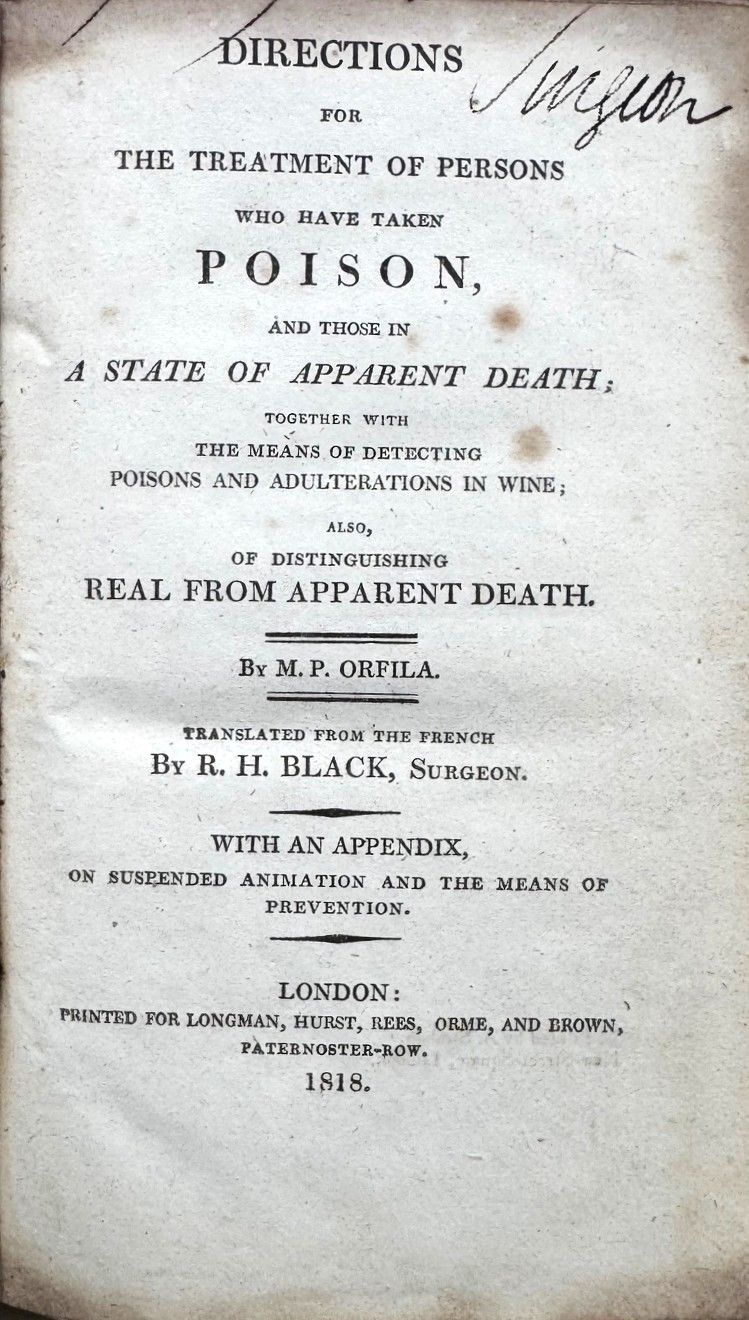
Directions for the treatment of persons who have taken poison, and those in a state of apparent death; together with the means of detecting poisons and adulterations in wine, also of distinguishing real from apparent death
- London: Longman, hurst, rees, orme, and brown, 1818
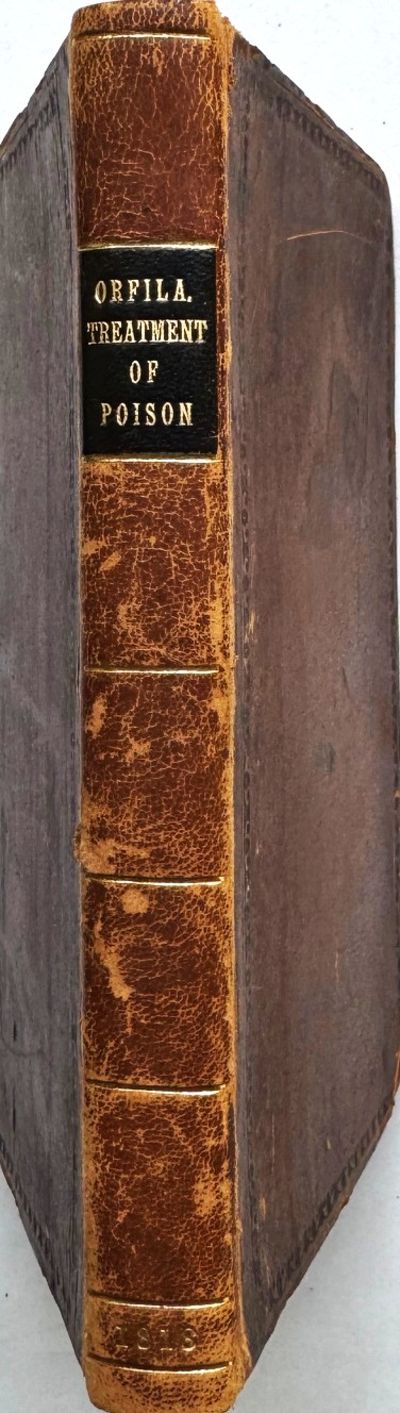
London: Longman, hurst, rees, orme, and brown, 1818. Contemporary calf, boards with blind-stamped borders, spine label; top margin trimmed, ownership signature on title page lost except for the word “surgeon,” annotations on pp. 33-34. First edition in English, translated by R.H. Black, first printed under the title Secours à donner aux personnes empoisonnées ou asphyxiées in Paris in 1816. This is a comprehensive guide on poisons and the dangers that can ensue when one is not particularly aware of their surroundings. Orfila defines poisons by dividing them into classes, and groups them among elemental acids, narcotics, tobacco and liquor, mushrooms, and putrefactive poisons from snakes, insects, tarantulas, and dolphins. Along with describing the poisons themselves, Orfila provides an education on a variety of poison-related subjects such as antidotes, signs of madness in dogs, treatment of frozen limbs, and asphyxia caused by liquor, drowning, hanging and strangulation, and how to tell if your wine has been poisoned. Tips are also provided for the prevention of the fatal effects of drinking cold water and what to do when you’ve been struck by lightning. Of particular interest is Orfila’s discussion of the means of treating infants, with descriptions of asphyxia of newborns, apoplexy of children, and how to deal with children born in a state of apparent death.
The author stresses the importance of distinguishing between those who look dead and those are actually dead. He includes precautions to be observed to avoid confounding the Dead with the Living, as well as “Directions for the treatment of persons apparently dead.”
Orfila (1787-1853) was a Spanish chemist who is considered the founder of toxicology. He pioneered the use of forensic toxicology in criminal trials. Along with being a physician in the service of King Louis XVIII and the president of the National Medical Academy of France, Orfila was also a musically trained choir singer who used his talents to strengthen his relationships and gain connections with those in high French society.
A very practical and essential guide for anyone looking to survive the dangers of being alive.
The author stresses the importance of distinguishing between those who look dead and those are actually dead. He includes precautions to be observed to avoid confounding the Dead with the Living, as well as “Directions for the treatment of persons apparently dead.”
Orfila (1787-1853) was a Spanish chemist who is considered the founder of toxicology. He pioneered the use of forensic toxicology in criminal trials. Along with being a physician in the service of King Louis XVIII and the president of the National Medical Academy of France, Orfila was also a musically trained choir singer who used his talents to strengthen his relationships and gain connections with those in high French society.
A very practical and essential guide for anyone looking to survive the dangers of being alive.
Details
Title
Directions for the treatment of persons who have taken poison, and those in a state of apparent death; together with the means of detecting poisons and adulterations in wine, also of distinguishing real from apparent death
Author
ORFILA, M. P.
Condition
Unknown
Publisher
Longman, hurst, rees, orme, and brown: London
Date
1818