

Progne, Tragedia.
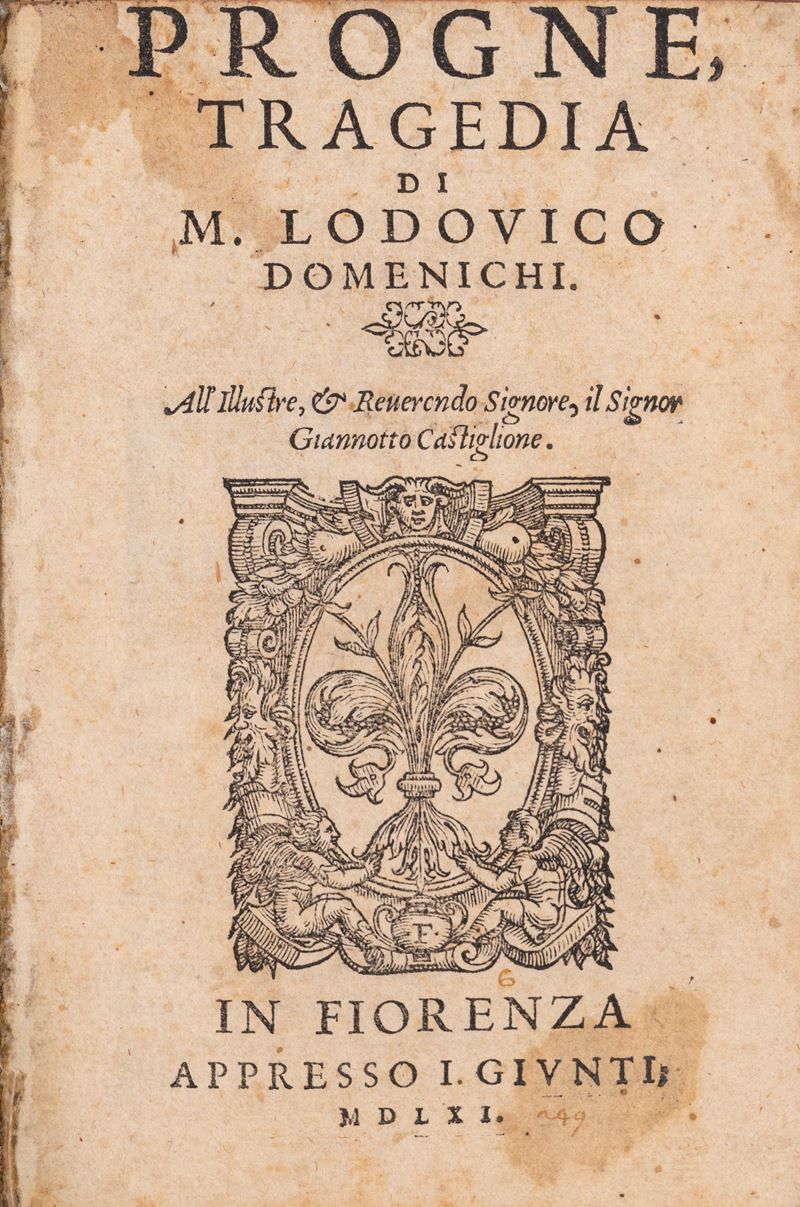
- Florence: I Giunti, 1561
Florence: I Giunti, 1561. First edition. Very Good. Octavo (15 cm); 66 pages (misnumbered 68), A-D\8 E\2 this copy LACKS final blank leaf E2. Printer's giglio device on title page, woodcut initials in text. In later (c18 or early c19) vellum over boards. Bookseller's notes in pencil on front pastedown. Traces of old tickets removed on front pastedown and front blank. First and last leaves bear some stains, while interior pages are relatively free of foxing. Extensive contemporary underlining in ink, along with occasional notes and jottings in contemporary hand in margins. A serviceable copy of a rare text.
References: Adams, D-782; Pettas, Florence, #352; Fontanini/Zeno (1753) I, p.473; Renouard, p. 273, #14; CNCE 13530.
Boredom forced Lodovico Domenichi to quit his law practice in Piacenza, as he explained in a letter to Aretino. He went to Venice to be with his old friend Doni and his new one Aretino. There he labored in the burgeoning publishing business as a "poligrafo," researching, editing, and translating texts, writing commentary, and producing original work. While setting up the text for Giolito's 1545 edition of Petrarca, Domenichi published his own book of sonnets--Petrarchan in form, but erotic in nature. With these poems, Domenichi's career as a bold non-conformist was confirmed.
In 1545, Domenichi left Venice for Florence, where Doni had set up a short-lived printing press. There he thrived as a textual editor and translator, producing texts of classical and contemporary authors for the powerful Giunti firm. The volume offered here is a vernacular adaptation of a Latin text by Gregorio Correr (d. 1464), written in the 1420s but not performed or published until 1558. Domenichi has been blamed for failing to attribute his "Progne" to Correr (see Renouard, p. 273, #14, and Zeno's note to Fontanini, I, 473), but to be fair, Correr's Latin original was published (by Paolo Manuzio) without attribution, as if an anonymous classical text. The style is Senecan, the matter taken from the episode in Ovid's Metamorphoses of Tereus, Procne, and Philomena, the mythic prototype of abusive relationships, and later a central element in Eliot's "The Wasteland."
References: Adams, D-782; Pettas, Florence, #352; Fontanini/Zeno (1753) I, p.473; Renouard, p. 273, #14; CNCE 13530.
Boredom forced Lodovico Domenichi to quit his law practice in Piacenza, as he explained in a letter to Aretino. He went to Venice to be with his old friend Doni and his new one Aretino. There he labored in the burgeoning publishing business as a "poligrafo," researching, editing, and translating texts, writing commentary, and producing original work. While setting up the text for Giolito's 1545 edition of Petrarca, Domenichi published his own book of sonnets--Petrarchan in form, but erotic in nature. With these poems, Domenichi's career as a bold non-conformist was confirmed.
In 1545, Domenichi left Venice for Florence, where Doni had set up a short-lived printing press. There he thrived as a textual editor and translator, producing texts of classical and contemporary authors for the powerful Giunti firm. The volume offered here is a vernacular adaptation of a Latin text by Gregorio Correr (d. 1464), written in the 1420s but not performed or published until 1558. Domenichi has been blamed for failing to attribute his "Progne" to Correr (see Renouard, p. 273, #14, and Zeno's note to Fontanini, I, 473), but to be fair, Correr's Latin original was published (by Paolo Manuzio) without attribution, as if an anonymous classical text. The style is Senecan, the matter taken from the episode in Ovid's Metamorphoses of Tereus, Procne, and Philomena, the mythic prototype of abusive relationships, and later a central element in Eliot's "The Wasteland."
Details
Title
Progne, Tragedia.
Author
Domenichi, Lodovico (1515-1564); Gregorio Correr.
Condition
Very Good
Publisher
I Giunti: Florence
Date
1561
Edition
First edition