

La theorie du rayonnement et les quanta... (offered with) Electrons and protons
- Paris: Gauthier-Villars, 1928
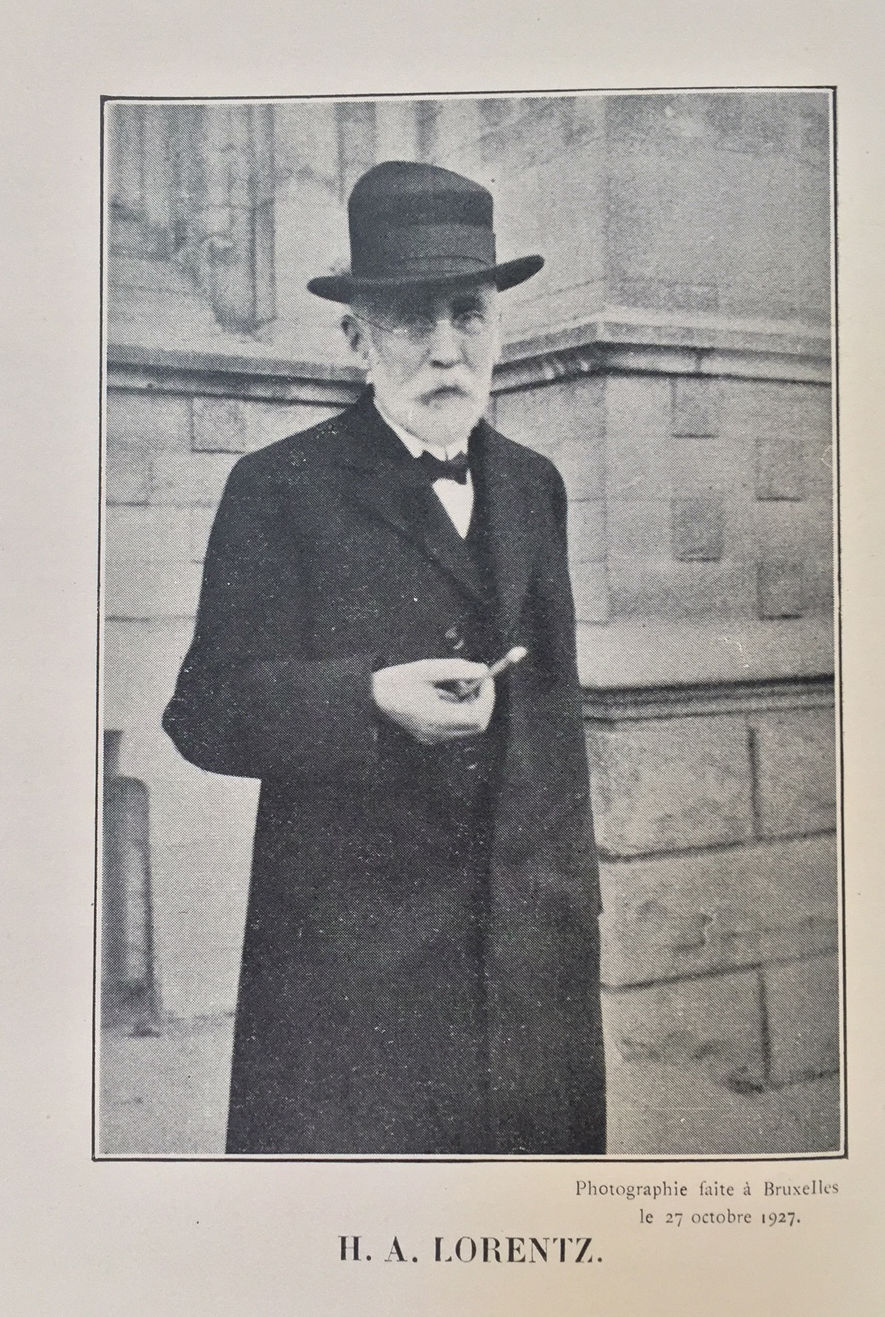
Paris: Gauthier-Villars, 1928. Both volumes with numerous text illustrations. Recent cloth. From the library of Martin J. Klein, professor of the history of science at Yale, and the first recipient of the Abraham Pais Prize for the History of Physics. I: The publication that resulted from the first Solway Conference of 1911 contains papers presented by Einstein (“L’état actuel du problème des chaleurs spécifiques; Weil, 52), Sommerfeld, Langevin, Nernst, Marie Curie, Perrin, Planck, Rubens, Warburg, Jeans and Lorentz (“Sur l’application au rayonnement du théorème de l’équipartition de l’énergie”), among others. This first conference on radiation and quanta examined applications from classical physics as well as quantum theory, and introduces a number of new concepts surrounding both theoretical and experimental work then being tested.
The Solvay Institute for Physics and Chemistry was founded by the Belgian industrialist Ernest Solvay in 1912, following the invitation-only 1911 conference which was attended by the world’s top scientists.
II: The fifth Solvay conference was perhaps the most famous, as it included luminaries such as Nobelists Einstein, Bohr, Bragg, Compton, Bohr, Dirac, Schrodinger, Curie, De Broglie and Heisenberg. Papers here include Bragg’s “L'intensité de réflexions des rayons X”; Compton’s “Discordances entre l'experience et la theorie électro-magnétique du rayonnement”; De Broglie, “La nouvelle dynamique des quanta”; Born & Heisenberg, “La mécanique des quanta”; Schrödinger, “La mécanique des ondes”; and Bohr, “Le postulat des quanta et le nouveau développement de l’atomistique”.
This was also the beginning of the Bohr-Einstein debates, a series of public disputes about quantum mechanics. Bohr proposed that wave equations described where entities like electrons could be; however the entities didn't actually exist as particles until someone went looking for them. The act of observation caused existence. In Bohr's own words, the entities in question had no "independent reality in the ordinary physical sense." Einstein of course was a bit more empirical. An electron was an electron, and just because someone wasn't looking at it, it was still there — wherever “there” happened to be (see Boyd, The Bohr-Einstein Debates, http://www.uh.edu/engines/epi2627.htm).
The Solvay Institute for Physics and Chemistry was founded by the Belgian industrialist Ernest Solvay in 1912, following the invitation-only 1911 conference which was attended by the world’s top scientists.
II: The fifth Solvay conference was perhaps the most famous, as it included luminaries such as Nobelists Einstein, Bohr, Bragg, Compton, Bohr, Dirac, Schrodinger, Curie, De Broglie and Heisenberg. Papers here include Bragg’s “L'intensité de réflexions des rayons X”; Compton’s “Discordances entre l'experience et la theorie électro-magnétique du rayonnement”; De Broglie, “La nouvelle dynamique des quanta”; Born & Heisenberg, “La mécanique des quanta”; Schrödinger, “La mécanique des ondes”; and Bohr, “Le postulat des quanta et le nouveau développement de l’atomistique”.
This was also the beginning of the Bohr-Einstein debates, a series of public disputes about quantum mechanics. Bohr proposed that wave equations described where entities like electrons could be; however the entities didn't actually exist as particles until someone went looking for them. The act of observation caused existence. In Bohr's own words, the entities in question had no "independent reality in the ordinary physical sense." Einstein of course was a bit more empirical. An electron was an electron, and just because someone wasn't looking at it, it was still there — wherever “there” happened to be (see Boyd, The Bohr-Einstein Debates, http://www.uh.edu/engines/epi2627.htm).
Details
Title
La theorie du rayonnement et les quanta... (offered with) Electrons and protons
Author
SOLVAY CONFERENCE]. LANGEVIN, BROGLIE; LORENTZ, BRAGG, ETC.
Condition
Unknown
Publisher
Gauthier-Villars: Paris
Date
1928