

Traite des causes physiques et morales du rire relativement a l’art de l’exciter
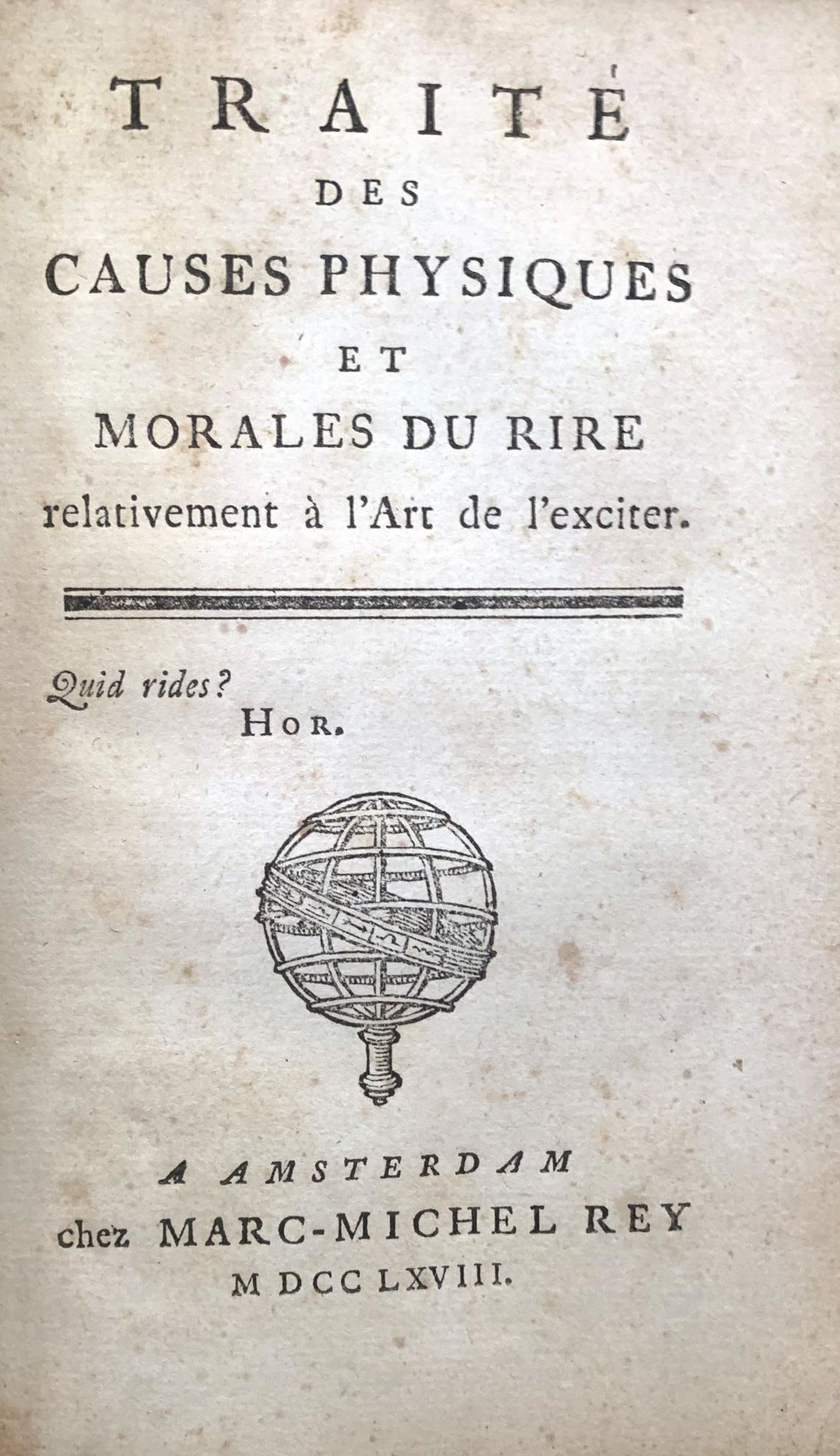
- Amsterdam: Marc-Michel Rey, 1768
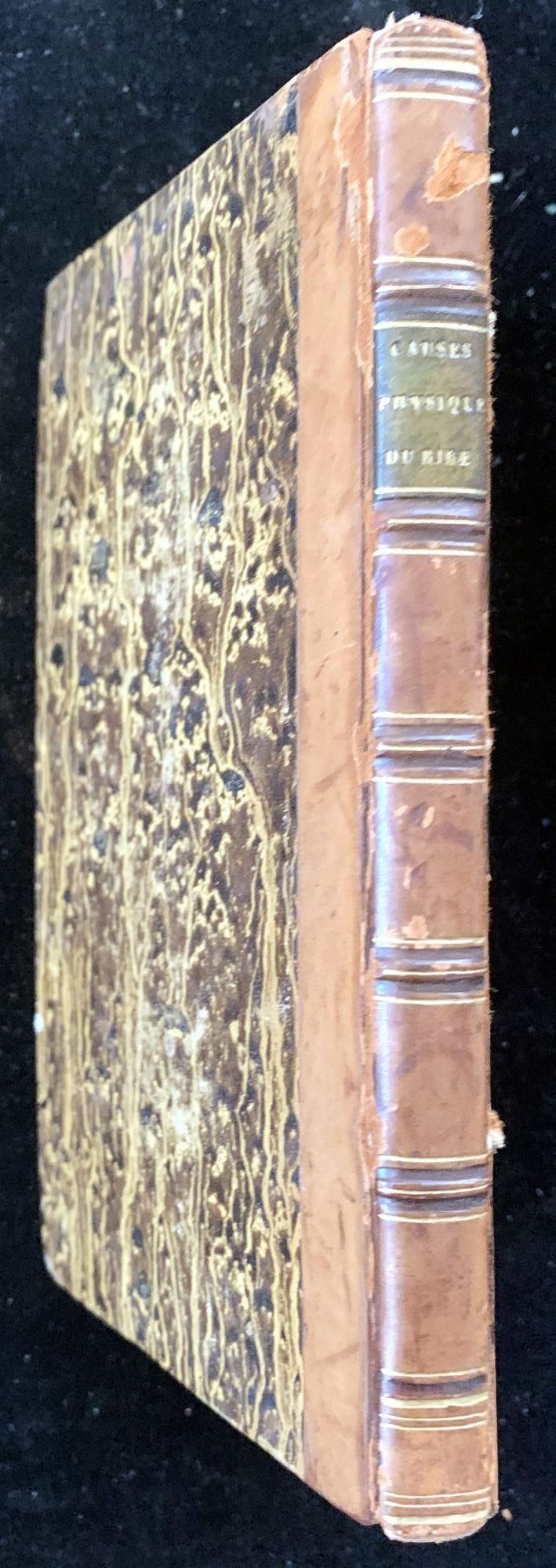
Amsterdam: Marc-Michel Rey, 1768. FIRST EDITION. Contemporary calf-backed marbled boards with bookmark ribbon. A very good copy with minor foxing. First edition of a treatise on laughter published anonymously in 1768, and translated into English the following year.
As laughter has always represented a mystery in the history of Western thought, Poinsinet de Sivry tries to find an answer to the following simple question: what makes man laugh? He starts by examining the works of the ancient Greek philosophers Socrates and Aristotle. Socrates pursues a definition of man as “ridiculous” without delving into the causes of laughter and Aristotle simply outlines what is ridiculous. The author proceeds to dissect other literary sources on the subject with a more specific focus. Using the comedies of Moliere as an example, he discusses what he considers arte the two principles of laughter, rational joy and craziness. Rational joy is based on the faculty that separates man from other animals; in fact animals feel joy but do not laugh. The principle of madness is based on the contrary argument that laughter escapes precisely when reason moves away and there is an eclipse of judgment. An important point is whether the reading of Molierre’s comedies produce a feeling of admiration and how that might related to laughter. The author concludes his work using the comic playwright Aristophane’s Plutus to analyze situations in which the causes of laughter are brought about by surprise (also confirming his love for theatre).
Poinsinet de Sivry (1733-1804), a versatile French linguist and literary scholar, philologist and dramatist, was a member of the Société Royale des Sciences & Belles-Lettres de Lorraine. After having translated in verse works of the most prominent Greek poets, he devoted himself to theater, composing tragedies such as Briseis (1759) and Ajax (1762). In his anonymous satire La Berlue (1759) Poinsinet presents his point of view and critics to contemporary behaviors.
As laughter has always represented a mystery in the history of Western thought, Poinsinet de Sivry tries to find an answer to the following simple question: what makes man laugh? He starts by examining the works of the ancient Greek philosophers Socrates and Aristotle. Socrates pursues a definition of man as “ridiculous” without delving into the causes of laughter and Aristotle simply outlines what is ridiculous. The author proceeds to dissect other literary sources on the subject with a more specific focus. Using the comedies of Moliere as an example, he discusses what he considers arte the two principles of laughter, rational joy and craziness. Rational joy is based on the faculty that separates man from other animals; in fact animals feel joy but do not laugh. The principle of madness is based on the contrary argument that laughter escapes precisely when reason moves away and there is an eclipse of judgment. An important point is whether the reading of Molierre’s comedies produce a feeling of admiration and how that might related to laughter. The author concludes his work using the comic playwright Aristophane’s Plutus to analyze situations in which the causes of laughter are brought about by surprise (also confirming his love for theatre).
Poinsinet de Sivry (1733-1804), a versatile French linguist and literary scholar, philologist and dramatist, was a member of the Société Royale des Sciences & Belles-Lettres de Lorraine. After having translated in verse works of the most prominent Greek poets, he devoted himself to theater, composing tragedies such as Briseis (1759) and Ajax (1762). In his anonymous satire La Berlue (1759) Poinsinet presents his point of view and critics to contemporary behaviors.
Details
Title
Traite des causes physiques et morales du rire relativement a l’art de l’exciter
Author
POINSINET DE SIVRY, Louis
Condition
Unknown
Publisher
Marc-Michel Rey: Amsterdam
Date
1768
Edition
FIRST EDITION