


Andrew Jackson Will See Justice Done
by Andrew Jackson
20/04/1838. Newly retired, he had sent his cotton from the Hermitage to be sold in New Orleans and had borrowed thousands of dollars against their prospective saleAlthough cotton was the sole cash crop of The Hermitage, cotton plants covered only 200 of the more than 1000 acres of the plantation. Production of any other crop was difficult due to the intense amount of labor needed to raise cotton. The perpetual process of planting, weeding then picking required by “king... Read More
Offered by The Raab Collection, LLC
Andrew Jackson, Running for President in 1824, Incurs a Debt for Supplies Used at the Hermitage
by Andrew Jackson
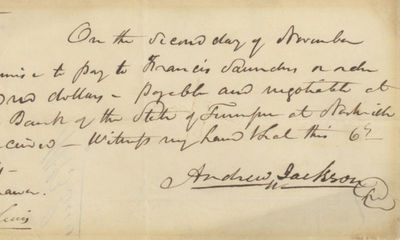
06/09/1824. Andrew Jackson bought commodities for the Hermitage from his neighbor Francis Saunders. Among these were wheat and salt. Saunders was also a court commissioner in Tennessee, so Jackson dealt with him on various legal matters as well.Autograph document signed, Tennessee, September 6, 1824, being a promissory note evidencing a debt Jackson owed Saunders. “On the second day of November next, I promise to pay to Francis Saunders or order, payable and negotiable at the Branch Bank of the... Read More
Offered by The Raab Collection, LLC
President Andrew Jackson Appoints a Hero of the Battle of New Orleans a Captain in the Navy
by Andrew Jackson
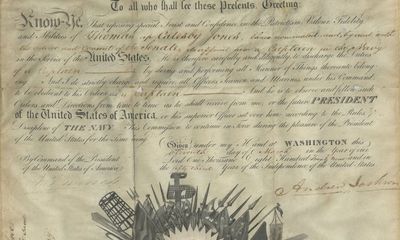
11/03/1829. Jones, as famed Captain and Commodore, also concluded a treaty with the king of Hawaii, and defended San Francisco during the Gold RushThomas ap Catesby Jones was one of the most controversial officers in the U.S. Navy during the first half of the nineteenth century. He served from 1805 until 1858. A fascinating representative of a period of tumultuous change for both the Navy and the country, he was a firebrand with a desire for reform and willingness... Read More
Offered by The Raab Collection, LLC
Thomas Jefferson, on the Eve of the Vice Presidency, Arranges to Collect Dividends from Stock Issued Under Alexander Hamilton's Fiscal Plan
by Thomas Jefferson
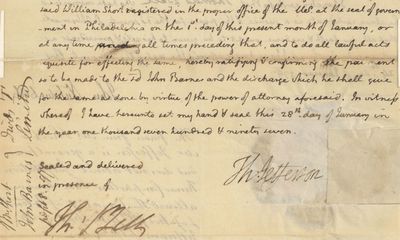
28/01/1797. One of the last acts of Jefferson’s private life before resuming high national elective office A window into the practical administration of Hamilton’s funded debt and also signed by the Chief US Comptroller at the Reserve in Philadelphia This extensive document last sold in 1976, when it was sold by legendary dealer Ralph NewmanFollowing the Revolutionary War, the new nation, its member states, and a great many of its citizens were deeply in debt. By 1790 the national debt stood... Read More
Offered by The Raab Collection, LLC
Secretary of State Thomas Jefferson’s (and George Washington's) First Formal Neutrality Instructions on the Outbreak of the French Revolutionary Wars
by Thomas Jefferson
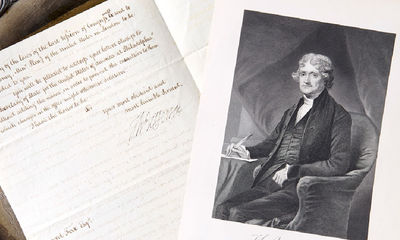
21/03/1793. In the musical Hamilton, it is depicted in the song ""Cabinet Meeting Number 2"" Having just learned of Louis XVI's death: ""Secure to our vessels the rights of neutrality, and protect them against all invasions of it"" He asks them to be vigilant to protect American shipping, trade and neutrality and to protect the American flag from being stolen and used against the new nation The text of these instructions was approved by President Washington, including the emphasis on the need... Read More
Offered by The Raab Collection, LLC
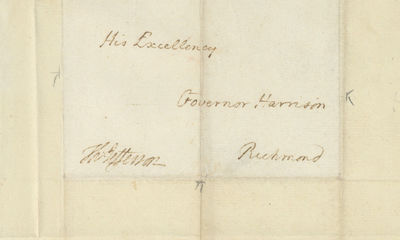
Magnificent Thomas Jefferson Free Frank, From an Important Letter to the Signer Benjamin Harrison
by Thomas Jefferson
31/12/1783. The letter dealt with ratification of the Treaty of Paris, and the Republican uprising in the Netherlands, affirming their right to bear armsCongressional assent was required for the Treaty of Paris ending the American Revolution to take effect, and delegates were called to convene at the Maryland State House in Annapolis, then serving as the nation's capital, in November 1783. The Treaty stipulated that Congress approve and return the document to Great Britain within six months of being... Read More
Offered by The Raab Collection, LLC
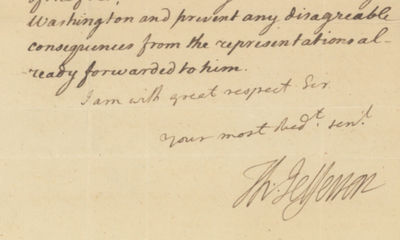
Gov. Thomas Jefferson Seeks to Supply General Washington With Information on the Condition of British Prisoners of War of the Saratoga Convention
by Thomas Jefferson
14/09/1780. An extraordinary letter, wherein Jefferson positions himself in relation to news from his state to the General of the Continental Army It also shows the remarkably challenging proposition of keeping charge of such a large and hostile armyJefferson and the Convention troopsThe surrender of General Burgoyne to General Gates at Saratoga, N.Y. on October 18, 1777, placed nearly 6,000 British and Hessian prisoners of war in the hands of the Continental Congress. According to the terms of their surrender,... Read More
Offered by The Raab Collection, LLC
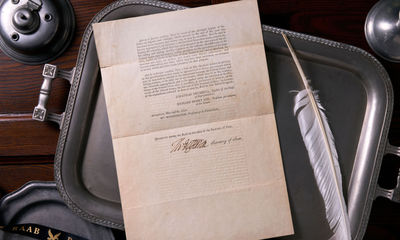
Thomas Jefferson Signs a Far Reaching Act of Congress Growing the US Infantry to Protect the Western Frontier
by Thomas Jefferson
08/05/1792. This great act funded the creation of just the 2nd regiment of US infantry, as well as for the Federal Judiciary, the State and Treasury Departments, and for paying the commissioners who negotiated the second treaty with the western Native Americans; It also authorizes and pays for raising the second regiment for the United States ArmyThe U.S. Army’s 1st Regiment of Infantry was organized in 1789 just after the first government under the new U.S. Constitution got under... Read More
Offered by The Raab Collection, LLC
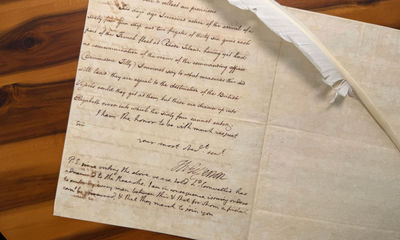
Governor Thomas Jefferson, in a Letter to Maj. Gen. Nathanael Greene Calls His State to Arms: ""Cornwallis has advanced to the Roanoke.""
by Thomas Jefferson
17/02/1781. With Cornwallis and the British converging on Virginia, Jefferson reports to Greene that he will defend the state Jefferson notes “the arrival of a sixty four gun ship and two frigates of thirty six guns each, part of the French fleet at Rhode Island” This is our first letter of Jefferson to Greene, nor do we recall seeing another[embed]https://vimeo.com/1186337282?share=copy&fl=sv&fe=ci[/embed] As 1781 dawned, Virginia had been essentially out of the war as a theater of significant armed conflict, having experienced just a... Read More
Offered by The Raab Collection, LLC
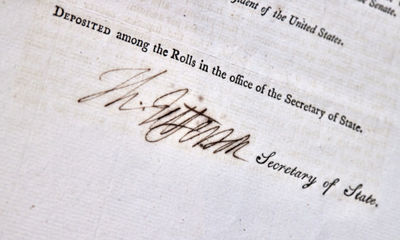
Thomas Jefferson Signs the Non-Intercourse Act, Setting Out for the First Time the Government's Official Policy to ""Civilize"" the Native Tribes
by Thomas Jefferson
01/03/1793. This is the first signed example of this 1792 Act that we have had, and a search of public sale records going back many decades fails to turn up even one other It also sought to ""promote civilization among the friendly Indian tribes"" so as to ""secure the continuance of their friendship”, and for the first time threatened criminal penalty against those who would challenge the primacy of the government in negotiating treaties and land purchasesAs the Europeans settled... Read More
Offered by The Raab Collection, LLC
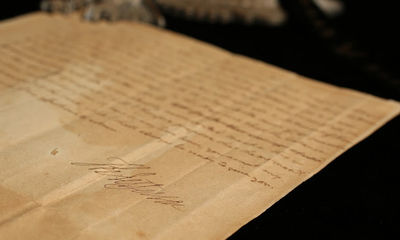
In an Unpublished Letter, President Thomas Jefferson Manages the Expense of his Presidential Household and his Estate in Monticello
by Thomas Jefferson
15/10/1802. Among the recipients were his servants, chef, coachman, and others, during a time when Meriwether Lewis was living with him A remarkable letter showing the fragile nature of the former President's and founding father's personal financial state and how he juggled funds This letter, unpublished and whose content was not known till now, was last sold in 1929 through the firm of Thomas Madigan in New York City. It was acquired by us from the heirs of that buyer.https://vimeo.com/973483379?share=copy Thomas Jefferson... Read More
Offered by The Raab Collection, LLC
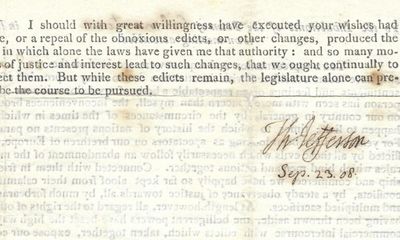
Thomas Jefferson On the Legacy of George Washington’s Farewell Message of Neutrality: “For years we have been looking as Spectators on our brethren of Europe, afflicted by all those evils which necessarily follow an abandonment of the moral rules which bind men and nations together.”
by Thomas Jefferson
23/09/1808. Jefferson hoped to avoid war and get Britain and France to Respect American Sovereignty and Neutrality in the Napoleonic Wars His core determination: “To have submitted our rightful commerce to prohibitions and tributary exactions from others, would have been to surrender our independence.” “For years we have been looking as Spectators on our brethren of Europe, afflicted by all those evils which necessarily follow an abandonment of the moral rules which bind men and nations together. Connected with them in... Read More
Offered by The Raab Collection, LLC
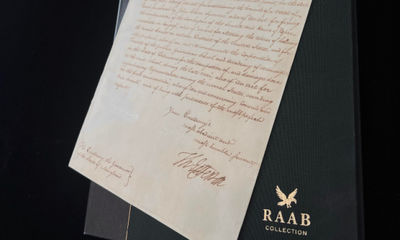
Thomas Jefferson Sends the First Act Setting in Place Congressional Representation in the House of Representatives
by Thomas Jefferson
23/04/1792. Interestingly, the method of apportioning was developed by Jefferson himself and was called the Jefferson MethodJefferson also transmitted a series of other laws newly passed Article 1, Section 2, Clause 3 or the U.S. Constitution provided the first apportionment of seats in the House of Representatives and stipulated that a Census (“enumeration”) of the population of the states must be made within three years of the first meeting of Congress. The apportionment of seats in the House was to... Read More
Offered by The Raab Collection, LLC
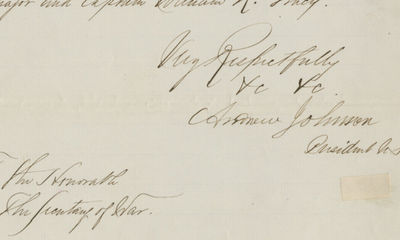
President Andrew Johnson Writes Secretary of War Stanton, Asking Him to Revoke a Post War Order
by Andrew Johnson
07/09/1865. Letter Signed as President, 1 page 4to, Washington, Sept. 7, 1865 to Secretary of War Stanton. “You will please issue an order revoking so much of Special Orders No. 410 July 31, 1865 as relates to mustering out of the service of the United States Brevet Major and Captain William R. Tracy.” Very good condition, on Executive Mansion letterhead.This was probably William Rogers Tracy (1839-1868) of Painesville, Ohio who was promoted Captain in 1864 and died with the... Read More
Offered by The Raab Collection, LLC
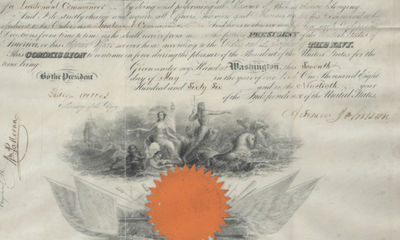
Naval Hero Moses Sherwood Stuyvesant is Promoted by President Andrew Johnson to the Rank of Lieutenant Commander
by Andrew Johnson
07/05/1866. Moses Sherwood Stuyvesant was in the Class of 1860. He was assigned to the U.S.S. Cumberland as aide to Commodore George J. Pendergrast, the Cumberland being his flagship. When war erupted the vessel went to Norfolk, Virginia. While there, the Navy Yard was partly destroyed and abandoned, and the Cumberland was placed on blockade duty, and took part in the capture of Forts Hatteras and Clark. Writing of this last, Stuyvesant calls attention to the fact that ""it... Read More
Offered by The Raab Collection, LLC
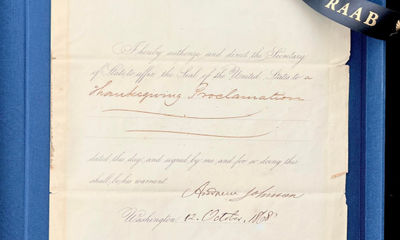
President Andrew Johnson Declares Thanksgiving in 1868
by Andrew Johnson
12/10/1868. It was President Lincoln that first declared the holiday of Thanksgiving in the United States. His successor, Andrew Johnson, chose to continue the tradition, and it has been maintained ever sinceJohnson’s 1868 Thanksgiving Proclamation stated: “In the year which is now drawing to its end the art, the skill, and the labor of the people of the United States have been employed with greater diligence and vigor and on broader fields than ever before, and the fruits of... Read More
Offered by The Raab Collection, LLC
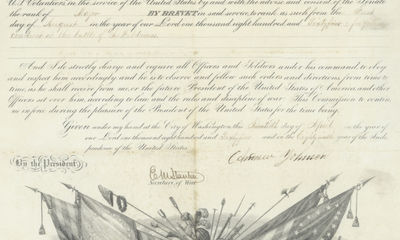
With John Wilkes Booth Still on the Loose and Lincoln's Body in the Capitol Rotunda, New President Andrew Johnson Rewards a Soldier for Heroism at the Battle of the Wilderness
by Andrew Johnson
20/04/1865. Documents signed in the first few days after Lincoln's assassination are very uncommon, this being by far the earliest we have seenThe Battle of the Wilderness was fought on May 5–7, 1864, during the Civil War. It was the first battle of Lieut. Gen. Ulysses S. Grant's 1864 Virginia Overland Campaign against Gen. Robert E. Lee and the Confederate Army of Northern Virginia. The fighting occurred in a wooded area near Locust Grove, Virginia, about 20 miles west... Read More
Offered by The Raab Collection, LLC

A Crucial State in Ratification of the 14th Amendment to the US Constitution Officially Notifies the Union that It has Rescinded That Ratification, With Its Guarantee of “Due process” and “Equal protection of the laws”
by Andrew Johnson
15/01/1868. The state’s action is cited as “Relating to withdrawing the assent of the State of Ohio from the proposed XIV constitutional amendment”; the ratification of Ohio is then “withdrawn and refused.” We've never seen anything like this on the market, in which a state withdraws its ratification of an amendment to the U.S. ConstitutionThe proposed Fourteenth Amendment to the United States Constitution would add four separate provisions to it. First, the amendment declared that all people born or naturalized... Read More
Offered by The Raab Collection, LLC

Andrew Johnson Document Signed as President
by Andrew Johnson
25/07/1868. Document signed, Washington, July 25, 1868, naming H. Burnham “Assessor of Internal Revenue for the Second District of California.” Just two months earlier, Johnson had been acquitted in his famous impeachment trial.
Offered by The Raab Collection, LLC
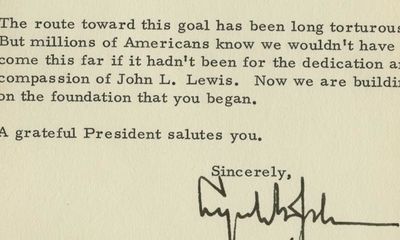
Epic Lyndon Johnson at the Height of His Great Society: He Congratulates Union Titan John L. Lewis on the Coal Mine Health and Safety Act
by Lyndon B. Johnson
11/9/68. ""A grateful President salutes you.”John L. Lewis was President of the United Mine Workers union from 1920-1960. Coal miners for 40 years hailed him as the man whose efforts brought higher wages, pensions and medical benefits. He was named by FDR a member of the Labor Advisory Board and the National Labor Board of the NRA, and was also the driving force behind the founding of the CIO, a federation of unions that organized industrial workers. In 1952,... Read More
Offered by The Raab Collection, LLC
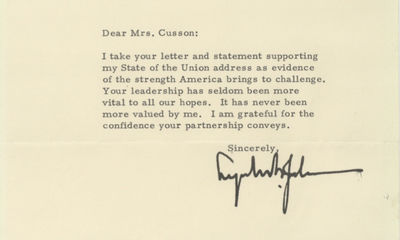
With the Momentous Tet Offensive Just Hours Away, President Lyndon B. Johnson Thanks a Democratic National Committeewoman for Supporting His Policies on the Vietnam War and Domestically
by Lyndon B. Johnson
29/01/1968. “I take your letter and statement supporting my State of the Union address as evidence of the strength America brings to challenge. Your leadership has seldom been more vital to all our hopes.”By the dawn of 1968, vocal opposition to the Vietnam War in the United States was increasing significantly, and would very soon reach a fever pitch. This would be fueled by the Tet Offensive on January 30, media coverage, and growing casualties. Public approval of President... Read More
Offered by The Raab Collection, LLC
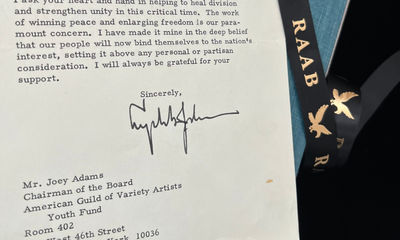
President Lyndon Johnson Explains His Decision to Not Run Again: ""The deep belief that our people will now bind themselves to the nation's interest, setting it above any personal or partisan consideration""
by Lyndon B. Johnson
11/4/68. As 1968 dawned, nobody doubted that Johnson would run for a second term as President, and indeed his name was entered in early primaries with his consent. However, early 1968 was tumultuous and events were fast-moving and unpredictable. On January 30, the North Vietnamese launched the massive Tet Offensive, a surprise attack on South Vietnamese and American forces that reached from every province in Vietnam right into the American embassy itself. Although U.S. and South Vietnamese forces claimed... Read More
Offered by The Raab Collection, LLC
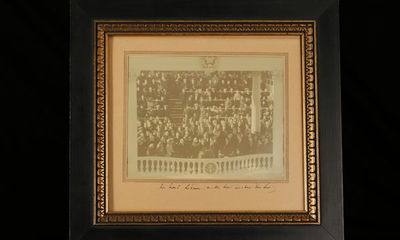
“Ask not what your country can do for you – ask what you can do for your country.”: A Signed Photograph of the Inauguration of John F. Kennedy, Showing Him Taking the Oath of Office
by John F. Kennedy
20/01/1961. Kennedy’s inauguration inspired people all around the world, and thrilled them with the possibilities for the futureJanuary 20, 1961, was a cold and clear day, and the nation’s capital was covered with a snowfall from the previous night. This was the day John F. Kennedy, the youngest man ever to be elected president, was to be inaugurated as the 35th president of the United States. In the 1960 campaign, Kennedy pledged “to get this country moving again,” but... Read More
Offered by The Raab Collection, LLC
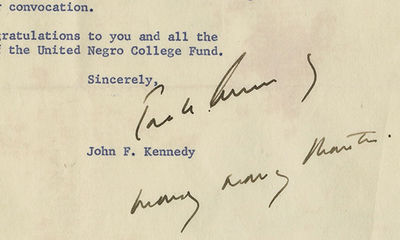
John F. Kennedy’s Letter to the United Negro College Fund After His Great 1959 Speech There, Endorsing the Organization and Praising “the outstanding job the Fund is doing in the fields of education and human relations.”
by John F. Kennedy
15/04/1959. Soon he would donate the proceeds he received for his Pulitzer Prize-winning book, Profiles in Courage, to the FundThe United Negro College Fund (UNCF) was founded in 1944 by Frederick Patterson, President of the Tuskegee Institute, and Mary McLeod Bethune, an advisor to Franklin D. Roosevelt’s Administration, to provide a steady, consistent stream of funding to 27 financially struggling small historically black colleges and universities scattered across the South. It also hoped to support access to higher education... Read More
Offered by The Raab Collection, LLC
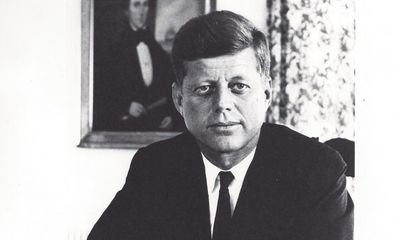
Signed Photograph of President John F. Kennedy, Presented to Norman Paul, His Assistant Secretary of Defense for Legislative Affairs
by John F. Kennedy
1961. When John F. Kennedy was elected president, Time Magazine commissioned photographer Alfred Eisenstaedt to do a photoshoot of the president-elect. Eisenstaedt took the photographs, and the best one appeared on the cover of Time in the November 16, 1960 issue. JFK liked it, and used the photograph to sign and present to notables after he entered the Oval Office. It is the photograph that he presented to Queen Elizabeth II in 1961.After serving in the Navy, Norman Paul... Read More
Offered by The Raab Collection, LLC