


Walt Whitman Sets to Work on His Reminiscence of Abraham Lincoln, to Be Published Alongside Those of Grant, Frederick Douglass and Cassius Clay
by Walt Whitman
21/10/1885. Walt Whitman had a connection to Lincoln. They passed each other often on their walks around Washington, when they would famously tip hats in acknowledgement. Whitman was greatly moved by Lincoln's assassination, and wrote his perhaps best and most renowned poem, ""My Captain”, in his honor. ""My Captain"" was first published on November 4, 1865, and Whitman later included it in the collection “Leaves of Grass” and recited the poem at several lectures on Lincoln’s death.This is a... Read More
Offered by The Raab Collection, LLC

Walt Whitman Requests a First-Hand Account of Lincoln’s Assassination to Use in His Lectures on Lincoln
by Walt Whitman
24/05/1879. “Shall count on getting the extracts from your Journal about Mr Lincon's murder & funeral soon as you can conveniently send them.”Poet Walt Whitman greatly admired Abraham Lincoln. Whitman related that the two men would pass each other on the street in Washington during the Civil War and tip their hats to each other. Whitman was deeply affected by Lincoln’s assassination, writing several poems as elegies. Shortly after Lincoln was killed in April 1865, Whitman wrote the first... Read More
Offered by The Raab Collection, LLC
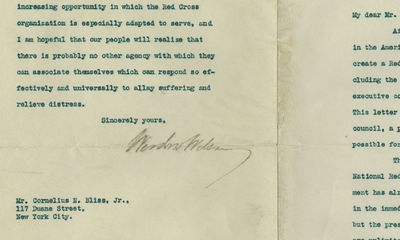
As the U.S. Enters World War I, President Woodrow Wilson Appoints Republican Philanthropist and Business Mogul Cornelius Bliss to the Red Cross War Council
by Woodrow Wilson
10/5/17. On March 19, 1913, President Woodrow Wilson was named the first honorary president of the American Red Cross, establishing a precedent for all chief executives who have followed. His quotation “I summon you to comradeship in the Red Cross” became a rallying cry, and decorated one of the most famous Red Cross posters - a young woman clutching an American flag with the Red Cross symbol and U.S. Capitol in the background.When the United States officially entered World... Read More
Offered by The Raab Collection, LLC
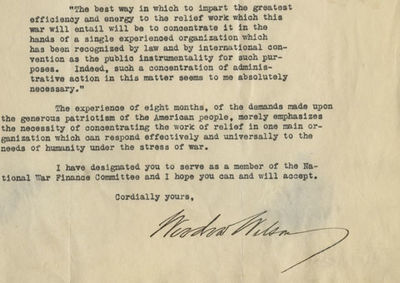
President Woodrow Wilson Asks the Acting Chairman of the American Red Cross to Serve on the National War Finance Committee, Which Raised the Most Money For a Philanthropic Cause Up to That Time
by Woodrow Wilson
6/3/18. “The experience of eight months, of the demands made upon the generous patriotism of the American people, merely emphasizes the necessity of concentrating the work of relief in one main organization which can respond effectively and universally to the needs of humanity under the stress of war. I have designated you to serve as a member of the National War Finance Committee and I hope you can and will accept.”On March 19, 1913, President Woodrow Wilson was named... Read More
Offered by The Raab Collection, LLC
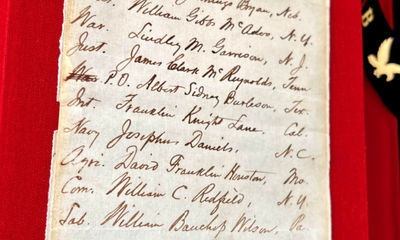
Woodrow Wilson’s Original List of His Initial Cabinet Appointments, in His Own Hand
by Woodrow Wilson
3/3/13. One of the great challenges faced by an incoming president is to select a cabinet. Wilson is no exception, and he pondered who to name from the time of his election until he arrived in Washington on the eve of his inauguration.On March 3, 1913, Wilson was staying at the Shoreham Hotel in preparation for his inauguration the following day. And on a piece of Shoreham Hotel stationery, he wrote out the men he had selected, their states,... Read More
Offered by The Raab Collection, LLC
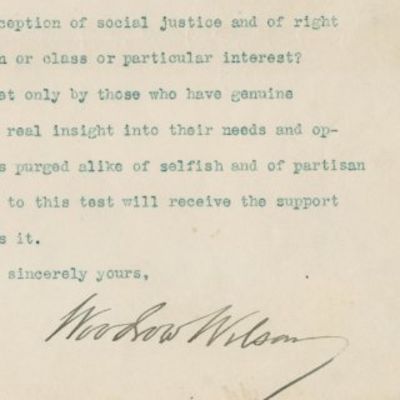
President Wilson’s Vision For Post-War America
by Woodrow Wilson
31/08/1918. American Doughboys began to flood into France in the first half of 1918, and the German command determined to make a major push to gain an advantage in the war before the Americans could make their presence felt. Their offensive did not go well, and in early August a counter-attack by the Allies placed the Germans on the defensive for the balance of the war. So by late August 1918, it was clear that the war would be... Read More
Offered by The Raab Collection, LLC
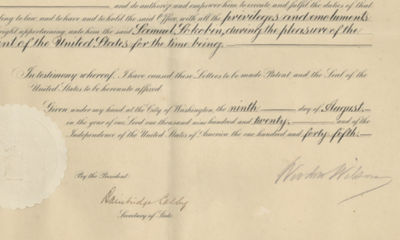
President Woodrow Wilson Appoints Samuel Sokobin An Interpreter to the American Consulate in China
by Woodrow Wilson
9/8/20. A colorful man, he also played a role in many investigations and adventures in China, as well as being an author of works on the Jews in ChinaSamuel Sokobin was an American consular official in China from 1914-1940, as well as a collector of rare books on China. He was also in 1940-41 a U.S. consul in Japan. Sokobin had many adventures, and books have been written about them. Sokobin was himself the author of three articles on... Read More
Offered by The Raab Collection, LLC
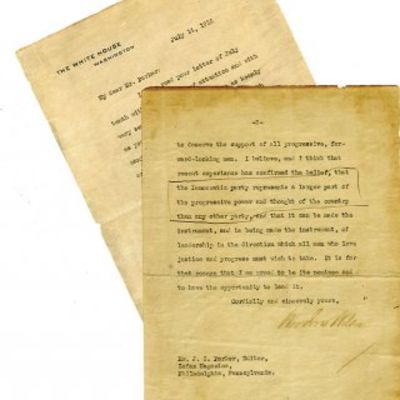
Woodrow Wilson: The Democratic Party Represents a Larger Part of the Progressive Power and Thought of the Country Than any Other Party
by Woodrow Wilson
14/07/1916. Wilson’s progressive policies brought the Democratic Party back from the wilderness where it had languished since the Civil War, and resulted in establishment of the Federal Reserve System and the Federal Trade Commission, as well as passage of the Clayton Anti-trust Act and the Farm Loan Act. The nation’s leader during World War I, his idealism had a permanent effect on the goals of American foreign policy, and his internationalist outlook favoring U.S. involvement abroad came after World... Read More
Offered by The Raab Collection, LLC

President Woodrow Wilson, In Paris for the Peace Conference Ending World War I, Makes Plans To Speak at an American War Cemetery Honoring the Fallen
by Woodrow Wilson
19/05/1919. At the cemetery, he would pledge himself to the soldiers who fought “that there should never be a war like this again .... This can be done. It must be done.”The Paris Peace Conference, also known as Versailles Peace Conference, was the meeting of the Allied victors following the end of World War I to set the peace terms for the defeated Central Powers following the armistices of 1918. This was the first great world war, one that... Read More
Offered by The Raab Collection, LLC
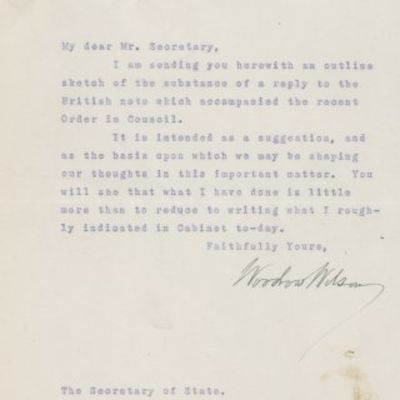
Letter of State Standing Up For American Rights During World War I, Drafted by Pres. Woodrow Wilson
by Woodrow Wilson
19/03/1915. With the outbreak of World War I in August 1914, American foreign policy became a struggle to remain out of the war and maintain the political and commercial rights of a neutral in the face of opposition from both belligerents. Britain used its powerful navy to establish a blockade of Germany, and the Germans in turn tried to counter-blockade Britain by using U-Boats to sink shipping bound there. By the start of 1915, it was clear that the... Read More
Offered by The Raab Collection, LLC
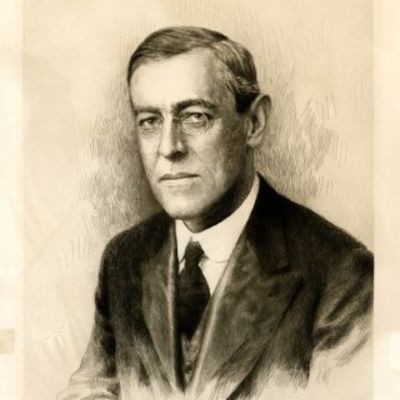
Large Signed Engraving of Woodrow Wilson
by Woodrow Wilson
1915. A 12 1/2 by 16 inch engraving of Wilson by William Barmore of New York, copyright 1915.Signed in dark pencil by the President, “Sincerely, Woodrow Wilson.” A large and dynamic image.
Offered by The Raab Collection, LLC
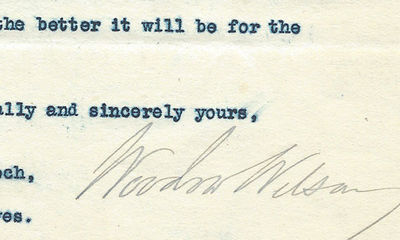
President Woodrow Wilson Advocates Establishing the U.S. International Trade Commission, and Refuses to Hamstring It As the Price For Passage
by Woodrow Wilson
8/6/16. “I think the freer it [the commission] is to get at the facts and to draw inferences as the facts demand, the better it will be for the whole country.”In the Progressive Era, many Americans supported the idea of non-partisan, semi-independent commissions to regulate and manage aspects of the economy. Theodore Roosevelt empowered the Interstate Commerce Commission and established the Food and Drug Administration. Woodrow Wilson created the Federal Trade Commission and the Federal Reserve system. He also... Read More
Offered by The Raab Collection, LLC
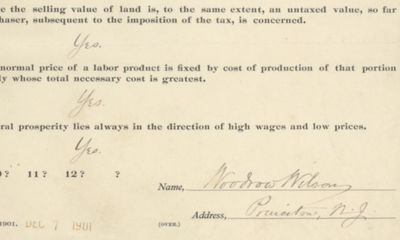
Woodrow Wilson Says “General Prosperity Lies Always in the Direction of High Wages and Low Prices”
by Woodrow Wilson
Dec-01. Likely a unique document, as we’ve never seen another anything like thisThe turn of the 20th century was a time in which there was much interest in political economy, and those working in that field were often polled to determine whether a consensus on questions of interest could be had. For example, in 1908 the American Economic Association Quarterly, based in Princeton, N.J., polled political economists, trying to elicit from them a consensus upon certain definitions and statements... Read More
Offered by The Raab Collection, LLC

Woodrow Wilson Defines Patriotism; Americans Should Serve “to the utmost limits of self-sacrifice""
by Woodrow Wilson
19/06/1916. The outbreak of World War I resulted in an upsurge in patriotism in the United States, even though it was not yet enmeshed in the conflict. One manifestation of this was Americanization Committees that were set up to promote American values and the teaching of the English language to immigrants who wanted to become American citizens. In the spring of 1916, President Wilson was running for reelection and was anxious to associate himself with patriotic sentiments. That is... Read More
Offered by The Raab Collection, LLC
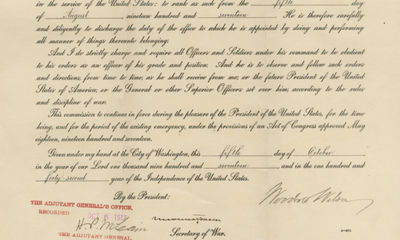
President Woodrow Wilson Mobilizes for War: He Appoints the Chief Engineer of the United States Army for World War I
by Woodrow Wilson
5/10/17. On May 7, 1915, the British Cunard liner Lusitania was torpedoed by a German U-boat, and almost 1,200 passengers were lost, including 128 Americans. The public was outraged and cries for war resounded. Wilson officially clung to his position of neutrality, and the United States was far from prepared for a large-scale war, much less one overseas. In 1914, when the conflict began, the United States had less than 100,000 soldiers.In March 1917 Wilson’s steadfast neutrality was pushed... Read More
Offered by The Raab Collection, LLC
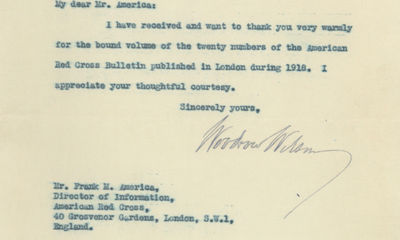
President Woodrow Wilson Thanks the Director of the Red Cross for Sending the American Red Cross Bulletin
by Woodrow Wilson
27/02/1919. Woodrow Wilson left for the Versailles Peace Conference to end World War I in December 1918, and attended the opening in January 1919. There he insisted that his proposals for a League of Nations be incorporated into the peace settlement. He returned to the United States in February to report on the progress at Versailles, cabling ahead to invite the members of the Senate Foreign Relations Committee to a working dinner at the White House to discuss the... Read More
Offered by The Raab Collection, LLC
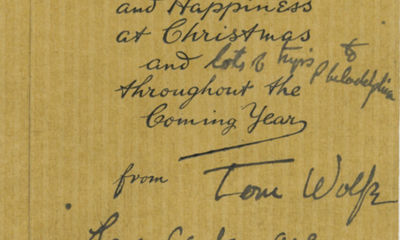
In a Christmas Card from 1930, Thomas Wolfe Writes that He Also ""sent one to Oscar Wilde wishing him 'lots of choir boys.’""
by Thomas Wolfe
12/12/30. William Faulkner once said that Thomas Wolfe, who died before age 40, may have been the greatest talent of his generation for aiming higher than any other writer. His influence extends to the writings of Beat Generation writer Jack Kerouac, and to authors Ray Bradbury and Philip Roth, among others. He was one of the first masters of autobiographical fiction, and his work was filled with details that came from his own life and his home in North... Read More
Offered by The Raab Collection, LLC
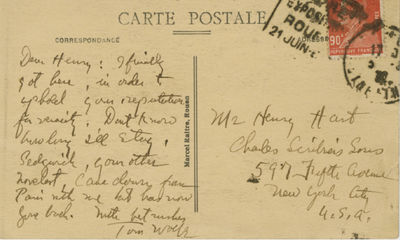
In an Unpublished Note, Thomas Wolfe Writes That He Has Arrived In Normandy
by Thomas Wolfe
21/06/1930. William Faulkner once said that Thomas Wolfe, who died before age 40, may have been the greatest talent of his generation for aiming higher than any other writer. His influence extends to the writings of Beat Generation writer Jack Kerouac, and to authors Ray Bradbury and Philip Roth, among others. He was one of the first masters of autobiographical fiction, and his work was filled with details that came from his own life and his home in North... Read More
Offered by The Raab Collection, LLC
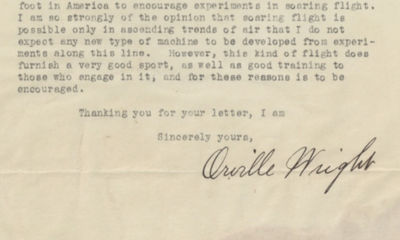
Orville Wright Doubts Viable Alternatives to the Flying Machine Invented by Himself and Brother Wilbur
by Orville Wright
7/10/22. “I am so strongly of the opinion that soaring flight is possible only in ascending trends of air that I do not expect any new type of machine to be developed from experiments along this line.”The Wright Brothers breakthrough in inventing the airplane was to realize that if the wing on one side of the aircraft met the oncoming flow of air at a greater angle than the opposite wing, it would generate more lift on that side.... Read More
Offered by The Raab Collection, LLC

Frank Lloyd Wright Is Pleased to Have His Humanistic Style of Architecture Placed in Opposition to Le Corbusier’s Stark Modernism Throughout the Architecture World
by Frank Lloyd Wright
10/9/31. Wright first wrote to Lewis Mumford in 1926, when he was in his 50s and already renowned, but at a low point in his career and in desperate need of renewed critical interest in his work; Mumford was in his 30s and making his name in cultural criticism, with much of his writing focused on architecture and urban planning. His writing, however, connected the separate domains of philosophy, architecture, anthropology, and literature to one another and to the... Read More
Offered by The Raab Collection, LLC